
Year 1786: Fun Facts, Trivia, and History
This quick read presents a mix of fun facts, trivia, and history events from the year 1786.

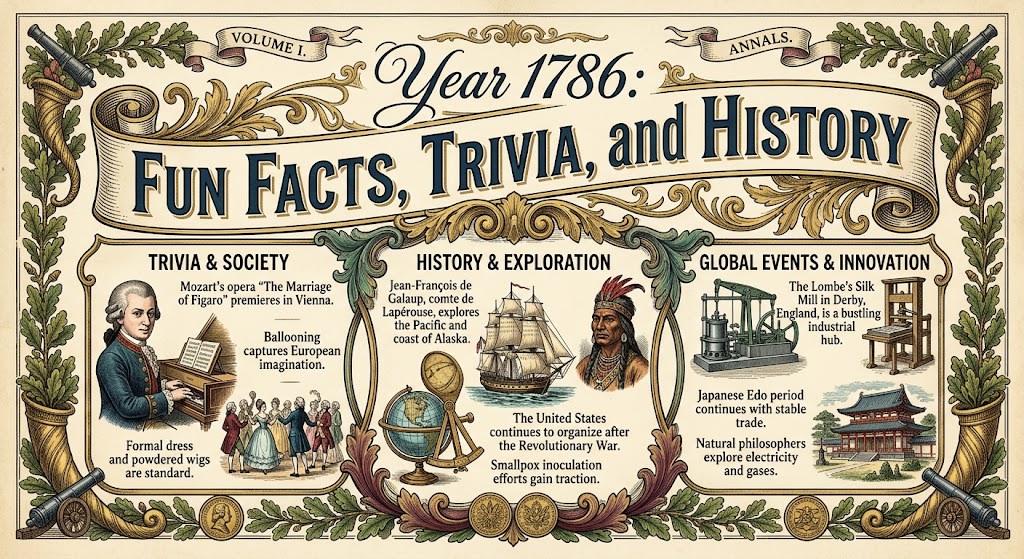
This quick read presents a mix of fun facts, trivia, and history events from the year 1786. Discover the year’s top news stories, most influential people, historic firsts, U.S. economic data, entertainment trivia, and much more.
Take a journey through history in just minutes.
In 1786, Shays’ Rebellion, the Pittsburgh Gazette, and ice cream were all center stage. Salted pork and cornmeal mush were American food staples, and James and Sarah were two of the most popular baby names. In addition, 40 pounds of pork cost $3.33, wheat was $1.17 a bushel, and 24 pounds of cheese cost $2.00.
Inflation rate: -2.06%
Consumer price index (CPI): 9.500
$100.00 in 1786 is equivalent in purchasing power to about $3,514.93 today. The U.S. dollar had “an average inflation rate of 1.49% per year” between 1786 and 2026, “producing a cumulative price increase of 3,414.93%.” In other words, a U.S. dollar today buys about 2.845% of what it could purchase back in 1786.
It’s worth noting that the U.S. dollar has lost about 97% of its value since 1786.
The average daily wage for a common laborer in the United States averaged $1.00.
Farmers accounted for over 90% of the U.S. labor force.
In 1786, Philadelphia was America’s largest city where you would find Quaker merchants, German farmers, and enslaved African Americans.
American companies established in 1786 included the Ohio Company of Associates, a land company whose members became “the first non-Native American group to permanently settle west of the Allegheny mountains.”
On January 16, the Virginia legislature passed the landmark Virginia Statute for Religious Freedom, which “disestablished the Church of England in Virginia and established complete religious liberty.”
On March 26, Columbia, South Carolina, was chartered as “the first planned city” in the United States.
On May 1, Mozart’s famous opera, The Marriage of Figaro, premiered in Vienna.
On June 8, the first advertisement for commercially made ice cream appeared in the New York Post Boy. The ice cream was for sale at NYC’s City Tavern.
On July 29, the Pittsburgh Gazette, the first newspaper west of the Alleghenies, began publishing.
On August 8, Jacques Balmat and Michel Paccard became the first individuals to climb to the top of Mont Blanc, “the highest mountain in Western Europe.”
On August 29, over 500 armed farmers and Revolutionary War veterans, “upset at the state government’s failure to provide debt relief,” blocked access to a county court in Northampton, Massachusetts. History.com tells us that the populist uprising marked the start of Shays’ Rebellion, “a series of attacks on Massachusetts courthouses and government facilities” that exposed the new federal government’s weakness and propelled “the creation of the Constitutional Convention to form a stronger national government.”
September 11 to 14: At the Annapolis Convention, “commissioners from five states met in Annapolis, Maryland, to discuss trade barriers under the weak national government.”
On October 15, New York City recorded “an exceptionally early freezing temperature of 32°F (0°C).”
On November 7, the oldest performing musical organization in the United States, the Stoughton Musical Society, was established in Stoughton, Massachusetts.
Popular fiction works for the year: Harriet Lee’s The Errors of Innocence and James Boswell’s Dorado.
Noteworthy non-fiction works: Thomas Clarkson’s An Essay on the Slavery and Commerce of the Human Species, Particularly the African, and William Herschel’s Catalogue of One Thousand New Nebulae and Clusters of Stars.
Famous people born in 1786 were Carl Maria von Weber (German composer) and Davy Crockett (American frontiersman and militia officer known as “King of the Wild Frontier”).
Famous people who died in 1786 included Eva Ekeblad (Swedish agronomist) and Nathanael Greene (American statesman).
In 1786 as well, the words “aristocrat,” “breakdown,” “coin money,” “cuisine,” “dander,” “disorderly conduct,” “du jour,” “embankment,” “ginger nut,” “groundswell,” “hard cider,” “Hinduism,” “hit-and-miss,” “ice skate,” “idealize,” “imposing,” “inadequacy,” “inedible,” “in medias res,” “in no time,” “irrelevant,” “lance corporal,” “millionaire,” “phobia,” “pin one’s hopes on,” “seventh heaven,” “sonata,” “stamping ground,” and “water biscuit” all appeared in print for the first time.
24 pounds of cheese: $2.00
40 pounds of pork: $3.33
Maslin (two kinds of grain mixed together): 76 cents a bushel
One-half bushel of onions: 42 cents
One-half bushel of potatoes: 17 cents
One pair of bridle bits: 17 cents
One pair of new stockings: 33 cents
One pair of shoes: $1.25
One petticoat: 17 cents
Six pounds of butter: 75 cents
Tobacco: Three pounds for 25 cents
Wages for one day of hoeing corn: 50 cents
Wages for one day of mowing: 67 cents
Wages for one day of reaping: 58 cents
Wages for one day of threshing: 42 cents
Wheat: $1.17 a bushel
References:
https://en.wikipedia.org/wiki/Category:American_companies_established_in_1786
https://www.foodreference.com/html/html/food-timeline-1785-1789.html
Disclaimer: In writing and editing this article, Gregory DeVictor has made every effort to ensure historical accuracy and not to mislead his audience. In addition, the contents of this article, including text, graphics, and captions, are for general informational purposes only.
© 2026 Gregory DeVictor
About the Creator
Gregory DeVictor
Gregory DeVictor is a trivia enthusiast who likes to write articles about American history and nostalgia. Each of his articles presents a mix of fun facts, trivia, and historic events about a specific calendar year, decade, or century.
Enjoyed the story? Support the Creator.
Subscribe for free to receive all their stories in your feed.
Comments