
Year 1781: Fun Facts, Trivia, and History
This quick read presents a mix of fun facts, trivia, and history events from the year 1781.

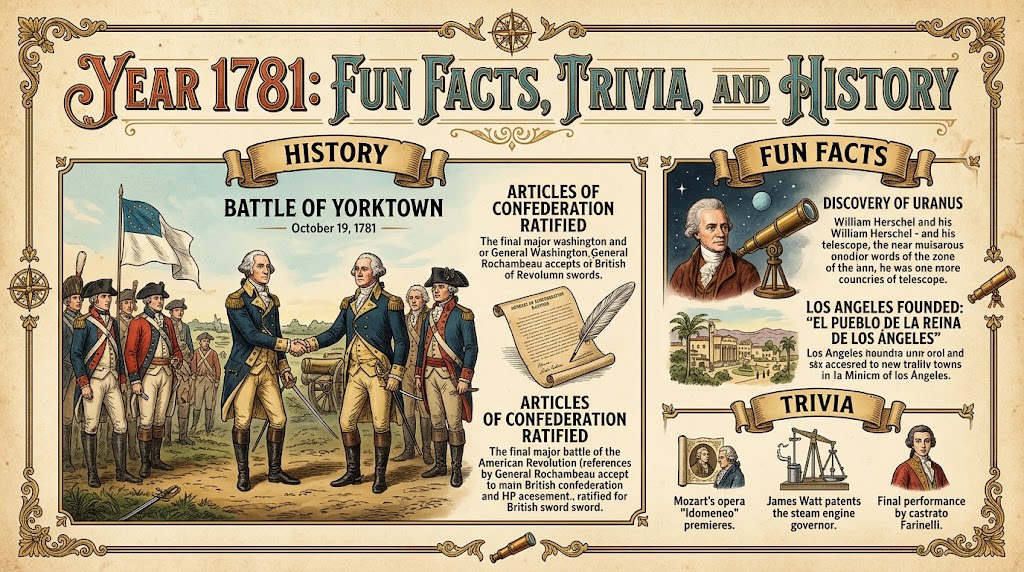
This quick read presents a mix of fun facts, trivia, and history events from the year 1781. Discover the year’s top news stories, most influential people, historic firsts, U.S. economic data, entertainment trivia, retail prices, and much more.
Take a journey through history in just minutes.
In 1781, the United States was in the midst of the American Revolutionary War, an “armed conflict” between the U.S. and Great Britain that took place between April 19, 1775, and September 3, 1783. The hostilities between the two nations were fueled in part by heavy taxes that Great Britain imposed upon American colonists, particularly through the controversial Stamp Act and Tea Act.
Patriots: Colonists from the Thirteen Colonies “who fought for independence from Great Britain” during the American Revolution.
Loyalists: Historians believe that about “15% to 20% of the colonial population (roughly 500,000 people) remained loyal to the British Crown” during the American Revolution.
Most populated colony: Virginia
Major urban centers included Boston, New York, and Philadelphia.
Emerging urban centers were Albany, New York; Lancaster, Pennsylvania; Louisville, Kentucky; Newport, Rhode Island; Portsmouth, New Hampshire; and Salem, Massachusetts.
Inflation rate: -18.98%
Consumer Price Index (CPI): 11.100
$100.00 in 1781 is equivalent in purchasing power to about $3,017.84 today. The U.S. dollar had “an average inflation rate of 1.40% per year” between 1781 and 2026, “producing a cumulative price increase of 2,917.84%.” In other words, a U.S. dollar today buys about 3.314% of what it could purchase back in 1781.
It is also worth noting that the U.S. dollar has lost about 97% of its value since 1781.
In 1781, farmers accounted for over 90% of the U.S. labor force, and the average daily wage for a common laborer in the United States averaged $1.00.
American companies established in 1781 included the Philadelphia-based Bank of North America, the first chartered bank in the United States.
On January 1, as part of the Pennsylvania Mutiny of 1781, an estimated 1,500 soldiers from the 6th Pennsylvania Regiment rebelled against the Continental Army at its winter camp in Morristown, New Jersey.
On January 1, the world’s first iron bridge, which crossed the Severn River, opened to traffic in Coalbrookdale, England.
On January 5, British naval forces led by Benedict Arnold burned Richmond, Virginia.
On January 17, at the Battle of Cowpens in South Carolina, Americans under the command of Daniel Morgan defeated British forces.
On February 2, Maryland ratified the Articles of Confederation, becoming the 13th and last state to do so.
On March 1, the Articles of Confederation, the first United States Constitution, went into effect.
On March 13, British-German astronomer Sir William Herschel discovered the planet Uranus.
On May 29, John Walker, an English chemist who invented the friction match in 1826, was born in Stockton-on-Tees, England.
On July 11, Thomas Hutchins became the Geographer of the United States.
On September 4, Los Angeles, California, was founded by Spanish Governor Felipe de Neve and “a group of 44 settlers known as los pobladores.”
On September 28, General George Washington and French allies, consisting of 9,000 American and 7,000 French troops, began the Siege of Yorktown in Virginia against British forces.
On October 19, British General Charles Cornwallis surrendered his army of over 7,000 men, “marking the last major battle of the Revolutionary War and signaling American victory.”
On November 5, John Hanson was elected President of the United States in Congress Assembled, a position he held for one year until November 1782.
On December 24, Baroness Frederika von Riedesel erected Canada’s first Christmas tree at Sorel, Québec.
On December 31, the first branch of the Bank of North America opened in Philadelphia.
Here are more than 25 foods and beverages that were an integral part of the American diet during the late 1700s: ale, baked fruit puddings, beans, beef, berry pies, cider, coffee and tea, corn mush, crabs, duck, eel, hasty pudding, johnnycakes, lobster, local fruits like apples and berries, local vegetables like cabbage, carrots, and onions, oat cakes, pepper cakes, pork, turkey, venison, whole-grain bread, and wine.
Dinner was the “main and largest meal” of the day and was traditionally eaten anywhere from 11:00 a.m. to 2:00 p.m. The modern three-meal eating pattern began “to take shape toward the end of the century.”
In 1781, the most popular baby names for boys included James, John, Henry, Thomas, and William. For girls, the most popular baby names were Anna, Elizabeth, Frances, Mary, and Sarah.
The most popular surnames in America included Baker, Brown, Carter, Davis, Johnson, Jones, Miller, Smith, Williams, and Wilson.
Top fiction works for the year: Benjamin Franklin’s A Letter to a Royal Academy and Robert Bage’s Mount Henneth
A popular children’s book published in 1781: Mrs. Barbauld’s Hymns in Prose for Children
Notable dramatic work for the year: Miles Peter Andrews’ Dissipation
Top nonfiction works published in 1781: Edward Gibbon’s The History of the Decline and Fall of the Roman Empire (Volumes II and III) and Samuel Johnson’s Lives of the Most Eminent English Poets
Famous people born in 1781 were David Brewster (Scottish physicist) and George Stephenson (British engineer).
In 1781, the words “after hours,” “as of,” “citrus,” “cocktail,” “deadlock,” “deployment,” “florist,” “life insurance,” “nuance,” “organ-grinder,” “quad,” “quiz,” “riverbed,” “scutter,” “self-renewal,” “snob,” “sulk,” “termite,” “utilitarian,” “waltz,” and “Welsh rarebit” all appeared in print for the first time.
24 pounds of cheese: $2.00
40 pounds of pork: $3.33
One-half bushel of onions: 42 cents
One-half bushel of potatoes: 17 cents
One pair of shoes: $1.25
Six pounds of butter: 75 cents
Tobacco: Three pounds for 25 cents
Wages for one day of mowing: 67 cents
Wages for one day of reaping: 58 cents
Wheat: $1.17 a bushel
References:
https://en.wikipedia.org/wiki/Category:American_companies_established_in_1781
https://www.foodreference.com/html/html/food-timeline-1780-1784.html
https://babel.hathitrust.org/cgi/pt?id=mdp.39015035798035&seq=16
Disclaimer: In writing and editing this article, Gregory DeVictor has made every effort to ensure historical accuracy and not to mislead his audience. In addition, the contents of this article, including text, graphics, and captions, are for general informational purposes only.
© 2026 Gregory DeVictor
About the Creator
Gregory DeVictor
Gregory DeVictor is a trivia enthusiast who likes to write articles about American history and nostalgia. Each of his articles presents a mix of fun facts, trivia, and historic events about a specific calendar year, decade, or century.
Enjoyed the story? Support the Creator.
Subscribe for free to receive all their stories in your feed.
Comments