
Year 1780: Fun Facts, Trivia, and History
This quick read presents a mix of fun facts, trivia, and history events from the year 1780.

This quick read presents a mix of fun facts, trivia, and history events from the year 1780. Discover the year’s top news stories, most influential people, historic firsts, U.S. economic data, entertainment trivia, retail prices, and much more.
Take a journey through history in just minutes.
n 1780, the United States was in the midst of the American Revolutionary War, an “armed conflict” between the U.S. and Great Britain that took place between April 19, 1775, and September 3, 1783. The hostilities between the two nations were fueled in part by heavy taxes that Great Britain imposed upon American citizens, particularly through the controversial Stamp Act and Tea Act.
Patriots: Colonists from the Thirteen Colonies “who fought for independence from Great Britain” during the American Revolution.
Loyalists: Historians believe that about “15% to 20% of the colonial population (roughly 500,000 people) remained loyal to the British Crown” during the American Revolution.
Total U.S. population: 2,780,369 (Between 1625 and 1780, the colonial population grew from about 2,000 to around 2.78 million, “largely displacing the country’s Native Americans.”)
White population: 2,200,000 (79%)
Black population (enslaved and free): 575,000 (21%)
Most populated colony: Virginia (around 538,000 residents)
Major urban centers included Boston, New York, and Philadelphia.
Emerging urban centers were Albany, New York; Lancaster, Pennsylvania; Louisville, Kentucky; Newport, Rhode Island; Portsmouth, New Hampshire; and Salem, Massachusetts.
Inflation rate: 12.30%
Consumer Price Index (CPI): 13.700
$100.00 in 1780 is equivalent in purchasing power to about $2,445.11 today. The U.S. dollar had “an average inflation rate of 1.31% per year” between 1780 and 2026, “producing a cumulative price increase of 2,345.11%.” In other words, a U.S. dollar today buys about 4.090% of what it could purchase back in 1780.
It’s also worth noting that the U.S. dollar has lost about 96% of its value since 1780.
In 1780, farmers accounted for over 90% of the U.S. labor force, and the average daily wage for a common laborer in the United States averaged $1.00.
American companies established in 1780 included the Woodford Reserve Bourbon Whiskey Distillery in Kentucky.
On January 4, a brutal two-day blizzard impacted George Washington’s Continental Army during their winter encampment in Morristown, New Jersey.
On March 1, the Pennsylvania General Assembly passed the Act for the Gradual Abolition of Slavery, which prohibited “the further importation of adults and children into the Commonwealth for the purposes of enslaving them.”
On May 12, British forces captured Charleston, South Carolina, after a “major siege.”
On May 19, New England’s Dark Day unfolded as darkness “blanketed the northeastern United States and parts of Canada, forcing residents to use candles at noon.” According to BBC News, “While the phenomenon remained a mystery for over two centuries, modern scientists solved it in 2007. By studying tree ring data (dendrochronology) from the Algonquin Highlands in southern Ontario, researchers discovered evidence of a massive Canadian forest fire that burned in the spring of 1780.” EnchantedNewEngland.com adds that “A unique combination of thick smoke from these massive wildfires, heavy fog, and dense cloud cover was trapped by weather fronts in the upper atmosphere, completely blotting out the sun across New England.”
On July 10, French military leader Comte de Rochambeau and his army of 7,000 soldiers landed in Newport, Rhode Island, to join the American Revolutionary War as U.S. allies.
On August 16, British troops defeated American forces at the Battle of Camden in South Carolina.
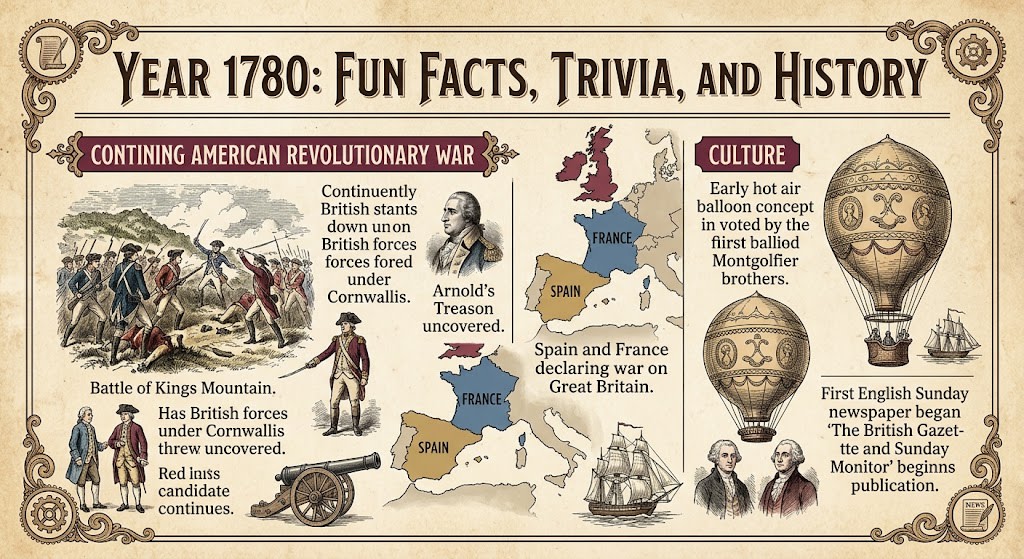
In September, American General Benedict Arnold’s shocking treason plot to hand over West Point, New York, to the British was revealed, which prompted him to escape down the Hudson River to join British lines, “forever cementing his name as a symbol of betrayal.”
On October 7, Patriot militias defeated Loyalist troops at the Battle of Kings Mountain in South Carolina.
On October 10, the Great Hurricane of 1780 devastated Barbados and went on to kill an estimated 20,000 to 30,000 people in the Caribbean, “making it the deadliest recorded hurricane in the Atlantic.”
On October 25, the Massachusetts Constitution officially took effect, “making it the oldest functioning written constitution in continuous effect in the world.”
On October 25, John Hancock was elected as the first governor of Massachusetts “in a landslide with over 90% of the vote.”
In 1780, the most popular baby names for boys included James, John, Henry, Thomas, and William. For girls, the most popular baby names were Anna, Elizabeth, Frances, Mary, and Sarah.
The most popular surnames in America included Baker, Brown, Carter, Davis, Johnson, Jones, Miller, Smith, Williams, and Wilson.
Top fiction works for the year: Herbert Croft’s Love and Madness and Samuel Jackson Pratt’s Emma Corbett, or, The Miseries of Civil War
A popular children’s book published in 1780: Mrs. Trimmer’s An Easy Introduction to the Knowledge of Nature, and Reading the Holy Scriptures. Adapted to the Capacities of Children
Notable dramatic work for the year: Sophia Lee’s The Chapter of Accidents
Top non-fiction works published in 1780: Horace Walpole’s On Modern Gardening and William Beckford’s Biographical Memoirs of Extraordinary Painters
Famous people born in 1780 were Elizabeth Fry (a British activist who promoted the “merciful treatment” of prisoners) and William Ellery Channing (an American religious leader known as the “apostle of Unitarianism”).
Famous people who died in 1780 included William Allen (an American Loyalist and former mayor of Philadelphia) and William Blackstone (a British jurist).
In 1780, the words “apple pie,” “bathroom,” “body shirt,” “congressman,” “corn whiskey,” “dandy,” “esprit de corps,” “French window,” “hit it off,” “international,” “novelette,” “restraining order,” “self-criticism,” “self-proclaimed,” and “tea garden” all appeared in print for the first time.
24 pounds of cheese: $2.00
40 pounds of pork: $3.33
One-half bushel of onions: 42 cents
One-half bushel of potatoes: 17 cents
One pair of shoes: $1.25
Six pounds of butter: 75 cents
Tobacco: Three pounds for 25 cents
Wages for one day of mowing: 67 cents
Wages for one day of reaping: 58 cents
Wheat: $1.17 a bushel
References:
https://en.wikipedia.org/wiki/Category:American_companies_established_in_1780
https://www.foodreference.com/html/html/food-timeline-1780-1780.html
https://babel.hathitrust.org/cgi/pt?id=mdp.39015035798035&seq=16
Disclaimer: In writing and editing this article, Gregory DeVictor has made every effort to ensure historical accuracy and not to mislead his audience. In addition, the contents of this article, including text, graphics, and captions, are for general informational purposes only.
© 2026 Gregory DeVictor
About the Creator
Gregory DeVictor
Gregory DeVictor is a trivia enthusiast who likes to write articles about American history and nostalgia. Each of his articles presents a mix of fun facts, trivia, and historic events about a specific calendar year, decade, or century.
Enjoyed the story? Support the Creator.
Subscribe for free to receive all their stories in your feed.
Comments