
Year 1778: Fun Facts, Trivia, and History
This quick read presents a mix of fun facts, trivia, and history events from the year 1778.

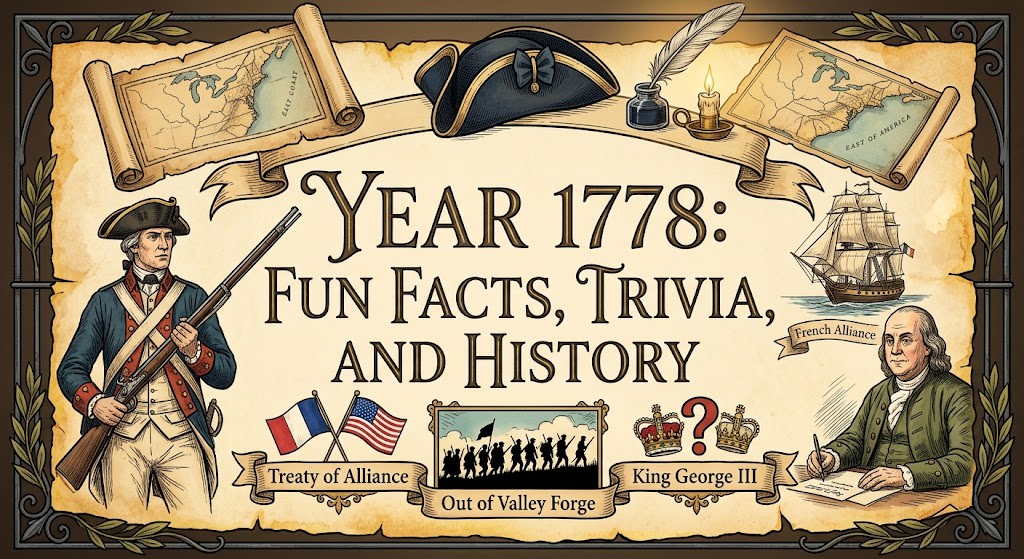
This quick read presents a mix of fun facts, trivia, and history events from the year 1778. Discover the year’s top news stories, most influential people, historic firsts, U.S. economic data, entertainment trivia, and much more.
Take a journey through history in just minutes.
In 1778, the United States was in the midst of the American Revolutionary War, an “armed conflict” between the U.S. and Great Britain that took place between April 19, 1775, and September 3, 1783. The hostilities between the two nations were fueled in part by heavy taxes that Great Britain imposed on American citizens, particularly through the controversial Stamp Act and Tea Act.
Patriots: Colonists from the Thirteen Colonies “who fought for independence from Great Britain” during the American Revolution.
Loyalists: Historians believe that about “15% to 20% of the colonial population (roughly 500,000 people) remained loyal to the British Crown” during the American Revolution.
In 1778, General George Washington set a standard daily military ration for a Continental Army soldier that included 1.5 pounds of flour or bread, one pound of beef or fish (or 12 ounces of pork), and four ounces of whiskey or spirits.
Inflation rate: 30.19%
Consumer Price Index (CPI): 13.800
$100.00 in 1778 is equivalent in purchasing power to about $2,427.39 today. The U.S. dollar had “an average inflation rate of 1.29% per year” between 1778 and 2026, “producing a cumulative price increase of 2,327.39%.” In other words, a U.S. dollar today buys about 4.120% of what it could purchase back in 1778.
It’s also worth noting that the U.S. dollar has lost about 96% of its value since 1778.
In January, legendary British explorer Captain Cook discovered the Hawaiian Islands and named them the Sandwich Islands.
On February 5, South Carolina became the first state to ratify the Articles of Confederation.
On February 6, the United States and France signed the Treaty of Alliance in Paris, which gave the U.S. official recognition and military support from France.
On February 23, Prussian-born military officer Baron von Steuben arrived at Valley Forge, Pennsylvania, “to train and drill the American troops into a professional army.”
On April 1, New Orleans merchant and American Revolutionary financier Oliver Pollock created the “$” symbol.
On June 28, the Battle of Monmouth, fought in New Jersey, proved that “the newly trained Continental Army could hold its ground against British forces.”
On June 28, during the Battle of Monmouth in New Jersey, Mary Ludwig Hays—aka Molly Pitcher—carried water to thirsty Patriot troops during extreme summer heat. On the battlefield, temperatures exceeded 100°F, leading many soldiers to suffer from heatstroke.
On September 17, the Treaty of Fort Pitt was signed in Pittsburgh, Pennsylvania, and became “the first formal written diplomatic agreement between the newly formed United States and a Native American group, specifically the Lenape (Delaware) Nation.”
On December 29, British troops “launched a surprise attack and captured Savannah, Georgia, shifting their war focus toward the American South.”
In 1778, Samuel Phillips Jr. founded Phillips Academy, a prestigious secondary boarding school located in Andover, Massachusetts. Notable people who attended or graduated from Phillips Academy include U.S. Presidents George H. W. Bush, George W. Bush, and Franklin Pierce; Florida Governor Jeb Bush; businessman and journalist John F. Kennedy Jr.; Facebook founder Mark Zuckerberg; Quora co-founder Adam D’Angelo; actors Humphrey Bogart and Jack Lemmon; actresses Dana Delany and Olivia Wilde; authors Dan Brown, J. D. Salinger, and John Irving; football coach Bill Belichick; and hedge fund manager Tom Steyer.
The word “thoroughbred” was first used in the United States in an advertisement that appeared in a Kentucky gazette “to describe a New Jersey stallion named Pilgarlick.”
Louisville, Kentucky, was founded when George Rogers Clark established a military outpost on Corn Island along the Ohio River.
Here are over 25 foods and beverages that were an integral part of the American diet during the late 1700s: ale, baked fruit puddings, beans, beef, berry pies, cider, coffee and tea, corn mush, crabs, duck, eel, hasty pudding, johnnycakes, lobster, local fruits such as apples and berries, local vegetables such as cabbage, carrots, and onions, oat cakes, pepper cakes, pork, turkey, venison, whole-grain bread, and wine.
Dinner was the “main and largest meal” of the day and was traditionally eaten anywhere from 11:00 a.m. to 2:00 p.m. The modern three-meal eating pattern began “to take shape toward the end of the century.”
In 1778, the most popular baby names for boys included James, John, Henry, Thomas, and William. For girls, the most popular baby names were Anna, Elizabeth, Frances, Mary, and Sarah.
The most popular surnames in America included Baker, Brown, Carter, Davis, Johnson, Jones, Miller, Smith, Williams, and Wilson.
Popular fiction works for the year: Clara Reeve’s The Old English Baron and Lady Mary Walker’s Munster Village
Noteworthy nonfiction works published in 1778: Gilbert Stuart’s A View of Society in Europe and Thomas Pennant’s A Tour in Wales
Notable dramatic works for the year: Samuel Foote’s The Devil upon Two Sticks, The Nabob, and The Taylors
Shakespearean scholars Samuel Johnson and George Steevens collaborated on and published a new edition of The Plays of William Shakespeare. It included Irish scholar Edmond Malone’s essay An Attempt to Ascertain the Order in Which the Plays Attributed to Shakspeare Were Written. Malone’s essay created “the very first chronological framework for William Shakespeare's dramatic works.”
Top poetic work published in 1778: John Codrington Bampfylde’s Sixteen Sonnets
Famous people born in 1778 included Catherine McAuley (an Irish nun who founded the Sisters of Mercy); Humphry Davy (a British chemist who discovered several alkali and alkaline earth metals); and James Kirke Paulding (an American novelist who wrote The Diverting History of John Bull and Brother Jonathan, The Dutchman’s Fireside, The Life of Washington, and The Lay of the Scottish Fiddle).
Famous people who passed away in 1778 included Jean-Jacques Rousseau (French philosopher) and Voltaire (French Enlightenment writer).
In 1778, the words “aboriculture,” “bank holiday,” “cranberry bush,” “embarrassing,” “give-and-take,” “godforsaken,” “green stuff,” “inhaler,” “lotto,” “Pembroke table,” “person of color,” “protégée,” “shower bath,” “sick headache,” “Slavic,” “statehouse,” “tea party,” and “William Tell” all appeared in print for the first time.
Courtesy of AmericanHeritage.com, here is the menu for a typical New England Thanksgiving dinner during the late 1700s:
Apple pie
Cauliflower
Cider
Haunch of venison
Indian pudding
Mincemeat pie
Onions in cream
Pigeon pasties
Plum pudding
Potatoes
Pumpkin pie
Raw celery
Roast pork
Roast goose
Roast turkey
Squash
References:
https://en.wikipedia.org/wiki/Category:American_companies_established_in_1778
https://www.foodreference.com/html/html/food-history-1775.html
https://www.americanheritage.com/thanksgiving-dinner-during-revolution
Disclaimer: In writing and editing this article, Gregory DeVictor has made every effort to ensure historical accuracy and not to mislead his audience. In addition, the contents of this article, including text, graphics, and captions, are for general informational purposes only.
© 2026 Gregory DeVictor
About the Creator
Gregory DeVictor
Gregory DeVictor is a trivia enthusiast who likes to write articles about American history and nostalgia. Each of his articles presents a mix of fun facts, trivia, and historic events about a specific calendar year, decade, or century.
Enjoyed the story? Support the Creator.
Subscribe for free to receive all their stories in your feed.
Comments