
Year 1776: Fun Facts, Trivia, and History
This quick read presents a collection of fun facts, trivia, and history events from the year 1776.

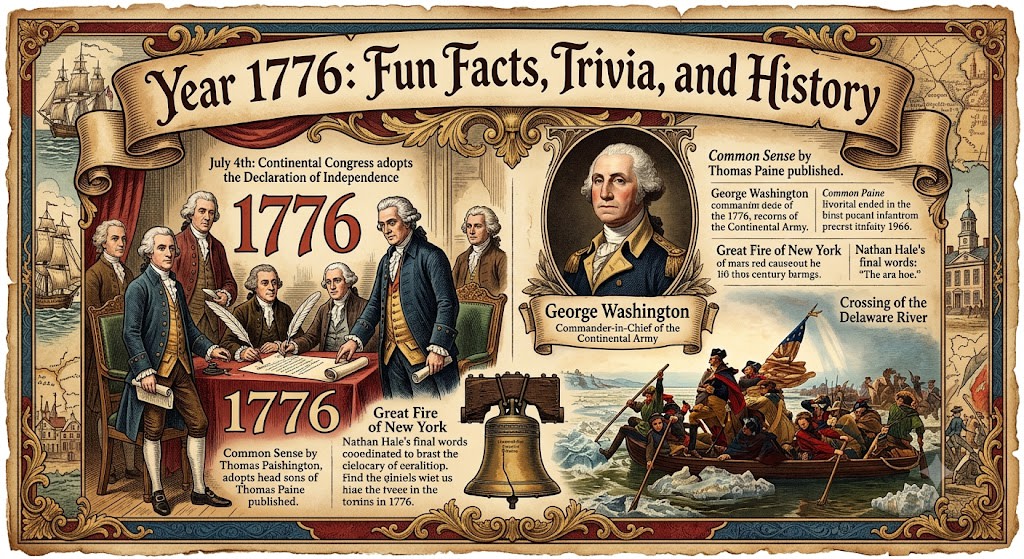
This quick read presents a collection of fun facts, trivia, and history events from the year 1776. Discover the year’s top news stories, most influential people, historic firsts, entertainment trivia, and much more.
Take a journey through history in just minutes.
In 1776, the 13 American colonies had a population of 2.5 million, which included an estimated 500,000 enslaved people.
The United States was 96% rural, with most people living on farms or plantations.
America’s most populated city was Philadelphia, with approximately 30,000 residents. Philly was followed by New York City (about 25,000 residents), Boston (around 15,000 residents), Charleston, South Carolina (about 12,000 residents), and Newport, Rhode Island (around 11,000 residents).
The American diet consisted mainly of “seasonal, local, and preserved whole foods,” including apples, beans, black-eyed peas, cornmeal, potatoes, salted meats, squash, turnips, and stews.
In January, the most famous American marriage of the year took place when Founding Father Dr. Benjamin Rush married 16-year-old Julia Stockton.
On January 10, American Founding Father Thomas Paine published the 47-page pamphlet, Common Sense, which set forth “his arguments in favor of American independence. Although little used today, pamphlets were an important medium for the spread of ideas in the 16th through 19th centuries.”
On February 17, British historian Edward Gibbon published the first volume of his influential work, The Decline and Fall of the Roman Empire.
On March 9, Scottish economist and philosopher Adam Smith published An Inquiry into the Nature and Causes of the Wealth of Nations.
On March 17, American forces under General George Washington “successfully forced the British to evacuate Boston, bringing an end to an 11-month siege.”
On April 3, Harvard College “voted to award General George Washington an honorary Doctor of Laws (LL.D.) degree.”
On May 4, Rhode Island declared its independence from Great Britain.
On June 11, the Continental Congress established a committee to draft the Declaration of Independence, “with Thomas Jefferson, John Adams, Benjamin Franklin, Roger Sherman, and Robert R. Livingston as members.”
On July 2, New Jersey gave voting rights to all adults “who could show a net worth of 50 pounds.”
On July 2, the 13 colonies officially “declared” their independence, while the Second Continental Congress “unanimously adopted” the Declaration of Independence on July 4.
On July 4, Henry Beeson founded the town of Union, Pennsylvania, later known as Uniontown, Pennsylvania.
August to November: The Continental Army “suffered a series of major defeats, including the Battle of Long Island and the loss of Fort Washington, allowing the British to capture and occupy New York City.”
August 2: While the Continental Congress “officially adopted” the Declaration of Independence on July 4, 1776, “the formal engrossed parchment was not ready for signing until nearly a month later. On August 2, most of the 56 delegates gathered in Philadelphia to affix their signatures.” According to Reader’s Digest, “John Hancock signed first, and his signature is the largest. The other delegates then signed, generally grouped by state from right to left and north to south.” Benjamin Franklin was the oldest signer at 70 years of age, while Edward Rutledge of South Carolina was the youngest at age 26.
August 7: Weeks before his death, Scottish philosopher David Hume added a codicil to his will giving instructions for the publication of the Dialogues Concerning Natural Religion, a book that he had been writing since 1750.
The "United States of America" was “officially adopted” as the nation's new name on September 9, 1776, replacing "United Colonies."
September 20: During the British occupation of New York City, a fire broke out at the Fighting Cocks Tavern and quickly spread throughout the city. “The Great Fire of 1776 destroyed an estimated 10 to 25 percent of New York City's 4,000 buildings, making it one of the most destructive urban fires in colonial American history. The exact cause of the blaze remains unknown, with both accidental and deliberate arson having been suggested over the years.”
On October 9, Father Francisco Palou founded Mission San Francisco de Asis (aka Mission Dolores) in what later became San Francisco, California.
On October 26, American Founding Father Benjamin Franklin departed for France to seek French support for the American Revolution.
On December 5, America’s first “academic honor society,” Phi Beta Kappa, was established at William & Mary College in Williamsburg, Virginia.
On December 19, Thomas Paine began publishing a series of 16 political phamplets, beginning with The American Crisis.
On December 25, after a series of defeats in New York that left the Continental Army's morale at its lowest point, “General George Washington led his troops across the icy Delaware River on Christmas night, launching a surprise attack that resulted in a decisive, morale-boosting victory at the Battle of Trenton.”
In 1776, Pittsburgh, Pennsylvania, located over 300 miles west of Philadelphia, was mainly farmland and had a population of only a few hundred people. (Remember, America’s most populated city in 1776 was Philadelphia, with an estimated 30,000 residents.)
Famous birthdays: Amedeo Avogadro (Italian physicist), Jane Porter (British novelist), and Sophie Germain (French mathematician).
Famous people who died in 1776 were David Hume (Scottish philosopher) and Nathan Hale (American war hero).
America’s favorite songs were The Liberty Song and Yankee Doodle.
In 1776 as well, the words “Anglo-American,” “bar soap,” “callboy,” “candelabra,” “charade,” “clannish,” “classify,” “differentiation,” “division of labor,” “executive officer,” “Franklin stove,” “friend of the court,” “gunboat,” “inadmissible,” “joint-stock company,” “jungle,” “keyboard,” “killjoy,” “natural resource,” “painted cup,” “Parthenon,” “pinheaded,” “practical joke,” “retroflex,” “sour cream,” “velveteen,” “volcanic,” and “watering hole” all appeared in print for the first time.
References:
https://www.battlefields.org/learn/articles/american-revolution-timeline
https://www.foodreference.com/html/html/food-history-1775.html#google_vignette
Disclaimer: In writing and editing this article, Gregory DeVictor has made every effort to ensure historical accuracy and not to mislead his audience. In addition, the contents of this article, including text, graphics, and captions, are for general informational purposes only.
© 2026 Gregory DeVictor
About the Creator
Gregory DeVictor
Gregory DeVictor is a trivia enthusiast who likes to write articles about American history and nostalgia. Each of his articles presents a mix of fun facts, trivia, and historic events about a specific calendar year, decade, or century.
Enjoyed the story? Support the Creator.
Subscribe for free to receive all their stories in your feed.
Comments