
Year 1775: Fun Facts, Trivia, and History
This quick read presents a mix of fun facts, trivia, and historical events from the year 1775.
This quick read presents a mix of fun facts, trivia, and historical events from the year 1775. Discover the year’s top news stories, most influential people, historic firsts, U.S. economic data, entertainment trivia, and much more.
Take a journey through history in just minutes.
In 1775, George Washington, Benjamin Franklin, and the American Revolutionary War were all center stage. James and Anna were popular baby names, Smith was the most common last name, and johnnycakes and hasty pudding were colonial food staples. In 1775 as well, the words “battle cry,” “bedraggled,” “corn bread,” “dumbbell,” “eggnog,” “kick the bucket,” “rifleman,” “sick and tired,” “snow squall,” “soy sauce,” and “tourist” all appeared in print for the first time.
In 1775, the United States was at the beginning of the American Revolutionary War, an “armed conflict” between the United States and Great Britain that took place between April 19, 1775, and September 3, 1783. The hostilities between the two nations were fueled in part by heavy taxes that Great Britain imposed on American colonists, notably through the controversial Stamp Act and Tea Act. The conflict was also ignited by the 1775 New England Restraining Act, which required the New England colonies to trade “exclusively” with Great Britain.
Patriots: Colonists from the Thirteen Colonies “who fought for independence from Great Britain” during the American Revolution.
Loyalists: Historians believe that about “15% to 20% of the colonial population (roughly 500,000 people) remained loyal to the British Crown” during the American Revolution.
Inflation rate: -4.94%
Consumer Price Index (CPI): 7.700
$100.00 in 1775 is equivalent in purchasing power to about $4,350.39 today. The U.S. dollar had “an average inflation rate of 1.51% per year” between 1775 and 2026, “producing a cumulative price increase of 4,250.39%.” In other words, a U.S. dollar today buys about 2.299% of what it could purchase back in 1775.
It is also worth noting that the U.S. dollar has lost about 98% of its value since 1775.
On January 11, Francis Salvador, the first Jewish person to hold elected office in North America, “took his seat on the South Carolina Provincial Congress.” Later, he became the first “recorded” Jewish soldier to be killed in the American Revolutionary War.
On January 17, Richard Brinsley Sheridan’s play The Rivals premiered in London.
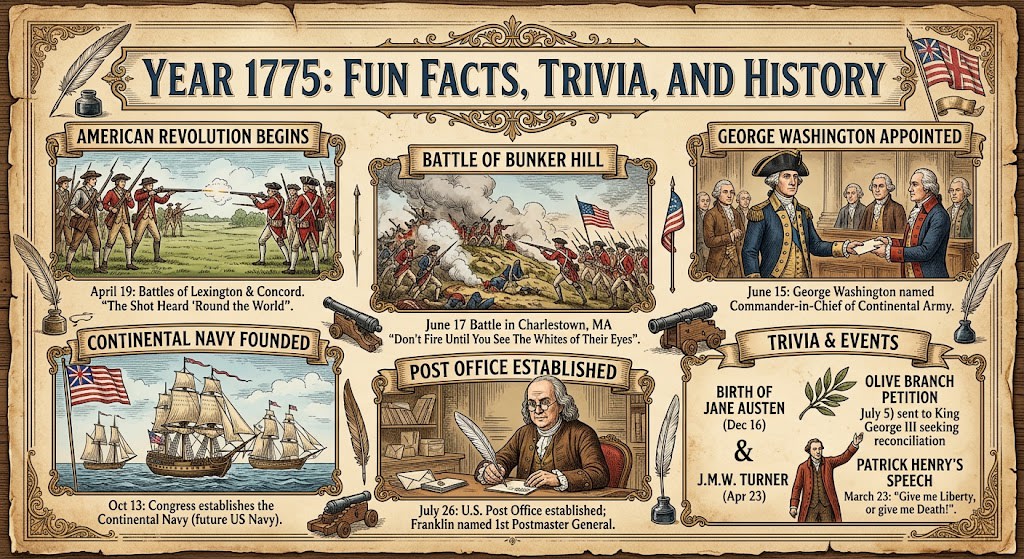
On March 23, during a speech before the Second Virginia Convention, American founding father and orator Patrick Henry responded to the “increasingly oppressive British rule” over the American colonies by declaring, “I know not what course others may take, but as for me, give me liberty or give me death!”
On March 25, George Washington planted pecan trees at his Mount Vernon, Virginia, estate.
On March 30, in an attempt to keep the New England colonies “dependent on the British,” King George III of England “endorsed” the New England Restraining Act, which “required New England colonies to trade exclusively with Great Britain as of July 1.”
On April 18, in his famous “midnight ride,” American patriot Paul Revere rode through the night to warn colonists that British troops were marching from Boston to Lexington.
On April 19, the American Revolutionary War officially began with the Battles of Lexington and Concord, when “local colonial militiamen, known as minutemen, exchanged gunfire with British regular troops, marking the first military clashes of the war for American independence.”
On May 10, the Second Continental Congress convened in Philadelphia and “authorized the issuance of paper money (‘Continentals’) to fund the early war effort.”
June 14 to 15: The U.S. Army was founded when the Continental Congress authorized “the enlistment of expert riflemen to serve the United Colonies for one year.”
On June 15, the Continental Congress voted to have George Washington lead the Continental Army.
On June 17, the Battle of Bunker Hill took place during the Siege of Boston. The British won “primarily because the colonial forces ran out of gunpowder and ammunition.” Nevertheless, the American colonists showed great bravery and proved “they could stand up to the powerful British army.”
On June 22, the Continental Congress authorized the issuance of $2 million in bills of credit to finance the American Revolutionary War.
On June 23, the first Thames Regatta took place in London. OnThisDay.com tells us that “organized by high-society club members, the landmark social and sporting spectacle featured competitive boat races with watermen rowing from Westminster Bridge to London Bridge and back, concluding with grand festivities at Ranelagh Gardens.”
On July 3, George Washington took command of the American Continental Army.
On July 5, the Continental Congress adopted the Olive Branch Petition, which appealed to King George III of England “for reconciliation between the colonies and Great Britain.” However, on September 1, King George III rejected the petition by declaring that the 13 colonies were in open rebellion against British rule.
On July 10, American military officer Horatio Gates issued an order to exclude Black people from joining the Continental Army.
On July 26, the Second Continental Congress appointed Benjamin Franklin as the first postmaster general of the United Colonies, which established “the foundation for the modern U.S. Postal Service.”
On August 5, the first Spanish ship, the San Carlos, entered San Francisco Bay.
On August 18, Hugo O'Conor, a Spanish military officer born in Ireland, founded Tucson, Arizona, and established the “Presidio San Agustín del Tucsón.”
On October 13, the Continental Congress authorized the “construction and administration” of the first American naval force—the precursor to the United States Navy.
On October 16, Portland, Maine, was burned by the British.
On November 12, General George Washington issued a formal order that prohibited recruiting officers from enlisting African American soldiers, free or enslaved, “alongside other restrictions against boys and old men.”
December 3: According to the Department of the Navy, “Lieutenant John Paul Jones raised the Grand Union Flag aboard the Continental Navy flagship Alfred in Philadelphia Harbor, marking the first time an American national flag was officially displayed on a U.S. naval vessel.”
Here are more than 25 foods and beverages that were an integral part of the American diet during the late 1700s: ale, baked fruit puddings, beans, beef, berry pies, cider, coffee and tea, corn mush, crabs, duck, eel, hasty pudding, johnnycakes, lobster, local fruits like apples and berries, local vegetables like cabbage, carrots, and onions, oat cakes, pepper cakes, pork, turkey, venison, whole-grain bread, and wine.
In 1775, the most popular baby names for boys included James, John, Henry, Thomas, and William. For girls, the most popular baby names were Anna, Elizabeth, Frances, Mary, and Sarah.
The most common surnames in America included Baker, Brown, Carter, Davis, Johnson, Jones, Miller, Smith, Williams, and Wilson. It’s also worth noting that “Smith” was the most common colonial surname in the 1700s.
Popular fiction works for the year: Charles Johnstone’s The Pilgrim, Moral Tales (published anonymously), and Samuel Jackson Pratt’s Liberal Opinions, Upon Animals, Man, and Providence.
Noteworthy nonfiction works published in 1775: Samuel Johnson’s A Journey to the Western Islands of Scotland and Samuel Johnson’s Taxation No Tyranny: An Answer to the Resolutions and Address of the American Congress.
Notable dramatic works for the year: David Garrick’s Bon Ton and Richard Brinsley Sheridan’s The Rivals.
Top poetic work published in 1775: Mary Robinson’s Poems.
Famous people born in 1775 included Charles Lamb (a British children’s author); Jane Austen (a British author who wrote the ever-popular novel Pride and Prejudice); and Lyman Beecher (a Presbyterian clergyman who started the American Temperance Society in Boston in 1826).
Famous people who passed away in 1775 included Peyton Randolph, an American founding father and president of the First Continental Congress.
In 1775, the words “battle cry,” “bedraggled,” “bibliographer,” “checkerboard,” “come across,” “corn bread,” “conscientious objection,” “dumbbell,” “eggnog,” “goings-on,” “hull down,” “impressive,” “jockey club,” “kick the bucket,” “Louisianan,” “oilskin,” “pesky,” “rainmaker,” “rifleman,” “self-justification,” “seltzer,” “sick and tired,” “skimp,” “snow squall,” “soy sauce,” “sustained,” “threshing machine,” “tourist,” “unannounced,” “uncooked,” “unfiltered,” “unsweetened,” “unwearable,” and “war paint” all appeared in print for the first time.
Courtesy of AmericanHeritage.com, here is the menu for a typical New England Thanksgiving dinner during the late 1700s. It’s also worth noting that the first “traditional” Thanksgiving in America took place “as a harvest feast” in 1621 in Plymouth, Massachusetts, and lasted for three days.
Apple pie
Cauliflower
Cider
Haunch of venison
Indian pudding
Mincemeat pie
Onions in cream
Pigeon pasties
Plum pudding
Potatoes
Pumpkin pie
Raw celery
Roast pork
Roast goose
References:
https://www.foodreference.com/html/html/food-history-1775.html
https://www.americanheritage.com/thanksgiving-dinner-during-revolution
Disclaimer: In writing and editing this article, Gregory DeVictor has made every effort to ensure historical accuracy and not to mislead his audience. In addition, the contents of this article, including text, graphics, and captions, are for general informational purposes only.
© 2026 Gregory DeVictor
About the Creator
Gregory DeVictor
Gregory DeVictor is a trivia enthusiast who likes to write articles about American history and nostalgia. Each of his articles presents a mix of fun facts, trivia, and historic events about a specific calendar year, decade, or century.
Enjoyed the story? Support the Creator.
Subscribe for free to receive all their stories in your feed.
Comments