
Why They Brainwashed You To Associate 13 with Negativity
While They Hoarded Its Power for Themselves

Look at a dollar bill.
Not casually — look at it deliberately, with the specific question in mind that most people never think to ask when they look at this object they handle dozens of times every week.
Count the layers of the pyramid. Thirteen. Count the stars above the eagle on the reverse side. Thirteen. Count the stripes on the shield the eagle carries. Thirteen. Count the arrows in the eagle's left talon. Thirteen. Count the olive branches in the right talon. Thirteen. Count the letters in Annuit Coeptis — the Latin phrase above the pyramid that translates as He approves our undertakings. Thirteen. Count the letters in E Pluribus Unum — Out of Many, One — the motto on the banner in the eagle's beak. Thirteen.
Now ask yourself — why would a nation whose founding fathers taught the world to associate thirteen with misfortune, with the betrayal of Jesus, with chaos and death and unlucky dinner parties — why would that same nation encode the number thirteen into the most widely circulated financial instrument in human history not once, not twice, but at least seven times in a single image?
The answer is not that they made a mistake. The answer is that they knew something about the number thirteen that they had no intention of sharing with the people who would spend their lives handling the symbol of their power without ever understanding what it actually said.
This essay is about what they knew. And why they worked so carefully to make sure you did not know it too.
The deliberate inversion — how sacred becomes taboo
Before getting into the specific evidence of how thirteen was hoarded by the most powerful institutions in Western history it helps to understand the mechanism through which sacred knowledge gets inverted into taboo — because the thirteen story is not unique. It is one of the clearest available examples of a pattern that repeats consistently across the history of institutional power's relationship to genuine spiritual knowledge.
The pattern works like this. A number, a symbol, a practice, or a form of knowledge carries genuine power — the specific power of alignment with cosmic reality, with natural cycles, with the frequencies that genuine spiritual traditions understand as the organizing principles of the universe. The people who access this knowledge gain genuine advantage — the specific clarity, the specific effectiveness, the specific quality of consciousness that genuine sacred knowledge produces when it is genuinely understood and genuinely applied.
The institutional power that wants to maintain its advantage over the general population has two choices. It can share the knowledge — which eliminates the advantage. Or it can take the knowledge for its own exclusive use while simultaneously convincing the general population that the knowledge is dangerous, evil, or simply meaningless — which maintains the advantage indefinitely.
The inversion of thirteen from sacred to unlucky is the most widely distributed and most thoroughly documented available example of this second choice being made deliberately and maintained systematically across centuries.
Teach the masses that the number is unlucky. Install the fear so deeply that it produces clinically recognized phobias, that it shapes architecture and aviation and the basic organization of daily life. And simultaneously — in the symbols, the rituals, the founding documents, and the organizational structures that the initiated keep among themselves — continue to use the number's genuine power for every significant act of institutional creation and institutional consolidation.
This is not speculation. The evidence is hiding in plain sight. It has been hiding there for centuries. And once you see it you cannot unsee it.
The United States — a nation built on thirteen
The thirteen original colonies is the explanation that American schoolchildren receive for why thirteen appears so consistently in American founding symbolism. It is not an adequate explanation. The number of original colonies does not explain why the founders — most of whom were Freemasons with deep knowledge of numerological significance — chose to encode thirteen into the Great Seal of the United States with the specific density and the specific deliberateness that the actual encoding reveals.
The Great Seal of the United States — designed in 1782 and appearing on the reverse of the dollar bill — contains thirteen in every significant element of its composition.
The pyramid has thirteen layers. This is the most immediately visible and the most discussed encoding — the unfinished pyramid with the all-seeing eye floating above its thirteenth level is the most recognizable symbol of esoteric knowledge in American founding imagery. The pyramid's thirteen layers do not represent the thirteen colonies. They represent the thirteen levels of initiation — the specific stages of esoteric development that the mystery tradition the founders were drawing from understood as the complete available arc of human spiritual development in the current age.
The all-seeing eye above the pyramid — the eye of providence, the eye of Horus in the Egyptian tradition that directly influenced the Masonic tradition that directly influenced the American founding — is positioned at the thirteenth level precisely because the thirteenth level is the threshold. It is the point of transition between the ordinary human consciousness that the twelve levels below represent and the divine consciousness that the eye represents — the specific threshold energy that thirteen has always carried in the traditions that understood it most deeply.
The eagle carries thirteen arrows and thirteen olive branches — war and peace, force and diplomacy, the two available instruments of power held in perfect balance. Thirteen stars form the constellation above the eagle's head. Thirteen stripes on the shield across the eagle's chest. The specific repetition of this number across every significant element of the seal is not the result of a coincidence involving the number of original states. It is the deliberate encoding of a number whose power the founders understood and intended to invoke in the symbolic foundation of the nation they were creating.
The thirteen letters of Annuit Coeptis and the thirteen letters of E Pluribus Unum complete the encoding — the very words chosen to describe the founding act and the founding principle carrying the number in their letter count as a final layer of confirmation that the choice of thirteen throughout the seal was not accidental but intentional.
These were men — Benjamin Franklin, Thomas Jefferson, John Adams, and the other founders who contributed to the seal's design — who understood the language of esoteric symbolism with the fluency of initiates. They did not stumble into encoding thirteen seven times in a single image. They chose to encode it because they understood what thirteen represented and they wanted that representation embedded in the foundational symbol of the nation's power.
Freemasonry — the thirteenth degree
The Masonic tradition that most directly shaped the American founding and that continues to organize significant dimensions of institutional power in the Western world has always understood thirteen as one of its most significant numbers.
The Scottish Rite of Freemasonry — the most systematically organized of the major Masonic bodies — organizes its initiatory system into 33 degrees. The thirteenth degree — the Royal Arch of Solomon or the Master of the Ninth Arch depending on the specific rite — is one of the most significant of the entire initiatory sequence. It represents the specific point at which the initiate crosses the threshold from the outer degrees of Masonic knowledge into the inner degrees where the tradition's most significant esoteric content is transmitted.
This placement of thirteen at the threshold of the most significant available Masonic knowledge is not coincidental. It reflects the same understanding of thirteen as the threshold number — the number of the crossing, the number of transition between the ordinary and the initiated consciousness — that the ancient traditions encoded in their own relationship to the number.
The Masonic tradition did not hide its use of thirteen. It simply did not explain it to the uninitiated — which is to say, to the vast majority of the population who were simultaneously being taught by the cultural institutions that Freemasonry significantly shaped that thirteen was a number to be feared rather than understood.
The same fraternity that taught the culture to fear thirteen built its most significant initiatory threshold at the thirteenth degree. The same founders who created a culture of thirteen-avoidance encoded thirteen into the nation's foundational symbols seven times. The pattern is not subtle once you are looking for it.
The Knights Templar and Friday the thirteenth
The most significant single event in the cultural establishment of Friday the thirteenth as ominous is the arrest of the Knights Templar on Friday, October 13th, 1307 — an event that most historical accounts present as the origin of the Friday the thirteenth superstition without examining the more interesting question of why this specific date was chosen.
King Philip IV of France — heavily indebted to the Templars and coveting their accumulated wealth, their banking infrastructure, and their institutional power — ordered the simultaneous arrest of hundreds of Templar knights across France on this specific date. The Templars were tortured, their order was dissolved, and their assets were seized.
The Templars themselves — who had spent nearly two centuries in Jerusalem with access to the esoteric knowledge preserved in the ancient Middle Eastern and Egyptian traditions — understood the power of thirteen. Their organizational structure reflected this understanding. The specific date chosen to arrest them — Friday the thirteenth — may not be coincidental in the way that most historical accounts imply.
The deliberate choice to arrest an order that used thirteen's sacred power on the date that combined the two elements — Friday and the thirteenth — that would most effectively attach ominous cultural associations to both, and through both to the number thirteen itself, is consistent with the pattern of deliberately inverting sacred knowledge into cultural taboo that we see operating across the thirteen story more broadly.
Whether or not the date was chosen with this specific intention — and the evidence suggests it may have been — the effect was the same. One of the most significant acts of institutional violence in medieval history attached itself to Friday the thirteenth in the cultural memory, and the superstition that followed served the interests of every subsequent institution that benefited from the population's fear of a number whose power those institutions continued to use for themselves.
The thirteen bloodlines
The research tradition that has most consistently documented the hoarding of thirteen's power by institutional elites is the work examining what has been called the thirteen bloodlines of the Illuminati — the specific families whose sustained intergenerational accumulation of institutional power across centuries has been documented by researchers including Fritz Springmeier and others in this field.
Whether one accepts the specific framework of the thirteen bloodlines research tradition or engages with it more skeptically the specific pattern it documents is consistent with what every other line of evidence in this essay points toward — the same families, the same institutions, and the same organizational structures that have consistently taught the masses to fear and avoid thirteen have simultaneously organized their most significant power structures around it.
The number thirteen in this tradition represents the specific quality of initiated power — the consciousness and the knowledge that has been maintained within the bloodlines precisely because its availability to the general population would undermine the advantage that exclusive access to it provides. The teaching of the masses to fear what the initiated use is not a side effect of the power structure. It is one of its primary operational mechanisms.
The ancient sacred thirteen — what they did not want you to know
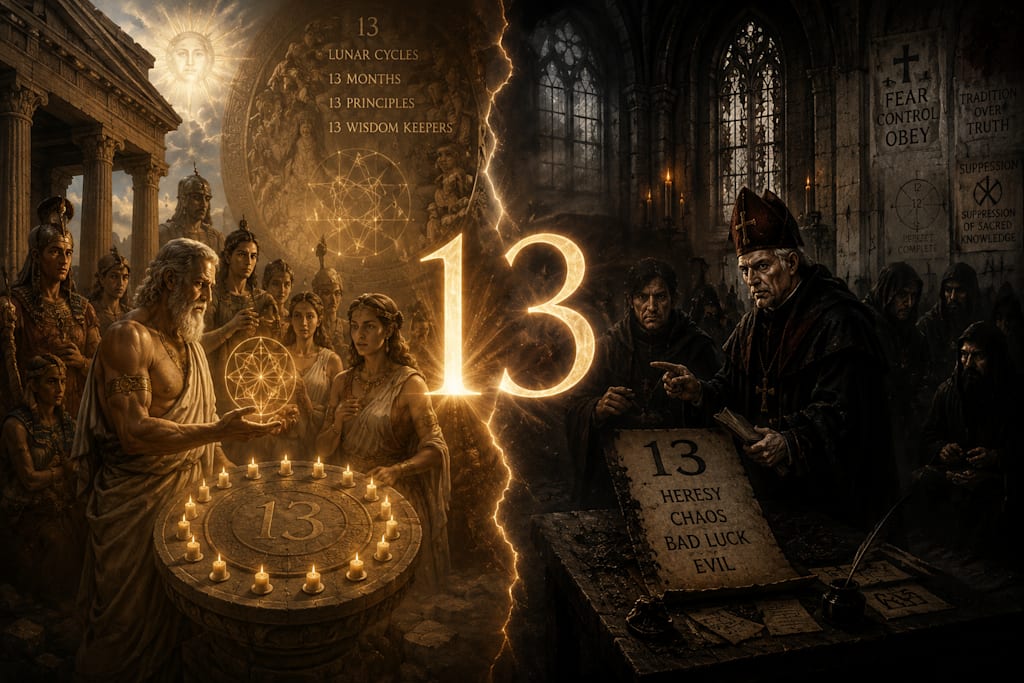
Before the inversion — before the institutional Christianity that replaced the lunar feminine traditions with solar masculine ones, before the arrest of the Templars, before the deliberate cultural encoding of thirteen as ominous — the ancient world understood this number very differently.
The thirteen lunar cycles in a solar year connected the number directly to the divine feminine — to the goddess, to the sacred creative power of the feminine principle, to the menstrual cycle that connects the feminine body to the cosmic cycles of natural time. Thirteen was the number of the moon. The number of the feminine divine. The number of the specific creative power that the transition from matriarchal to patriarchal religious organization specifically worked to suppress.
The ancient Egyptians understood thirteen as the number of the soul's threshold — the specific point of transition between the mortal and the immortal, between the ordinary world and the divine one. The thirteen stages of Osiris's dismemberment and reassembly — the death and resurrection story that predates the Christian resurrection narrative and that significantly influenced the Masonic tradition's core symbolism — organized the most significant available sacred narrative around the number thirteen.
The Mayans built their entire cosmological system around thirteen — the thirteen numbers of the sacred Tzolkin calendar, the thirteen heavens of their cosmological understanding, the thirteen Baktuns of the Long Count calendar. The civilization that produced the most sophisticated calendar system in pre-Columbian history understood thirteen as the organizing principle of cosmic time.
The Native American traditions across multiple nations recognize thirteen moons in the year — and the thirteen moons are the specific framework through which the natural world's cycles and the human being's relationship to those cycles are most accurately understood.
These were not primitive or uninformed cultures guessing at the nature of reality. They were civilizations whose accumulated understanding of astronomical cycles, of sacred mathematics, and of the specific relationship between numerical patterns and cosmic reality represented the most careful and most sustained available engagement with these questions in human history.
They all arrived at thirteen.
The specific suppression of what all of these traditions understood about this number — and the simultaneous hoarding of that understanding by the institutional power structures that claimed to supersede them — is what the thirteen story is most essentially about.
What thirteen actually represents
Strip away the superstition. Set aside the cultural programming that has been running so consistently for so long that most people experience it as simply the way things are rather than as the specific installed belief system it actually is. And what remains is the genuine spiritual significance of a number that the most careful available traditions understood as among the most powerful accessible to human consciousness.
Thirteen is the number of transformation — the specific quality of genuine change that requires genuine ending before genuine beginning can occur. The death that is genuinely prerequisite to the rebirth. The dissolution of what has reached completion before what is genuinely new can emerge. The Tarot's thirteenth card — the Death card that represents not literal death but the most complete available transformation — encodes this understanding in the most widely distributed available esoteric symbolic system.
Thirteen is the number of the divine feminine in her most complete expression — the full-spectrum sacred feminine power that includes the nurturing, the creative, the fierce, the transformative, and the specifically death-and-rebirth cycling quality that the ancient world understood as the most fundamental available cosmic creative force.
Thirteen is the number of what exceeds the perfect system — what cannot be fully contained within any available framework and that consistently points toward what is possible beyond the current system's limits. Twelve represents completion. Thirteen represents what comes after completion — the surplus, the excess, the genuinely revolutionary consciousness that the perfect twelve cannot contain and that the institutions organized around twelve's completeness most need to suppress.
The complete spiritual meaning of the number 13 addresses all of these dimensions in the depth they deserve — the numerological, the historical, the specifically sacred, and the practically applicable understanding of a number whose genuine power is confirmed by the extraordinary lengths to which institutional power has gone to prevent its general availability.
The most important question
If thirteen were simply unlucky — if it were genuinely just a number with a negative frequency that produced misfortune for those who engaged with it — the institutions that encoded it seven times into the Great Seal of the United States, that placed it at the threshold of their most significant initiatory sequences, and that organized their most powerful bloodline frameworks around it would not have done so.
Power does not organize itself around what diminishes it. It organizes itself around what strengthens it.
The specific pattern of teaching the masses to fear thirteen while hoarding its power in founding symbols, initiatory structures, and dynastic bloodlines is the most direct available evidence that the number carries genuine power — power significant enough that exclusive access to it was considered worth the considerable institutional effort of convincing everyone else that the access would only harm them.
You have been told that thirteen is unlucky your entire life. You have absorbed that message so thoroughly that it probably feels less like a belief and more like simply the way things are.
But the dollar bill in your pocket tells a different story. The Masonic thirteenth degree tells a different story. The Knights Templar's organizational structure tells a different story. The ancient Egyptian, Mayan, Native American, and Celtic traditions all tell a different story.
The number thirteen is powerful. It has always been powerful. And the most powerful institutions in Western history have never stopped using that power — even while they were teaching you to be afraid of it.
That is not coincidence.
That is control.
And now you know.
About the Creator
Enjoyed the story? Support the Creator.
Subscribe for free to receive all their stories in your feed.
Comments
There are no comments for this story
Be the first to respond and start the conversation.