
Why China Released Millions of Rabbits in Desert
Why China Rabbits in Desert

Did you know that Australia has a population of about 22.7 million people, while it is also home to around 200 million rabbits—almost 10 times more than humans? These rabbits have caused so much destruction that the government has declared them a harmful species and has made many unsuccessful attempts to control them.
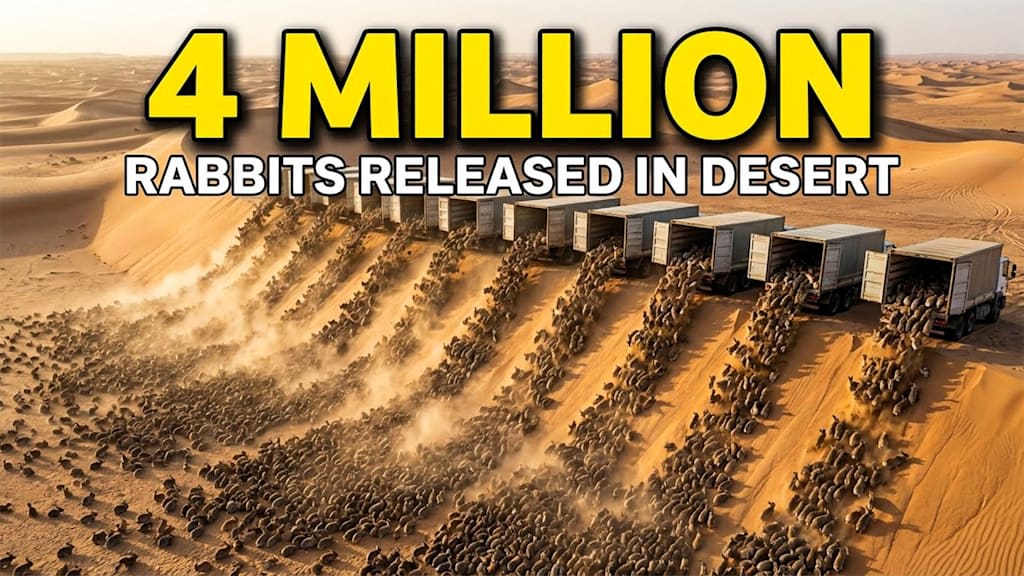
On the other hand, China has imported more than 4 million rabbits over the past 30 years—not for food, but for a unique experiment in the Kubuqi Desert. The results of this experiment surprised the entire world.
Welcome once again my story.
When a desert expands and turns fertile land into barren land, this process is called desertification. One of the biggest victims of this process is China’s Kubuqi Desert. At one point, it was expanding at a rate of 500,000 acres per year, swallowing fertile land rapidly.
China tried many solutions during the 1950s and 1960s—sand control stations, tree plantations—but nothing worked effectively.
Then a local entrepreneur, Wang Wenbiao, came up with a revolutionary idea. He invested his own money and started placing dry shrubs in square patterns across hundreds of acres of desert. Between them, he planted willow trees.
Willow trees can survive with very little water because their roots can go as deep as 300 feet to find moisture. Their wood is useful for paper and furniture—but only if they can survive in the desert.
Strong desert winds were a major problem, blowing away sand and moisture. To protect the young trees, shrubs were placed around them.
Initially, people mocked Wang, thinking it was impossible to grow trees in a desert. But after three years, a new problem appeared: the trees needed maintenance. For better wood quality, their new branches had to be regularly trimmed—something difficult and expensive in the desert.
This is where rabbits entered the story—specifically Rex rabbits.
Rex rabbits have soft, high-quality fur used in luxury clothing. But they were introduced for another reason: they love eating the fresh shoots of willow trees.
By eating these shoots, they naturally trimmed the trees, allowing the main trunk to grow thicker and more valuable for industry. So rabbits helped both the environment and the economy.
But this was just the beginning.
Willow roots stabilized the sand, preventing it from blowing away and helping retain moisture. Meanwhile, rabbits played another crucial role—their waste acted as fertilizer, enriching the soil.
Rex rabbits also reproduce rapidly—a female can give birth to up to 50 babies per year. As their population grew, so did soil fertility.
Soon, barren sand started turning into fertile land where organic vegetables could be grown.
Another interesting factor: rabbits digest grass but not its seeds. So seeds passed through their system and spread naturally, leading to more vegetation growth.
This created a self-sustaining ecosystem:
Rabbits trimmed trees
Fertilized soil
Spread grass
Provided valuable fur
After the success of this experiment, Wang expanded the project using 100 bulldozers to level sand dunes and plant more trees. Local people were encouraged to raise rabbits, turning homes into small farms.
Over 10 years, the area transformed completely. From barren desert, it became green land.
The Kubuqi Desert covers about 18,600 square kilometers. According to UN reports, about 33% (6,250 sq km) has turned green over 30+ years. It is now called an “ecological marvel” instead of the “Sea of Death.”
The project also improved people’s lives. China invested about 3 billion yuan (~$400 million), building villages and creating jobs. Today:
Over 2,000 farms operate
3 million rabbits are sold annually
Farmers earn around $9,600 per year
People who once fled the desert are now becoming prosperous.
But a question arises: if rabbits can green deserts, why are they dangerous in Australia?
The reason is control. Rabbits were introduced to Australia in 1859 (just 24 initially) for hunting. Within 70 years, their population exploded uncontrollably because they lived freely in natural conditions.
In China, however, rabbits are kept in controlled environments and used strategically.
That’s why rabbits are a curse in Australia but a blessing in China.
The story doesn’t end here.
The Kubuqi Desert is also home to the world’s largest solar power image—the Junma Solar Power Plant. Spread across 6,000 acres with 5 million solar panels, it forms the shape of a running horse (visible from space).
By 2022, it had generated 2.3 billion kWh of electricity, saving 7,600 tons of coal and reducing 1.8 million tons of CO₂ emissions.
But it does more than produce electricity. The panels reduce sunlight on the ground, decreasing evaporation and allowing grass to grow underneath. Rabbits again help by grazing and fertilizing the land.
Wind speeds are reduced by up to 50%, reducing sand movement and improving soil fertility.
Today, animals like sheep, goats, ducks, and rabbits coexist there. Grass grows under solar panels, and willow trees surround the area.
What was once the “Sea of Death” is now called the “Sea of Life”—all starting with the smart use of rabbits.
Researchers now call this model an “eco-economic revolution.” With nearly 50% of the world being desert and 40% facing desertification, countries like the US and Europe are learning from this model.
The message of the Kubuqi Desert is clear:
If humans and nature work together, even a desert can be turned into a garden of life.
About the Creator
Imran Ali Shah
🌍 Vical Midea | Imran
🎥 Turning ideas into viral content
✨ Watch • Share • Enjoy
Enjoyed the story? Support the Creator.
Subscribe for free to receive all their stories in your feed.
Comments
There are no comments for this story
Be the first to respond and start the conversation.