
Why America Struggles to Win Its Long Wars
A literary reflection on power, political division, and the hidden limits of modern warfare.

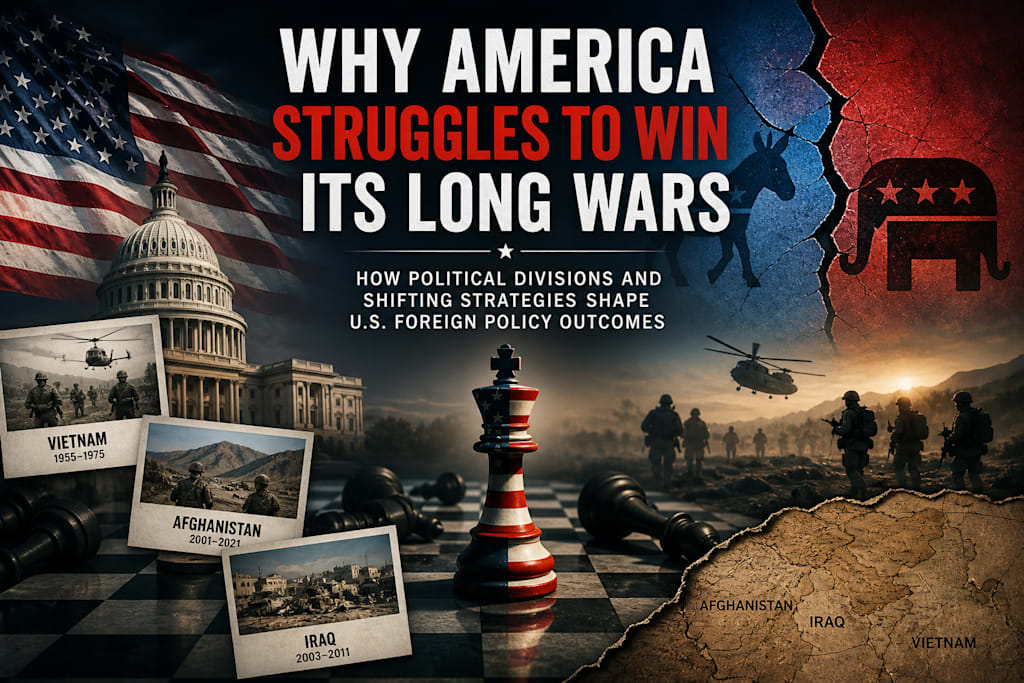
Power, in its grandest form, often carries the illusion of certainty.
Yet history has shown that even the mightiest nations can find themselves entangled in conflicts where victory slowly dissolves into ambiguity. The United States, with all its strength and global reach, has walked this uncertain path time and again—where dominance on the battlefield fails to secure peace beyond it.
Beneath the surface of strategy and the language of war lies a deeper, quieter truth: that the limits of power are not only drawn on distant maps, but shaped from within. This is not merely an account of wars, but a reflection on the unseen fractures that influence their outcomes—and a question that lingers: can power, without unity, ever achieve lasting victory?
Why America Struggles to Win Its Long Wars
Faramarz parsa
The United States has long stood as one of the world’s most powerful nations, with unmatched military capabilities and global influence. Yet, despite this strength, it has faced a series of strategic setbacks in modern history. These outcomes raise a fundamental question: why does a superpower struggle to achieve lasting success in prolonged conflicts?
From the Vietnam War to the War in Afghanistan and the Iraq War, the United States demonstrated overwhelming military superiority in initial phases. However, translating battlefield success into stable political outcomes proved far more difficult. In Vietnam, a technologically advanced army was ultimately worn down by guerrilla warfare and local resistance. In Afghanistan, the longest war in U.S. history ended with a rapid withdrawal and the return of the Taliban. In Iraq, the removal of Saddam Hussein did not lead to the stable democratic system that had been envisioned.
These cases suggest that modern conflicts are not won by military force alone. Instead, they require a deep understanding of local dynamics, culture, and political realities—areas where external powers often struggle.
Beyond battlefield complexities, internal political divisions also play a significant role. The rivalry between the Democratic Party and the Republican Party has, at times, influenced the direction and consistency of U.S. foreign policy. While this competition is a natural feature of democracy, it can create discontinuity in long-term strategies.
In many instances, one administration initiates a conflict while another is left to manage its consequences. This leads to shifting priorities and inconsistent messaging. For example, U.S. policy toward Iran has fluctuated significantly—from diplomatic engagement under Barack Obama to withdrawal from agreements under Donald Trump, and later attempts to revive diplomacy under Joe Biden. Such shifts make it difficult for allies and adversaries alike to predict long-term American policy.
This lack of continuity has broader global implications. International partners may hesitate to commit to long-term agreements if policies can be reversed within a single election cycle. Meanwhile, strategic competitors such as China and Russia may interpret these divisions as signs of weakness or inconsistency.
It is important, however, not to oversimplify these challenges. U.S. setbacks are rarely the result of a single factor. They emerge from a combination of complex warfare environments, ambitious political goals, and the inherent difficulties of nation-building efforts. Domestic political competition is only one part of a much larger equation.
Ultimately, the strength of any nation lies not only in its military power, but in the consistency and coherence of its long-term strategy. For the United States, maintaining a balance between healthy democratic competition and sustained national objectives remains a critical challenge.
Without a greater degree of strategic continuity, even the most powerful nations risk repeating cycles of engagement, withdrawal, and reassessment—leaving behind unresolved conflicts and uncertain outcomes.
—————
2026/5/2
About the Creator
Ebrahim Parsa
⸻
Faramarz (Ebrahim) Parsa writes stories for children and adults — tales born from silence, memory, and the light of imagination inspired by Persian roots.
Enjoyed the story? Support the Creator.
Subscribe for free to receive all their stories in your feed.
Comments
There are no comments for this story
Be the first to respond and start the conversation.