
Why Alaeddin Ghazi Refused the Throne
The Shocking Truth Behind the Rise of the Ottoman Empire and the Brother Who Chose Silence Over Power
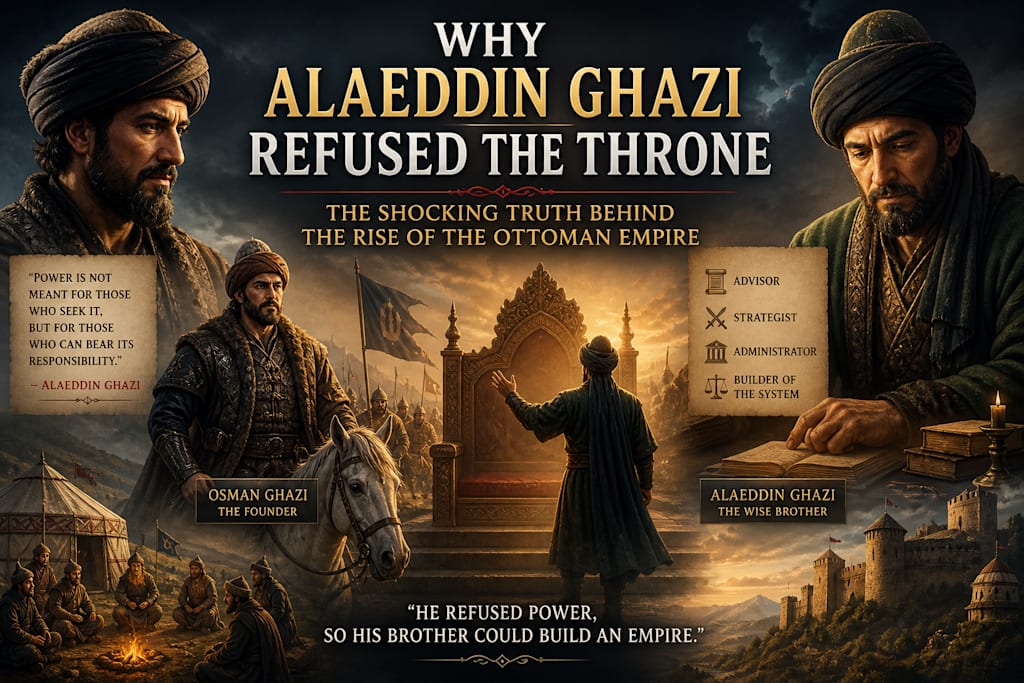
In the early days of the Ottoman dream, when the small Turkic principality was still struggling for survival on the edges of the Byzantine world, two brothers stood at the heart of its destiny. One was Osman Ghazi, the fierce and visionary leader who would lay the foundation of an empire. The other was Alaeddin Ghazi, a man of deep thought, calm wisdom, and quiet strength. History remembers Osman as the founder, but Alaeddin remains a shadow—an enigma whose silence may have shaped the future more than any sword.
The legend begins after the death of their father, Ertuğrul Ghazi. The tribe, still fragile and surrounded by powerful enemies, needed unity. Osman emerged as a natural leader. His courage in battle and his ability to inspire warriors made him the choice of the people. But behind him stood Alaeddin, equally respected, perhaps even more educated, and deeply thoughtful about governance, justice, and order.
When Osman began expanding the small beylik through raids and strategic conquests, many elders believed that Alaeddin should share power. Some even whispered that the future of the tribe required not just a warrior, but a ruler who could build systems, laws, and stability. Alaeddin Ghazi was seen as that man.
But something unexpected happened.
According to traditional accounts and later Ottoman narratives, Alaeddin did not compete for leadership. In fact, when asked to take responsibility in governance, he stepped back. While Osman led campaigns on the battlefield, Alaeddin focused on shaping internal structure—organizing administration, advising on justice, and helping build the early foundations of what would later become the Ottoman state system.
Yet the most shocking part of his story is not ambition, but absence of it.
Why would a man of intelligence, respect, and noble lineage refuse power in a world where power meant survival?
Some historians suggest that Alaeddin understood something deeper than conquest. He saw that Osman’s strength was not just in his sword, but in his destiny. Osman had the charisma of a conqueror, a man who could unite warriors under one banner. Alaeddin, however, was more suited to building systems than leading armies. He may have recognized that two competing leaders would fracture the fragile unity of the tribe.
So he made a decision that changed history.
He stepped away from the throne.
In doing so, Alaeddin Ghazi may have prevented a civil conflict that could have destroyed the early Ottoman movement before it even began. Instead of dividing the tribe, he chose to strengthen it from within. He advised Osman, supported governance, and focused on justice rather than conquest.
There is also a more emotional interpretation of his choice. Some stories suggest Alaeddin was deeply spiritual and reflective. He may have viewed power as a burden rather than a blessing. In a world driven by war, bloodshed, and survival, he may have preferred peace over dominance. The throne, in his eyes, was not a prize—it was a responsibility too heavy for personal desire.
Meanwhile, Osman Ghazi continued his rise. His victories over Byzantine territories brought fame and fear. The small beylik slowly transformed into a growing power. And behind the scenes, Alaeddin’s influence shaped internal stability. Early Ottoman administrative practices, fairness in taxation, and structured governance are often linked by tradition to his guidance.
But history is rarely kind to those who step out of the spotlight.
As the Ottoman narrative grew, Alaeddin Ghazi faded into the background. Unlike Osman, who became the symbol of conquest and empire, Alaeddin remained the quiet brother—respected, but forgotten. His refusal to seek power meant he also refused immortality in historical memory.
Yet his decision carries a shocking truth that echoes through time: sometimes the most powerful choice is not to rule, but to allow others to lead while you build what they cannot see.
The rise of the Ottoman Empire was not only forged in battlefields but also in silence, wisdom, and restraint. Alaeddin Ghazi represents that hidden force—the man who may have refused the throne not out of weakness, but out of understanding.
And perhaps the real shock is this: without his silence, Osman’s voice might never have become the foundation of an empire.
About the Creator
Enjoyed the story? Support the Creator.
Subscribe for free to receive all their stories in your feed.
Comments
There are no comments for this story
Be the first to respond and start the conversation.