
Where the Lion First Wore a Crown
The Lion's Line: Royal Indigenous Media Series
Sovereign Chronicles Editorial Staff
Oct 8, 2026 11:11
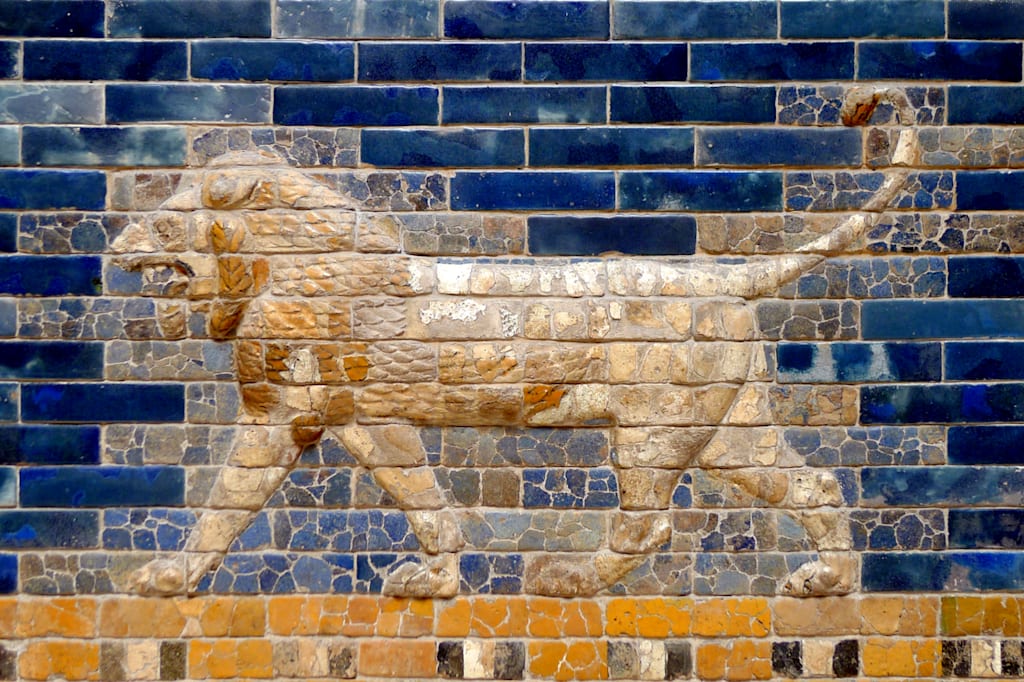
If you walk into the Pergamon Museum in Berlin today, a procession of lions walks toward you.
They are glazed brick, deep blue and gold, each one striding with its mouth open — and they have been walking that wall for about two thousand six hundred years. They belonged to the Ishtar Gate of Babylon. Kings passed under them. Armies marched past them. And every person who saw them understood instantly what they meant: here rules a power that answers to heaven.
But Babylon was late to the idea. The lion wore a crown a thousand years before Babylon ever laid a brick — in Sumer, in the first cities human beings ever built.
Around five thousand years ago, in the marshy flatland between the Tigris and the Euphrates, people did something no one had done before. They built Eridu. Then Uruk. Then a string of cities so close together they could see each other's temple towers on the horizon. And with the cities came something else no one had done before: kingship.
The Sumerians wrote it down themselves, on clay tablets we can still read. Their King List begins with a sentence that should stop you cold: kingship descended from heaven.
Read that again. They did not say kingship was invented. They said it came down — from above, from the gods, from a court that existed before any city did.
This is where the lens of this series opens. The Holy Tablets name that court. At its head stands ANU — called the Source, the Most High — presiding over the Anunnagi with a full celestial administration: commanders, scribes, scientists. His firstborn, Enqi, the master builder whose home is water, comes down to the Persian Gulf, joins the two rivers, and founds Eridu — the first city. His daughter Ninti, the Great Scientist, is the maker of mortals. Whether you read that as history, as memory, or as the oldest political theology on Earth, notice what it claims: kingship was never a human invention. It was a delegation.
Now look at what the Sumerians carved. Their sun god was Utu — the one the Babylonians would later call Shamash — god of justice, the one who sees everything the daylight touches. Their great goddess was Inanna, who the Babylonians called Ishtar. And again and again, the artists put a lion at their feet, or under their throne, or in their hands.
This was not decoration. In Sumer, the lion meant divine order made visible. The wild, devouring power of the marsh lion — every farmer knew it, every herder feared it — taken up and set in its place beneath the gods. The message was precise: the same heaven that sends the sun to judge the Earth sends the king to order the city. To stand near the lion was to stand near the source of sovereignty. To master the lion — and Sumerian kings are shown gripping lions by the tail, staring them down — was to prove you could hold what heaven had handed you.
That is why the lion hunt became a royal ritual, not a sport. When a king faced the lion, he was reenacting the founding contract: heaven delegates, the king upholds, chaos stays outside the walls.
And here is the thread this whole series will follow. The lion never belonged to one kingdom. It belonged to the idea of kingship — and wherever kingship traveled, the lion traveled with it. From Sumer it would go west to Egypt, where pharaohs would carve it into a mountain of limestone with a human face. It would go to Judah, where the House of David would take it as a dynastic name. It would cross the sea to Persia, to India, to Sri Lanka — and a thousand years later it would walk onto the shields of medieval Europe: Scotland, England, Denmark, Norway, Bohemia, León.
Sixteen kingdoms. Five thousand years. One symbol. That is the line we are walking.
Sources: The Sumerian King List (standard translation; opening line on kingship descending from heaven) · The Ishtar Gate, Pergamon Museum, Berlin (reign of Nebuchadnezzar II, c. 575 BCE) · Lion-hunt reliefs of Ashurbanipal, British Museum (Nineveh, c. 645–635 BCE) · Utu/Shamash and Inanna/Ishtar lion iconography, standard Assyriological references · The series' bloodline lens: The Holy Tablets by Dr. Malachi Z. York (ANU, Enqi, Ninti, Eridu, the Abzu — royal-family extraction filed with this series' source materials).
About the Creator
Enjoyed the story? Support the Creator.
Subscribe for free to receive all their stories in your feed.
Comments
There are no comments for this story
Be the first to respond and start the conversation.