
What the Myths Never Hid: Queer Echoes in Celtic Tradition
Queer Echoes in Celtic Tradition
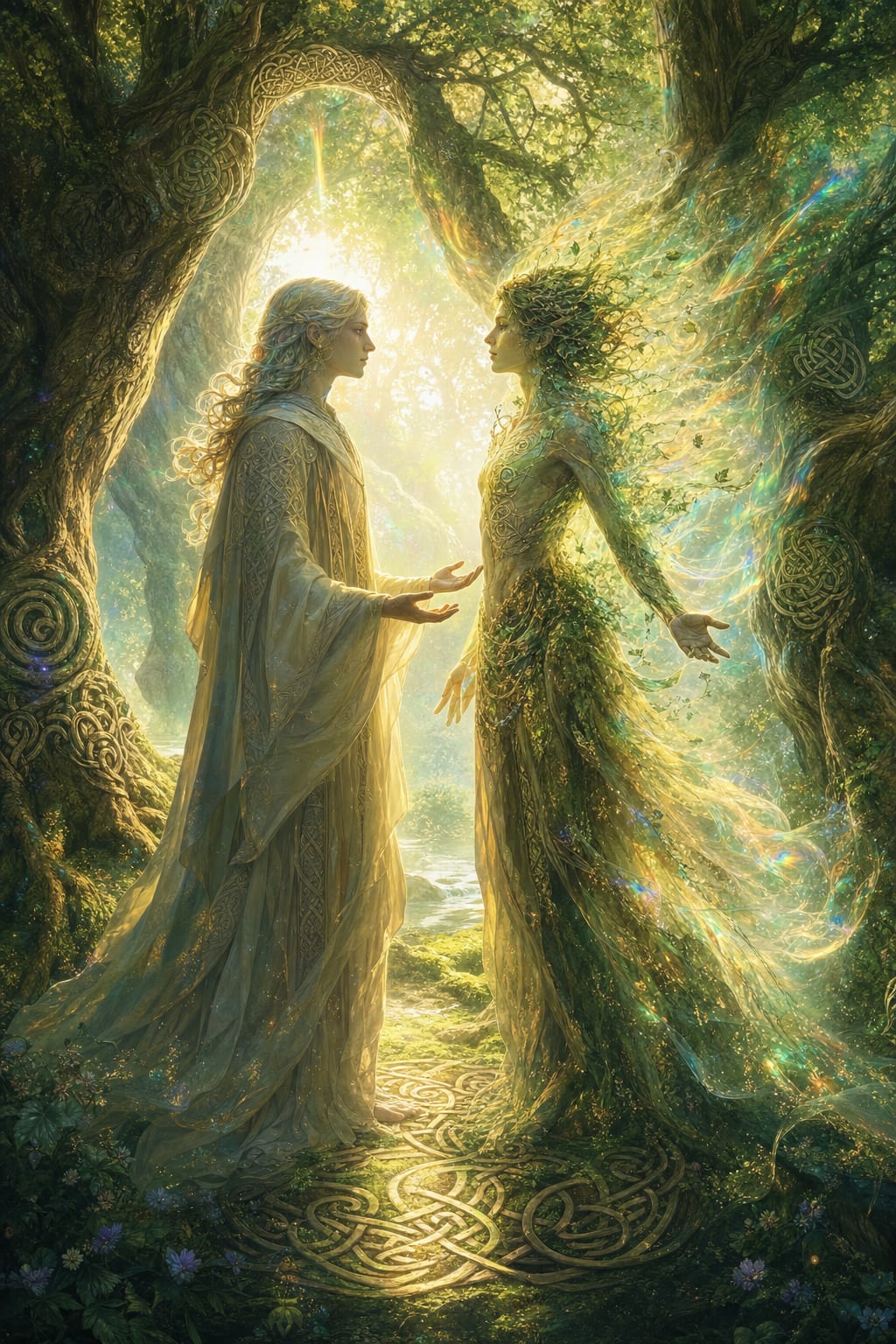
There is a tendency, when we reach back toward the ancient world, to assume that what we find will be simpler than ourselves — that the people who told these stories lived in a world more rigidly ordered, more binary, more tightly hemmed by rules about what a body could be and what a soul could want. Celtic mythology, read with care, dismantles that assumption almost immediately. The old stories — Irish, Welsh, Scottish Gaelic — are not neat. They are not straight lines. They move through gender and form the way water moves through stone: insistently, shaping everything they touch.
This Pride Month, it seems right to begin at the beginning: not with modern affirmation layered over old material, but with an honest look at what was actually there, woven into the fabric of these traditions long before anyone asked them to conform to other peoples' categories.
The Otherworld Does Not Recognize Your Rules
The Celtic Otherworld — known in Irish tradition as Tír na nÓg, Mag Mell, or simply the Land Under the Wave — is not simply a paradise for the dead. It is a space where the rules governing the mortal world cease to apply. Time runs differently there. Bodies age differently, or do not age at all. The soul, in Druidic understanding, is not permanently fixed to one form or one life; it travels, transforms, returns. The Otherworld is the place where transformation is not exceptional but essential.
This matters deeply for how we think about identity in Celtic thought. The soul's journey across multiple lifetimes and forms was not considered a degradation or a punishment — it was the nature of existence. Divinity, in the Druidic worldview, flows through all living things regardless of their outward shape. The gods themselves shift, travel between worlds, take on animal and human and elemental forms. The idea that one form, one body, one fixed presentation of self could be the only authentic version of a person was fundamentally foreign to this cosmology.
When we understand the Otherworld as a space that operates outside the categories of ordinary human society — including its gender categories — we begin to see it differently. It is not merely a place of rest. It is a place of radical possibility. And Celtic myth keeps returning to it, keeps sending its most interesting characters through it, as if the tradition itself knows that the most profound truths live at the threshold.
Shapeshifting as Identity: Étaín, Gwydion, and the Fluid Body
The most visible expression of Celtic identity fluidity is shapeshifting, and the tradition is saturated with it. These transformations are rarely simple. They are rarely mere tricks. When the Irish heroine Étaín is transformed by the jealous first wife of her husband Midir — turned first into a pool of water, then a worm, then a fly, then a human woman born into a different family with no memory of her former self — the story is wrestling with something profound: what is the self, and what remains of it when the body changes entirely? Étaín is still Étaín even through every form. Her essence persists. What she is cannot be reduced to what she looks like or what body she currently inhabits.
Gwydion, the great magician of the Welsh Fourth Branch of the Mabinogion, is one of the most liminal figures in all of Celtic literature. He is a shapeshifter, a trickster, a man who crosses and recrosses every boundary the text places before him. He does not simply change his shape — he changes his social position, his gender presentation, his form. His nephew's story, Lleu Llaw Gyffes, is only possible because Gwydion refuses to accept fixed categories as final. And Gwydion himself, as punishment alongside his brother Gilfaethwy, will spend years experiencing the world from inside female bodies — a passage we will explore in depth in another article, because it is extraordinary and deserves its own space.
The shapeshifting of Celtic myth is not decorative. It is philosophical. It says, again and again, that the body is not the boundary of the self.
The Warrior Bond as a Form of Love
Celtic tradition inherited a deep understanding of intense love between people of the same gender — most clearly visible in the warrior tradition, where bonds forged in training, battle, and shared survival were understood to be among the most sacred relationships a person could hold. The Irish concept of the anam cara, or soul friend — described with such beauty by the philosopher and poet John O'Donohue as a friendship in which "you are understood as you are without mask or pretension" — has roots in this older soil. The soul friend is not defined by gender. They are defined by the quality of the knowing: total, fearless, unconditional.
We see this most powerfully in the relationship between Cú Chulainn and Ferdiad in the Ulster Cycle. These two warriors trained together under the warrior-woman Scáthach, shared the same teachers, the same skills, the same formation. The text calls them companions, heart-friends, closer than brothers. When they are forced to fight at the Ford — brought to battle by Medb's manipulation — Cú Chulainn begs Ferdiad not to cross to meet him. He says: "When we were together with Scáthach… you were my heart companion, you were my people, you were my family." When Ferdiad falls, Cú Chulainn holds his body across the ford, weeping in language that cannot be called anything less than grief for a beloved.
Whether you read that bond as romantic love in a modern sense or as something the culture would have named differently, the text is clear about one thing: this was the deepest love of Cú Chulainn's life. And Celtic tradition did not flinch from saying so.
An Invitation
To every LGBTQIA+ reader who has come to Celtic myth looking for themselves and found, at first glance, only heroes who looked like everyone else's heroes: look again. Look at Étaín moving through forms, still herself through all of them. Look at the Otherworld, which has never cared about your categories. Look at the intensity with which warriors loved each other, the way the tradition described that love without shame or qualification. Look at the shapeshifters, the tricksters, the souls who could not be pinned down.
Celtic myth was never as straight as later retellings made it appear. The queerness was always there, moving under the surface of the stories like water under stone — not hidden, exactly, but waiting for the right reader to recognize it. You are that reader. These stories were always, in part, for you.
About the Creator
The Celtic Spirit- A modern Guide to Celtic Belief and Practice
explaining Celtic mythology, druid practice, and reconstructions of paganism for modern readers
Enjoyed the story? Support the Creator.
Subscribe for free to receive all their stories in your feed. You could also become a paid subscriber, letting them know you appreciate their work.
Comments
There are no comments for this story
Be the first to respond and start the conversation.