
What Is AI Slop?
AI Slop: From Internet Slang to a Weapon Against Artificial Intelligence

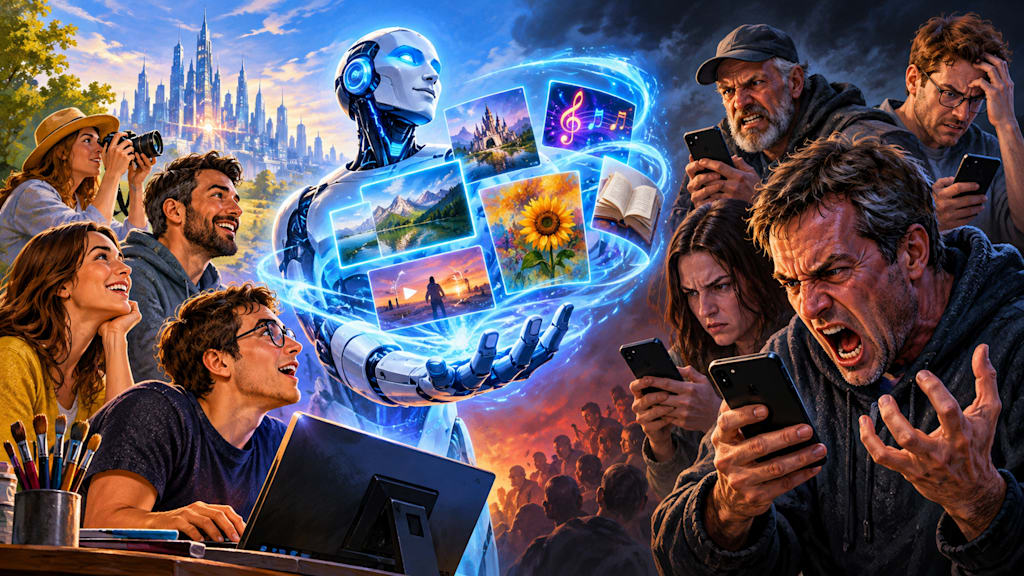
It's a term frequently used across the internet, yet not everyone understands its meaning or background. AI slop emerged as internet slang around 2024, describing low quality, mass produced content generated using artificial intelligence. But how did the term become so popular, and what does it really represent?
As AI tools became increasingly accessible to the general public, people began experimenting with them, using technology to bring their ideas and creativity to life. However, as with every new technology, there was a downside. Some individuals quickly recognized the potential to make money or gain fame by producing content on a massive scale. Books, pictures, music, videos, and countless other creations were suddenly being generated in enormous quantities. The focus shifted from creativity and self expression to volume, attention, and profit.
And so, the term AI slop found its place. It was an appropriate expression for content produced carelessly, without originality, quality, or meaningful effort.
Interestingly, while AI stands for Artificial Intelligence, the word “slop” itself is centuries old. It originally referred to muddy or messy substances and eventually became associated with waste food. Its modern application to AI generated content is relatively new.
The history of artificial intelligence itself goes much further back. In 1955, mathematician John McCarthy used the phrase "Artificial Intelligence" in a formal funding proposal for the 1956 Dartmouth Summer Research Project on Artificial Intelligence. The proposal was co-written with Marvin Minsky, Nathaniel Rochester, and Claude Shannon. That workshop is widely regarded as the birthplace of AI as an academic field.
As for AI slop, it is believed that an online user @deepfates helped popularize the modern use of the word in May 2024, describing it as a term for unwanted AI generated content. British programmer Simon Willison subsequently helped spread its use through his blog and discussions about the growing phenomenon.
However, somewhere along the way, the term began taking on a broader meaning, and not necessarily a fair one.
Before AI took over, people would hire proofreaders to review written materials as the final step before publication, catching surface level errors that slipped through the writing and editing process. They would hire vocalists, mixing engineers, and instrumentalists to record their lyrics and music, painters to create artwork for their projects, and video producers to bring their ideas to the screen.
Suddenly, the need for many of these professionals began to disappear. AI could often do the job faster, better, and cheaper. As a result, many individuals found themselves losing their full time jobs or the side income they had previously relied on.
Take away someone's source of income, and you may see hatred, jealousy, and resentment begin to grow. As they say, misery loves company.
Some of these individuals began deliberately joining AI groups, stalking AI creators, and posting negative comments about AI generated content, often using the term AI slop. It didn't matter whether the content was good or bad, or even whether they genuinely enjoyed it. They would still deliberately post negative comments. It became their personal mission to bring down something they could no longer stop: a technological shift that was inevitable.
By 2026, the term AI slop had increasingly become a go-to expression for people who had been negatively affected by AI in one way or another. It was no longer reserved for genuinely low quality, mass produced content. Anything remotely connected to AI could suddenly be labeled AI slop. That's simply one aspect of human nature: hatred and jealousy can be powerful motivators.
Ultimately, AI is simply another technological revolution, one that will continue to reshape how people create, work, and express themselves. Like every major advancement before it, it will bring opportunities for some and challenges for others. Criticism of AI is perfectly reasonable, and genuinely low quality content deserves to be called out. But dismissing everything created with AI as "slop" misses the bigger picture. Quality should be judged by the result, not simply by the tools used to create it. After all, technology evolves, and so must our understanding of creativity.
About the Creator
Thorne Empire
I write the lyrics and let the AI carry the tune. Sometimes it’s magic, sometimes it misses the mark; but every word is a piece of me. Whether it hits or not, the fact that you listened, and felt anything at all; that means everything.
Enjoyed the story? Support the Creator.
Subscribe for free to receive all their stories in your feed.
Comments