
Warriors Who Loved Without Shame: Sacred Bonds in Celtic Tradition
Devotion, Kinship, and the Warrior Heart in the Ancient Celtic World
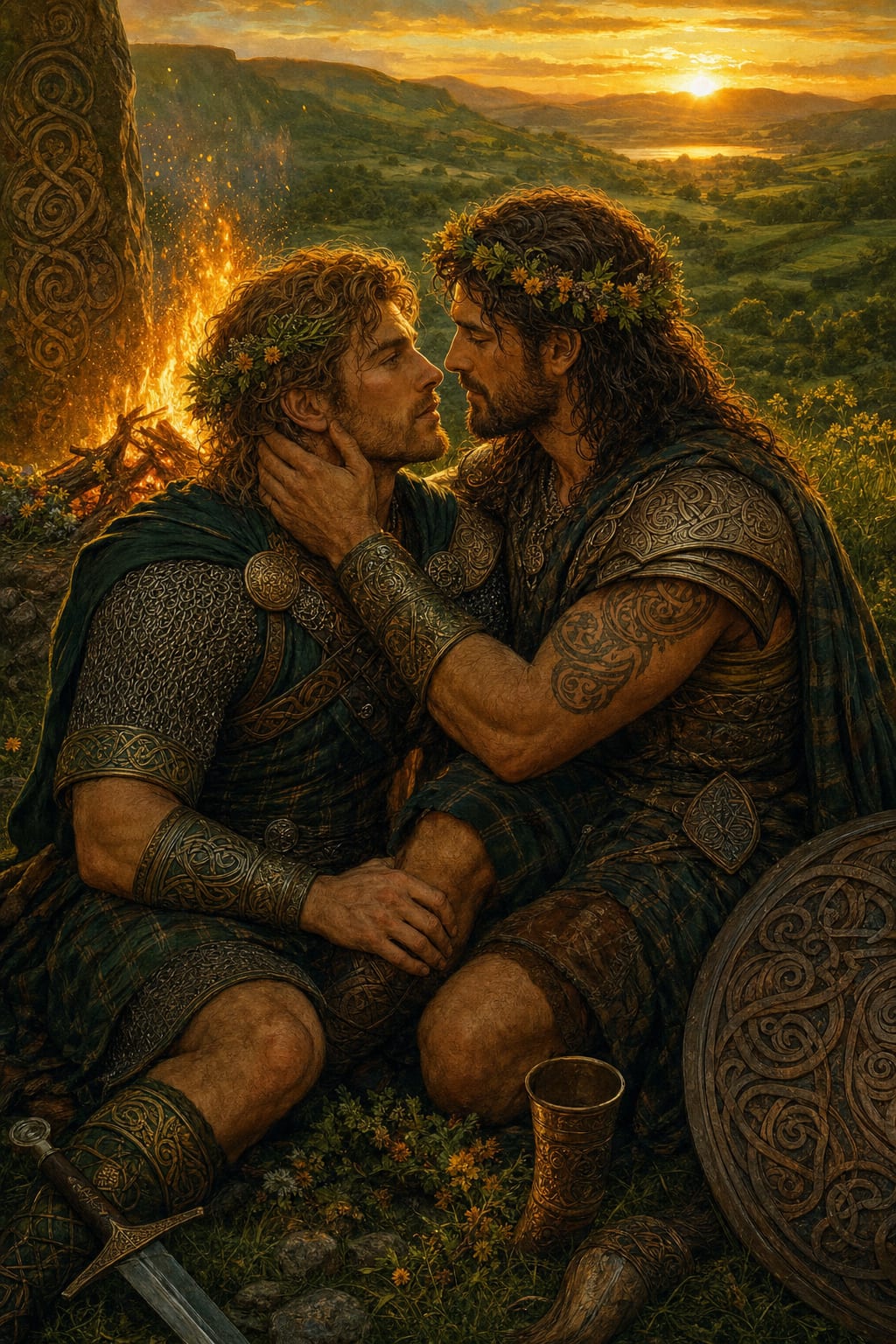
At the height of summer, when the light holds longest and the world turns its face most fully toward warmth, it seems right to talk about love. Not the careful, qualified kind — not the love that requires footnotes and caveats about what we can and cannot know about the past. The direct kind. The kind that Celtic literature, particularly in the Irish tradition, has always been willing to name: the love between two people who know each other entirely, who have been made by the same fires, who would rather die than face a world the other is not in.
Litha — the summer solstice, the midsummer celebration that stands at the heart of the Wheel of the Year — is a festival of fullness. The sun is at its highest. The light is at its most abundant. In Celtic tradition, this was a time of great bonfires, of honoring the land in its moment of most generous flowering, of celebrating everything that has come into bloom. It is, above all, a time for love in its largest definition.
And Celtic tradition, when it comes to love, was never as narrow as the world that later tried to contain it.
The Anam Cara: A Love Without Conditions
In the old Gaelic tradition, the concept of the anam cara — the soul friend — describes a bond that transcends the categories the social world usually imposes on relationships. Anam is the Gaelic word for soul; cara for friend. But the anam cara relationship was never simply friendship in the diminished, polite modern sense. As John O'Donohue articulated so beautifully in his exploration of this ancient concept, the anam cara is the person before whom "the superficial and functional lies and half-truths of social acquaintance fall away" — the person with whom you can be exactly as you are, without mask or pretension or performance.
What O'Donohue recovered, and what the older tradition already contained, is the understanding that the deepest form of love is the one in which you are fully witnessed. The soul friend sees you not as the role you play in society, not as the body you inhabit, not as the name the world calls you — but as the self underneath all of that. In a tradition where the soul was understood to travel through many lifetimes and many forms, this kind of recognition carried enormous weight. To be known at the soul level was to be known across time.
The anam cara relationship in early Irish monastic tradition was not categorized by gender. Monks had soul friends who were women. Women had soul friends who were men. The bond was defined not by the bodies involved but by the quality of the seeing. The tradition was not naive about this — it did not pretend that such depth was common or easy. But it held it up as an ideal, as the highest form of human connection, and it named it without shame.
Cú Chulainn and Ferdiad: A Love the Text Cannot Contain
The Ulster Cycle of Irish mythology is full of battles, cattle raids, and the thunderous clash of heroes. The Táin Bó Cúailnge — the Cattle Raid of Cooley — is its central epic, and it is there that we find the passage which, once read, cannot be unfound: the encounter at the Ford between Cú Chulainn and his beloved Ferdiad.
They trained together. This is the foundation of everything. Both men studied under Scáthach, the warrior-woman of Alba, the greatest teacher of martial arts in the mythological world. In the tradition's logic, this matters: they were made by the same hands, shaped by the same discipline, tested by the same ordeals. The Táin describes their bond in language that goes beyond camaraderie. They shared the same skills, the same techniques, the same formation. They were each other's mirror.
When Queen Medb of Connacht needs someone who can face Cú Chulainn in single combat — after her champions have fallen one by one — she sends for Ferdiad. He refuses, repeatedly. He knows what it would mean to cross the ford to fight his companion. She manipulates him into it through promises, through shame, through the suggestion that Cú Chulainn has spoken ill of him. And when Ferdiad finally comes, Cú Chulainn's reaction is not battle-readiness. It is grief.
"When we were together with Scáthach," Cú Chulainn says across the water, "you were my heart companion, you were my people, you were my family." He begs Ferdiad not to do this. Ferdiad, committed now by his word of honor, cannot turn back. They fight for four days, healing each other's wounds through the night, sharing food and drink across the ford, sleeping in a grief that the text describes as mutual and total.
When Cú Chulainn finally kills Ferdiad with the Gáe Bulg, he cradles his body across the water. His lament is among the most beautiful passages in all of Irish literature: "It was not right, you to fall by my hand. It was not a friendly ending." He describes looking at Ferdiad's body — red and pale in death — and says that every battle he has fought was "play and pleasure" compared to this combat with the one he loved.
Whether the tradition would have used the word we use — whether it would have named this as romantic love — matters less than what is actually on the page. What is on the page is a man who considers the loss of another man the greatest sorrow of his life. A man who cannot face what his hands have done. A man who holds the body of his companion and weeps in language that has no other word for it but love.
The Fénnid: A Chosen Family Beyond Kinship
The warrior tradition in Celtic Ireland also produced, in the institution of the fénnid and the Fianna, something that speaks directly to the queer experience of chosen family. The fénnidi were outlaw warriors — men (and sometimes women) who stood outside the normal bonds of kinship and clan, living outside the boundaries of settled society, bound instead to each other. The Fianna, the great warrior band of Fionn Mac Cumhaill, was such a group: a community defined not by birth but by choice, by the willingness to pass the same tests, to live by the same code, to protect and answer for each other.
This is chosen family in its oldest form. Not the family you were born into, but the one you earned. Not the bonds the world assigned you, but the ones you made through trial, loyalty, and love. For those who have been pushed to the margins of their birth families, who have built their real families from friends and fellow travelers rather than blood relations, this structure resonates with particular force.
The Fianna lived in the liminal spaces — in the forests, on the edges of kingdoms, beyond the jurisdiction of ordinary law. They were outside the social order, and they were magnificent. They were not lesser for their outsider status; in the mythology, they were often the most free.
Midsummer and the Love That Does Not Need Permission
Litha asks us to stand in the fullness of who we are. The bonfires burn at their highest. The sun does not apologize for its brightness. And in the spirit of the Celtic tradition — which always understood that the deepest love is not always the one society names, that the most sacred bonds are not always the ones the law records — this midsummer, we celebrate all of it.
The warriors who loved each other in language so tender it outlasted every empire that tried to normalize them. The soul friends who knew each other across every mask and every form. The chosen families who built kinship out of loyalty and fire. Celtic tradition always knew that love, in its truest form, refuses category. It was never afraid to say so.
About the Creator
The Celtic Spirit- A modern Guide to Celtic Belief and Practice
explaining Celtic mythology, druid practice, and reconstructions of paganism for modern readers
Enjoyed the story? Support the Creator.
Subscribe for free to receive all their stories in your feed. You could also become a paid subscriber, letting them know you appreciate their work.
Comments
There are no comments for this story
Be the first to respond and start the conversation.