
The Year Without A Summer: What Really Happened in 1816?
Summer in 1816?

# The Year Without a Summer – The Story of Mount Tambora
There was once a year in history that became known as **"The Year Without a Summer."** People around the world were shocked and confused as the warm season seemed to disappear. Farmers watched helplessly as their thriving crops were destroyed almost overnight. Rivers, springs, and lakes froze even during the months that were supposed to be warm. Strange darkness covered the sky during the daytime, and temperatures kept dropping unexpectedly.
People looked toward the heavens in fear, wondering what was happening. However, the real cause of this disaster was not in the sky. It was thousands of miles away on Earth, where a single event changed the climate of the entire planet.
In Indonesia lies the beautiful island of Sumbawa. On this island stood a massive mountain known as **Mount Tambora**. Rising approximately 4,300 meters high, it was one of the tallest peaks in the region. For centuries, it remained silent and peaceful. Nearby communities lived normal lives, farming, fishing, and raising families.
What they did not know was that beneath the mountain, a massive reservoir of magma was building up tremendous pressure. Then came **April 10, 1815**, the day Mount Tambora unleashed one of the most powerful volcanic eruptions in recorded human history.
The explosion was so powerful that it was heard thousands of miles away. People living over 2,600 kilometers from the volcano heard the thunderous blast. In some areas, British military officers believed a naval battle had begun and prepared their cannons for combat.
The sky turned black, and ash, burning rocks, and fire rained from above. Superheated clouds of gas and volcanic material, known as **pyroclastic flows**, rushed down the mountain at incredible speeds and temperatures exceeding 1,000°C. Entire villages and the Kingdom of Tambora were wiped out within moments.
The eruption also triggered massive tsunamis that devastated coastal settlements. When the smoke finally cleared, people discovered that the summit of Mount Tambora had disappeared. In its place was a gigantic crater, known as a **caldera**, measuring about 6 kilometers wide and 1 kilometer deep.
Most people assume lava is the most destructive part of a volcanic eruption. In the case of Mount Tambora, however, the real danger came from the gases released into the atmosphere.
The eruption blasted enormous amounts of ash, smoke, and millions of tons of sulfur dioxide into the **stratosphere**, the upper layer of Earth's atmosphere. These particles spread around the globe, especially across the Northern Hemisphere.
In the stratosphere, sulfur dioxide reacted with water vapor and formed sulfate aerosols. These microscopic particles acted like tiny mirrors, reflecting sunlight back into space. As a result, less solar energy reached Earth's surface, causing global temperatures to drop significantly.
The consequences became fully visible in **1816**, which became famous as **The Year Without a Summer**.
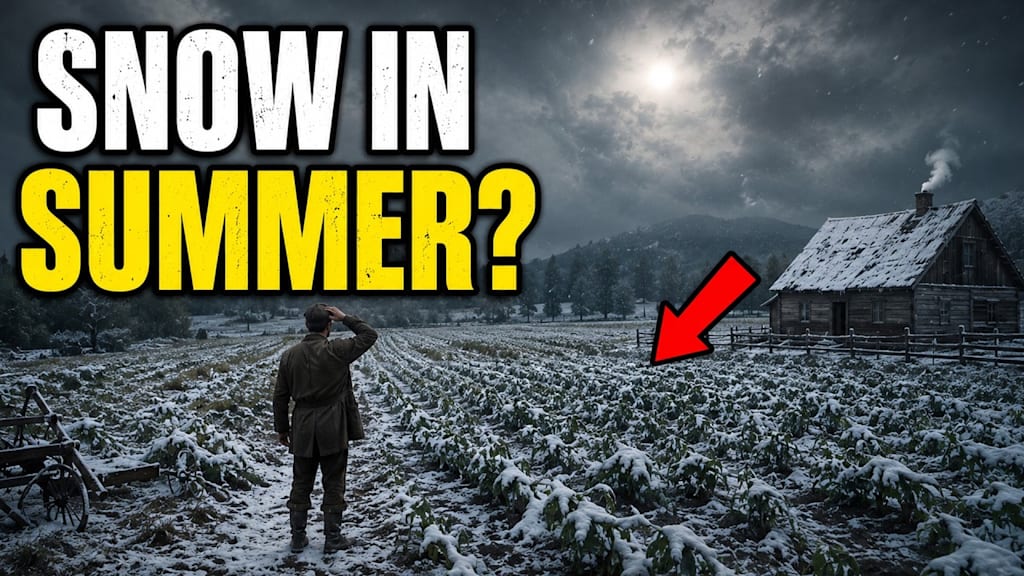
During months that should have been warm, unusual cold gripped much of the world. In New England, Canada, and parts of the northern United States, snow fell during July. Temperatures dropped below freezing even in midsummer.
Farmers were devastated. Every time they planted crops, unexpected frosts and snowfall destroyed them. Birds fell from the sky due to cold weather and lack of food. Across Europe, thick fog and persistent cold weather caused crop failures, famine, and disease.
As food production collapsed, prices skyrocketed. Grain, rice, and flour became too expensive for many people to afford. Riots and looting broke out across Europe and North America as desperate populations fought for survival.
The most remarkable aspect of this disaster was that people had no idea what was causing it. There was no internet, television, telegraph, or rapid communication system. While people could see the strange weather around them, they had no way of knowing that a volcano thousands of miles away in Indonesia was responsible.
Many believed the world was ending. Some thought the Sun had permanently lost its power. Others viewed the catastrophe as divine punishment.
The science behind the event is straightforward. The sulfur dioxide released by Tambora formed sulfate aerosols high in the atmosphere. These aerosols reflected sunlight away from Earth, reducing the amount of heat reaching the surface. It was as if a giant invisible blanket had been placed around the planet, blocking the Sun's warmth.
Eventually, gravity caused these particles to settle back to Earth. By 1817, the climate began showing signs of improvement. By 1818 and 1819, sunlight had largely returned to normal levels, and crops started growing again. Scientists estimate that by around **1820**, global temperatures had fully recovered.
Although this event occurred more than 200 years ago, it raises an important question: could it happen again?
If a similar eruption occurred today, the consequences could be even more severe. Volcanic ash is extremely dangerous for aircraft engines. A famous example occurred when **British Airways Flight 009** flew through a volcanic ash cloud near Jakarta, causing all four engines to fail temporarily.
A modern Tambora-scale eruption could ground flights worldwide, disrupt global trade, crash financial markets, and trigger food shortages. Social media could further amplify panic and misinformation.
Despite our advanced technology, humanity remains vulnerable to the immense forces of nature.
What makes this especially concerning is that Mount Tambora is not extinct. It is still classified as an active stratovolcano. Its last recorded eruption occurred in 1967, and recent seismic activity suggests that the volcano is not completely dormant.
No one knows when pressure beneath the mountain might build again to dangerous levels. If such an eruption occurs in the future, humanity could once again experience another "Year Without a Summer"—or perhaps something even worse.
Because no matter how advanced human civilization becomes, nature always follows its own timetable, makes its own decisions, and reminds us that some forces remain beyond our control.
About the Creator
Imran Ali Shah
🌍 Vical Midea | Imran
🎥 Turning ideas into viral content
✨ Watch • Share • Enjoy
Enjoyed the story? Support the Creator.
Subscribe for free to receive all their stories in your feed.
Comments
There are no comments for this story
Be the first to respond and start the conversation.