
The Whispering Landscape: The Dark Animism of Japan’s Shinto Gods
Eight Million Shadows: The unsettling reality of living among unseen deities.

1. Eight Million Shadows
In Western mythology, gods often reside in a distant, majestic heaven. But in Japan, divinity is uncomfortably close. The traditional term is Yaoyorozu no Kami—literally, "The Eight Million Gods."
They do not live above us; they live with us. A god resides in the ancient, twisted cedar tree behind the shrine, in the sudden freezing fog that rolls off the mountain, and even in the rusty needle abandoned at the bottom of a sewing box. This is not a comforting, pastoral animism. It is a world where human beings are never truly alone, and where the boundary between the sacred and the terrifying is as thin as a single sheet of shoji paper.
2. The Duality of Kami: Nigimitama and Aramitama
To understand the Japanese gods, one must understand their psychology. A Kami is not inherently good or evil. Instead, every deity possesses two distinct souls:
Nigimitama (The Gentle Soul): When properly honored through silence and meticulous rituals, the god brings fertile crops, clean mountain water, and protection.
Aramitama (The Rough Soul): If ignored, polluted, or disrespected, that exact same god transforms into a force of pure destruction. A river god becomes a sweeping flood; a forest spirit becomes a localized madness that swallows travelers whole.
The ancient Japanese did not worship gods because they loved them; they worshiped them out of a deep, structural dread of what happens when the balance shatters.
3. Inari: The Fox and the Ledger
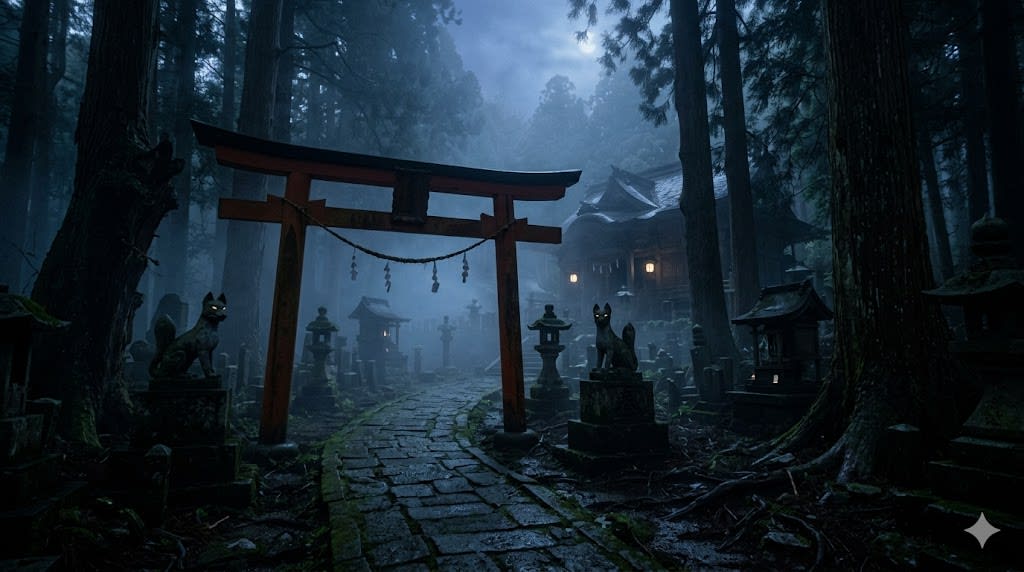
Walk into any Japanese village or modern neon alleyway, and you will eventually encounter a pair of stone foxes guarding a row of vibrant red Torii gates. This is the domain of Inari, the deity of rice, agriculture, and modern commerce.
While popular culture views the fox (Kitsune) messengers as cute protectors, older folklore paints a much more unsettling picture. Inari’s foxes are creatures of absolute geometric order and sharp instinct. In the misty twilights of rural Japan, these stone statues are said to watch the villagers with cold, unblinking eyes. If a businessman breaks a vow made to Inari, the fortune reversed isn’t just financial ruin—it is the sudden, erratic possession by a fox spirit (Kitsunetsuki), a psychological unraveling where the victim begins to bark, refuse human food, and starve in empty rooms.
4. Kojin: The God of the Fireplace and the Kitchen
While grand shrines are built for storm gods, the most dangerous deity might be the one sitting inside the house. Kojin is the god of the hearth, the kitchen fire, and the domestic space.
Kojin represents the fierce control of a dangerous element. He is the master of the flame that cooks your rice, but also the flame that can burn your entire wooden household to ash in a matter of minutes. Because of this, the kitchen in an old Japanese home was treated with the discipline of a sacred ritual. To leave a knife dirty, to spill ash on the floor, or to argue loudly near the stove was an insult to Kojin. He is a reminder that even within the safest domestic structures, a volatile, ancient force is constantly listening from the shadows.
5. Conclusion: Walking the Borderline
The true horror and beauty of Shinto animism lie in its absolute lack of compromise. The landscape is alive, watching, and weighing your intent.
When you walk down an empty mountain road in Japan and feel a sudden, inexplicable drop in temperature, it isn't just weather. It is a passing presence. In the world of the Eight Million Gods, humans are merely temporary guests in a world made of steel, stone, and ancient memories. To survive, one must learn to read the invisible signs, respect the boundaries, and never, ever step off the path after the sun goes down.
About the Creator
Takashi Nagaya
I want everyone to know about Japanese culture, history, food, anime, manga, etc.
Enjoyed the story? Support the Creator.
Subscribe for free to receive all their stories in your feed.
Comments
There are no comments for this story
Be the first to respond and start the conversation.