
The Vanished Voices of Berlin's Book Burning
Uncovering the Hidden Resistance Against Nazi Censorship
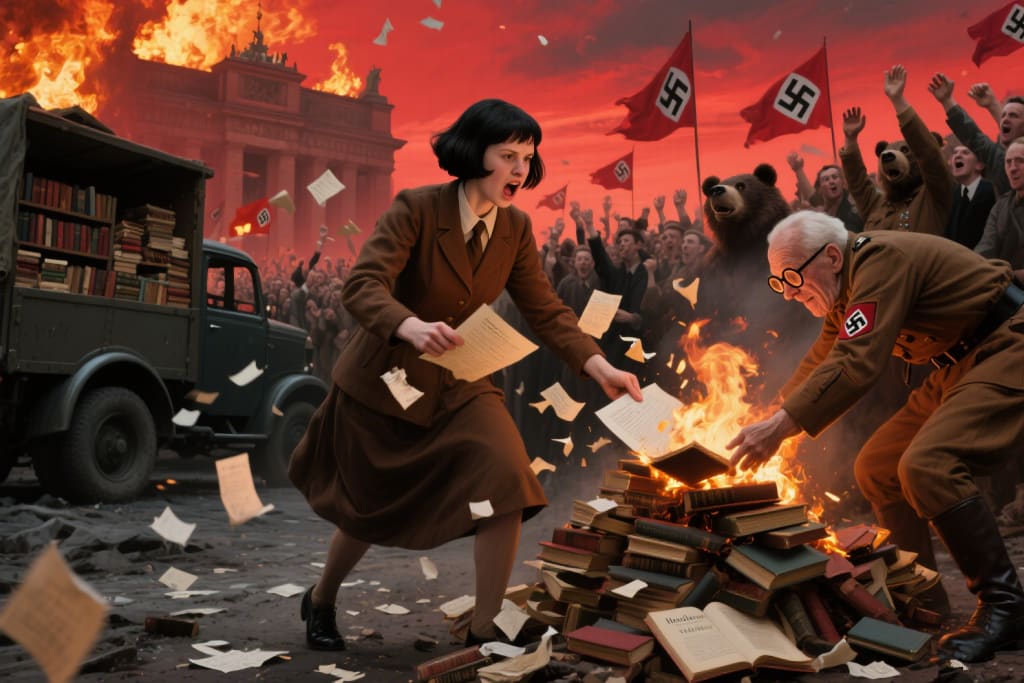
On the evening of May 10, 1933, as the clock struck eight, the first match was struck along Unter den Linden. Flames erupted like a venomous serpent, crawling up the carefully stacked towers of books and blotting out the Prussian blue sky. The crackling of burning paper mixed with the zealous chants of Nazi students, creating a macabre symphony that echoed through the streets of Berlin. As they hurled tens of thousands of books into the inferno, a sharp tear pierced the air, a sound that would have gone unnoticed amidst the chaos if not for its symbolic weight. Twenty-two-year-old Jewish librarian Irene Mendelssohn, her hands trembling with a mix of fear and determination, in a defiant act that went against every instinct for self-preservation, shredded her Nazi Party membership application into tiny pieces. This moment, buried for nearly nine decades under layers of historical narrative and political manipulation, now emerges like a charred manuscript yearning to be read, a testament to the courage of an ordinary individual in the face of tyranny.
For Irene, the application had initially seemed like a desperate lifeline in a rapidly changing and hostile world. Born into a family of booksellers, she had grown up surrounded by the smell of ink and the rustling of pages. Her love for literature and knowledge led her to become the youngest cataloger at the prestigious Berlin State Library, a position she had earned through years of hard work and dedication. But as the Nazi regime tightened its grip on Germany, she watched in horror as her world began to crumble. Colleagues, friends, and mentors, one by one, vanished without a trace, victims of political purges that swept through the cultural and intellectual institutions of the country.
The day the stormtroopers arrived at the library demanding a list of "un-German" books was etched into Irene's memory like a scar. She remembered standing behind the oak desk, her fingers nervously fidgeting with the hem of her skirt as she watched them scan the shelves with cold, calculating eyes. When they asked for the call numbers of works like All Quiet on the Western Front, a powerful anti-war novel that challenged the glorification of conflict, and The Interpretation of Dreams, a groundbreaking work of psychology, she felt a knot form in her stomach. She knew that providing the list would mean betraying the very essence of her profession, the preservation and dissemination of knowledge, but refusing would put her own life and the lives of those around her in danger.
In the days that followed, Irene watched in horror as the call numbers of these and other masterpieces materialized on the regime's blacklist. The night before the burning, she huddled in her small, sparsely furnished apartment, clutching the application form as if it were a talisman. Outside, the acrid stench of burning ink and sulfur wafted in through the open window, a chilling echo of the Jewish texts that had been destroyed in her father’s printing press years earlier. She thought about the words of her father, a man who had instilled in her a deep love for learning and a strong sense of justice. "Books are the keys to the past, the present, and the future," he had told her once. "They hold the power to shape minds and change the world." Now, those very books were being systematically destroyed, their ideas silenced by the flames.
Amid the cheering mob at the book burning, Irene stood on the outskirts, her eyes fixed on the inferno. She watched as the flames consumed the works of great thinkers like Zweig, Einstein, and Mann, their words reduced to ash and smoke. When an elderly man with round glasses, his face etched with lines of wisdom and experience, lunged forward to save a volume of Heine's poetry, only to be kicked to the ground by Brownshirts, something inside Irene snapped. The pen she had been holding dug deep into her palm, drawing blood, but she barely felt the pain. In that moment, she remembered the note from her dismissed director, a woman who had been a mentor and a friend. "A true librarian guards more than just books," she had written. "She guards the freedom of thought, the right to question, and the power of knowledge."
Irene's resistance began with subtle acts of defiance, small gestures that could easily be dismissed as insignificant but which held great meaning for her. Under the cover of night, when the library was empty and the only sound was the ticking of the clock, she would carefully remove banned books from the shelves and recatalog them, concealing them among religious texts and labeling them in Hebrew, a language that few of the Nazi officials could read. It was a risky move, one that could have cost her her job and her freedom, but she felt it was a necessary one. She knew that these books, with their ideas of equality, freedom, and human dignity, were too important to be lost.
But Irene's most audacious move came three months later. While sorting through a stack of incoming books, she discovered a disturbing truth: the remaining banned books were destined for Dachau, not as reading material for the prisoners, but as firewood to heat the camps. Horrified by this revelation, she began to hatch a plan. She spent days researching the transportation routes, studying the schedules of the trucks that carried the books, and identifying potential allies. And then, she met Helmut Scholz, a truck driver with a secret passion for poetry.
Helmut was a reluctant participant in the regime's book-burning campaign. He had been conscripted into the job, his love for literature at odds with the orders he was given. When Irene approached him with her plan, he was initially hesitant. But as she spoke, her eyes shining with determination and her voice filled with passion, he began to see the possibility of a different path. Together, they worked out the details of the operation, carefully planning every step to ensure its success.
On the night of the heist, Irene and Helmut met at a secluded warehouse on the outskirts of Berlin. The air was thick with tension as they waited for the truck to arrive. When it finally did, Helmut distracted the guards while Irene quickly loaded the books onto a waiting van. It was a race against time, but they managed to complete the operation without being detected. The books were then transported to an underground print shop in Leipzig, a hidden haven for those who dared to resist the regime.
In that damp basement, Irene formed the "Invisible Book Society" with a group of like-minded individuals, including left-wing intellectuals, Jewish scholars, and artists. They worked tirelessly, day and night, dissecting and reassembling forbidden texts, binding Tolstoy in Bible pages and wrapping Marx's works in hymnals. Irene’s ingenious code system—matching spine colors to the alphabet—transformed each book into a key to forbidden knowledge. It was a complex and time-consuming process, but they knew that the risk was worth it. They were not just preserving books; they were preserving the spirit of freedom and intellectual curiosity that the Nazis were trying so hard to extinguish.
The operation continued for several years, a hidden resistance movement operating in the shadows. But as the Nazi regime grew more powerful and more ruthless, the danger to Irene and her comrades increased. In 1938, on the night of Kristallnacht, the "Night of Broken Glass," when Nazi mobs attacked Jewish businesses, homes, and synagogues across Germany, Irene knew that their time was running out. Facing arrest and certain death, she made the difficult decision to sink the last cache of books into the Elbe River. Standing on the banks of the river, she watched as the floating pages, like white doves, carried fragments of unburned civilization into the unknown, a final act of defiance in the face of overwhelming darkness.
History textbooks often focus on the political symbolism of the book burnings, the grand gestures and the powerful speeches. They overlook the ordinary people, the unsung heroes like Irene Mendelssohn, who fought to preserve knowledge and freedom in the face of tyranny. Irene’s story lies buried in the Berlin State Library’s yellowed personnel files, marked "missing, presumed dead." But her legacy endures, not just in the altered call numbers and the coded book spines, but in the countless lives she touched and the ideas she helped to preserve.
When we consider the pages history tried to incinerate, we must look beyond the flames to the hands that shielded the sparks of truth. Irene and her comrades remind us that real history isn’t found in official narratives, but in the buried footnotes, the censored archives, and the acts of bravery that persist despite the threat of destruction. Their stories are a powerful reminder of the importance of standing up for what we believe in, even in the face of seemingly insurmountable odds. And as we look to the future, we can draw inspiration from their courage and their determination, knowing that the fight for knowledge, freedom, and justice is a never-ending one.
d the sparks of truth. Irene and her comrades remind us that real history isn’t found in official narratives, but in the buried footnotes, the censored archives, and the acts of bravery that persist despite the threat of destruction.
About the Creator
Enjoyed the story? Support the Creator.
Subscribe for free to receive all their stories in your feed.
Comments
There are no comments for this story
Be the first to respond and start the conversation.