
The Three Women Who Visit Every Cradle
The old European legend of the Fates, the youngest one who gets it wrong, and the gothic romance it inspired
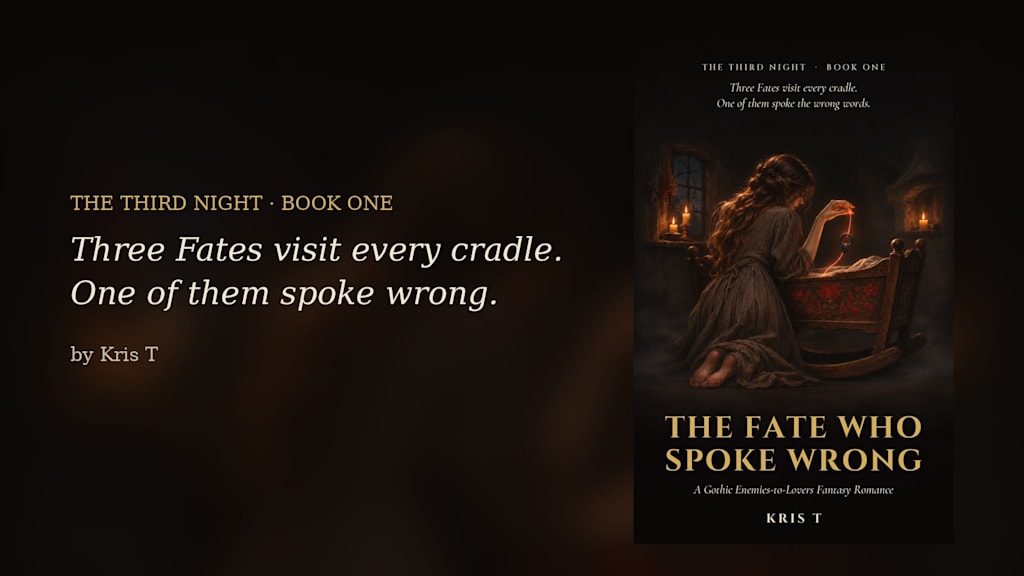
In old European villages there was a rule every new mother knew. On the third night after a baby was born, you left the door unlatched. You set bread, salt, honey and wine on the table. Then you went to sleep and did not look at the cradle, because three women were coming to decide how the child's life would go.
The custom survived for centuries, and it is older than any of the countries that keep it. When I started writing The Fate Who Spoke Wrong, I wanted to know where it came from. The answer is that almost every corner of Europe tells the same story with different names.
Three women at the cradle
The Greeks called them the Moirai. Clotho spins the thread of a life, Lachesis measures how long it will be, and Atropos cuts it. Hesiod was already writing about them around 700 BC. What is remarkable is that they never left. In Greek villages well into the twentieth century, people still prepared the house for the Moires on the third night after a birth, so that they would arrive in a good mood.
The Romans had the Parcae. The Slavs had the Rozhanitsy and Sudenitsy, the "birth-givers" and "judges" who stood over the cradle and pronounced. In Lithuania the goddess Laima decided a child's fate at birth. In Scandinavia it was the Norns, three women who sat beside the well under the world tree and laid down the lives of men.
The details change, but the shape is always the same: three women, a newborn, and words that cannot be taken back.
The youngest one is the dangerous one
The part of the legend that caught me was a small, repeated detail. In many versions, the trouble comes from the youngest of the three.
In the Old Norse Tale of Norna-Gest, three wise women come to a child's cradle. The first two give him good gifts. The youngest feels slighted, because nobody paid her enough attention, and she says the child will live only until the candle beside him burns down. The eldest snuffs the candle out and gives it to his mother to keep. He lives for three hundred years, until he lights it himself.
You know a later version of the same idea even if you have never read a saga. In "Sleeping Beauty", the fairies bless the princess one by one. The one who was not invited speaks a curse, and the youngest fairy can only soften it, not erase it.
Folklore keeps returning to one terrifying thought. Fate is not a law of nature. It is something a person says out loud, and people make mistakes.
What if she got it wrong?
That is the question my book starts with. Thirty years ago, the youngest Fate leaned over a blacksmith's son and said he would not see the end of his thirtieth winter. Her voice faltered while she said it. Nobody heard the falter except her.
Theodore has lived his whole life inside that sentence. Fathers turn him away at the gate. Nobody gives him work that will take longer than a season. And now, with twenty-eight days left, he does the one thing no mortal is supposed to do. He waits behind his sister's chimney with a ring of cold-forged iron and a hank of red wool, and he catches the Fate who spoke his death.
Iron and red wool are not my invention, by the way. Across European folklore, cold iron is what spirits cannot cross, and red thread is what you tie on a cradle or a cow's horn to keep evil away. If you wanted to hold a Fate, those are the tools the old stories would hand you.
A romance that argues with destiny
Mira, the youngest Fate, has spoken ten thousand futures and never chosen one of her own. Bound to Theodore, she is hungry, cold and tired for the first time in her existence, and she is in the company of the one man in the valley with every reason to hate her. She cannot unsay what she said. The longer she stays, the more she wants to try, and the more she suspects that her mistake was no accident.
That is the heart of the book: an enemies-to-lovers slow burn between a captor and his captive, set in a world of spirits, dry springs and restless dead, with a mystery whose answer does not arrive until the final chapters. It is a gothic folklore romance, low on spice and high on yearning, with a happy ending.
Why the Fates still work
I think the legend lasted because it says something true. Parents stand over a cradle and wonder what will happen to this child, and it helps to imagine someone who knows. The same story also lets us argue back. If fate is spoken, it can be misspoken, and something misspoken can be put right.
The next time you hear about a door left unlatched on the third night, think about the youngest Fate on her way to the cradle, trying to get the words right.
Kris T is the author of The Fate Who Spoke Wrong, Book 1 of the folklore romance series The Third Night.
About the Creator
Enjoyed the story? Support the Creator.
Subscribe for free to receive all their stories in your feed.
Comments
There are no comments for this story
Be the first to respond and start the conversation.