
The Ten Not-so Crucial Days?
The Impact of Trenton and Princeton on the American Revolution
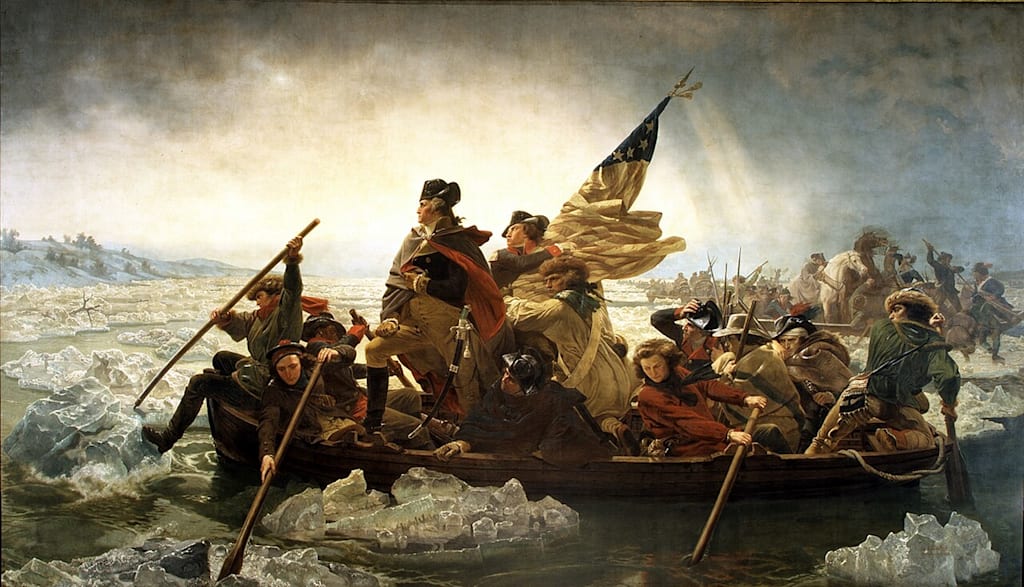
How crucial were the 10 days between Washington crossing the Delaware and the Battle of Princeton? David Hackett Fischer in his book, Washington's Crossing, compared the campaign to the Tet Offensive in Vietnam, shattering the morale of the British people. The crossing of the Delaware is celebrated in paintings like the one above by Emanuel Leutze and is reenacted every year at the site of the crossing.
I was born and raised in the Trenton area, so the idea of the importance of the battles was drilled into me at an early date, with trips to Washington Crossing and the Old Barracks in Trenton as well as driving past the Battle Monument, which marked the location of American artillery during the Battle.
But did the Battles of Trenton and Princeton really change the course of the war, or is their importance maybe a little less than what we've been led to believe?
At the time of the Battle of First Trenton, the British Army had gone into winter quarters - which means that it was not likely to undertake any major offensive into Pennsylvania until 1777. It's likely Washington could have held the west bank of the Delaware until the weather had changed and might have been able to retrain and reinforce his army closer to Philadelphia just as he was in Morristown.
It is true that the offensive did force the British to abandon large sections of New Jersey that they seized after the disaster in New York. However, by driving the British closer to New York City, did Washington make it easier to move their soldiers into transports for the Philadelphia campaign the following year? Howe may have had a much more difficult time moving his army from the Delaware to the Hudson - creating a possibility for a Monmouth-like scenario almost a year early.
And while the victories at Trenton and Princeton certainly came as a shock to British morale, surely the capture of Philadelphia the following year would have erased the memory of those battles. If these defeats would have affected the morale of the British as Fischer believed, then wouldn't capturing the enemy's capital been the equivalent of the United States capturing Hanoi in 1969?
And if they were not the great victories we've been taught they were, why do we remember them that way? As the nation began to create the "marble" image of George Washington as the great man, statemen and general writers looked to Trenton and Princeton - probably because Washington's resume was a little thin on victories. After all, throughout the war Washington was better at keeping the army in the field than defeating the British in battle. After the defeat in New York, outside of Trenton and Princeton, Washington doesn't come out with a clear win until Yorktown. Beaten badly at Brandywine and Germantown, and eking out a draw at Monmouth - there's not many other highlights.
It is likely that the Battles of Trenton and Princeton had an effect on both the Americans and the British the same way the Battle of First Bull Run had during the Civil War. It showed both sides that this would not be a short war. If the British thought the war would end in the Spring of 1777, Trenton and Princeton clearly disabused them of that idea. Instead, it would be a long, difficult war - one in which even in 1781 with the help from the French, Washington was not sure they were going to win.
About the Creator
Enjoyed the story? Support the Creator.
Subscribe for free to receive all their stories in your feed.
Comments
There are no comments for this story
Be the first to respond and start the conversation.