
The Secrets Beneath the Giza Plain
Do the Pyramids and Sphinx Conceal a Lost Library, Deep Chambers and Evidence of Atlantis?
Introduction
The pyramids of Giza have stood for approximately 4,500 years, but their size and precision still encourage questions that conventional explanations do not always satisfy. The Great Pyramid alone contains about 2.3 million stone blocks, including enormous granite beams transported from Aswan. Beside it stands the Sphinx, carved directly from the limestone bedrock and watching silently across the desert.
Egyptologists generally maintain that the pyramids were royal monuments built during the Fourth Dynasty. Archaeological context, workers’ settlements, quarry marks, and surviving papyri describing the transport of stone support that explanation. However, the accepted account does not prove that every passage, chamber and purpose has already been discovered. Modern scanning has demonstrated that substantial unknown spaces can remain concealed inside structures examined for centuries.
The Chambers We Already Know About
The Giza Plateau is not merely a flat surface carrying three pyramids. It contains tombs, shafts, natural fissures, quarried cavities, passages and chambers cut into the limestone. Some descend many metres below ground, showing the builders could create an extensive subterranean world.
Beneath the Great Pyramid lies an unfinished subterranean chamber reached through a descending passage. Nearby, the so-called Osiris Shaft extends through several underground levels and ends in a water-filled chamber containing a stone sarcophagus. Other shafts and tombs appear throughout the plateau, although their dates and purposes vary considerably.
Known openings and cavities also exist around the Sphinx. Some are natural fissures, while others appear to have been enlarged or entered during earlier investigations. Their existence does not automatically prove that a great library lies below the monument, but it shows why stories about hidden rooms cannot be dismissed merely because the ground appears solid.
Modern Scans Have Found Unknown Spaces
Scientific scanning has already changed what we know about the Great Pyramid. The ScanPyramids project used cosmic-ray muons to examine the monument without damaging it. In 2017, researchers announced a large previously unknown void above the Grand Gallery. A separate corridor behind the northern face was later examined with a tiny camera and shown to be a real constructed space.
Nobody yet knows the full purpose of these discoveries. They might be relieving spaces designed to reduce pressure, abandoned passages, construction features or entrances to areas still inaccessible. Whatever their explanation, they demonstrate something important: confident declarations that nothing remains to be found at Giza have repeatedly proved premature.
More dramatic claims appeared in 2025 and 2026, when researchers associated with the Khafre Project said satellite radar analysis revealed deep shafts, chambers, and immense structures beneath the Giza Plateau. Their computer images attracted worldwide attention, with some supporters describing an underground city.
Excavation has not confirmed these extraordinary interpretations, peer-reviewed research has not accepted them, and radar specialists have questioned whether the method could reveal structures at the claimed depths. The responsible conclusion is therefore neither immediate belief nor automatic ridicule, but independent testing followed by carefully controlled investigation.
The Legendary Hall of Records
The most famous supposed chamber is the Hall of Records, usually described as a hidden library containing the history and scientific knowledge of an earlier civilisation. The modern version of this story was largely popularised by the American clairvoyant Edgar Cayce, who claimed that survivors from Atlantis concealed records near the Sphinx.
Cayce predicted that the records would eventually be discovered, although no recognised excavation has found them. Surveys around the Sphinx have detected anomalies at different times, but an anomaly can represent a natural cavity, fractured limestone, moisture or disturbed ground. Only physical investigation can establish whether any particular feature is an artificial chamber.
The absence of a discovered library does not prove that no further chamber exists. However, it would be misleading to claim that the Hall of Records has already been located. At present, it remains a fascinating possibility supported by tradition and speculation rather than confirmed archaeological evidence.
Did Atlantians Help the Egyptians?
The theory of Atlantean involvement begins with the suggestion that an advanced civilisation existed before recorded Egyptian history. According to this idea, survivors of a catastrophe reached Egypt and passed their knowledge of astronomy, mathematics, stone working and sacred architecture to the people living beside the Nile. Egyptian civilisation then preserved and developed this inheritance, eventually producing the pyramids and other remarkable monuments.
Supporters point towards the precision of the Great Pyramid, its astronomical alignment and the difficulty of moving enormous stones with ancient equipment. They also cite Plato’s account of Atlantis and flood traditions found in many cultures. Some further argue that the weathering around the Sphinx could indicate a much earlier origin during a wetter climatic period.
These ideas are intriguing, but no object, inscription or human remains accepted by archaeologists have demonstrated the presence of Atlantians at Giza. The Egyptians also left substantial evidence of their own developing architectural ability, from mastaba tombs and early pyramids to the increasingly sophisticated monuments at Saqqara, Meidum and Dahshur. If Atlantians helped them, the evidence remains hidden or has not yet been correctly recognised.
Nevertheless, the possibility can be discussed as a hypothesis. Ancient people travelled, exchanged knowledge and absorbed ideas from neighbouring cultures. The stronger claim that refugees from Atlantis directed pyramid construction requires much stronger evidence, especially because Atlantis itself has never been conclusively located.
Zahi Hawass and the Accusations of Secrecy
Zahi Hawass, Egypt’s former antiquities minister and one of the most internationally recognised archaeologists, has exercised considerable influence over exploration at Giza. He has firmly rejected many alternative claims, including recent reports of a vast underground city. His critics say that he controls access too tightly, dismisses discoveries before independent examination and prevents information that challenges the accepted history from receiving proper attention.
It is understandable that some people suspect suppression when permits are refused or when detailed information is slow to appear. Egypt must protect irreplaceable monuments from damage, treasure hunting and poorly designed investigations, so access cannot be unrestricted. However, decisions should be transparent, scientific results should be published, and qualified independent teams should be allowed to examine important claims.
No publicly demonstrated proof shows that Hawass is deliberately concealing an Atlantean library or blocking the publication of information about Giza. That allegation should therefore not be presented as established fact. A fairer criticism is that the concentration of authority, together with emphatic public dismissals, has encouraged distrust and created the impression that one powerful figure can decide which possibilities deserve investigation.
What Should Happen Next?
The answer is not to drill recklessly beneath ancient monuments. The Giza Plateau should be examined through several independent, non-destructive techniques, including muon scanning, ground-penetrating radar, electrical resistivity, seismic surveys, and miniature robotic cameras. Results should be released with methods, limitations and raw data wherever security permits, allowing specialists from different countries to test the conclusions.
Any significant anomaly should be mapped before considering a carefully chosen entry point. Egyptian archaeologists must remain central to this work, but credible international experts should also participate. Openness would protect Egypt’s authority while reducing claims that inconvenient discoveries are being concealed.
Conclusion
The Giza Plateau unquestionably contains underground shafts, chambers and unexplained spaces. Modern scanning has shown that unknown structures can survive inside the pyramids, although it has not proven the existence of an underground city, an Atlantean library, or the legendary Hall of Records.
The traditional Egyptian achievement remains extraordinary without Atlantean assistance. However, history advances because people continue asking difficult questions and testing accepted explanations. If a deeper civilisation contributed knowledge to ancient Egypt, only physical evidence can establish it.
Zahi Hawass may be right to reject some sensational claims, but rejection should never replace investigation. Giza belongs to Egypt, although its history matters to the entire world. The secrets beneath the plateau should be protected, examined and published, because genuine archaeology has nothing to fear from reliable evidence.
Editor’s Note
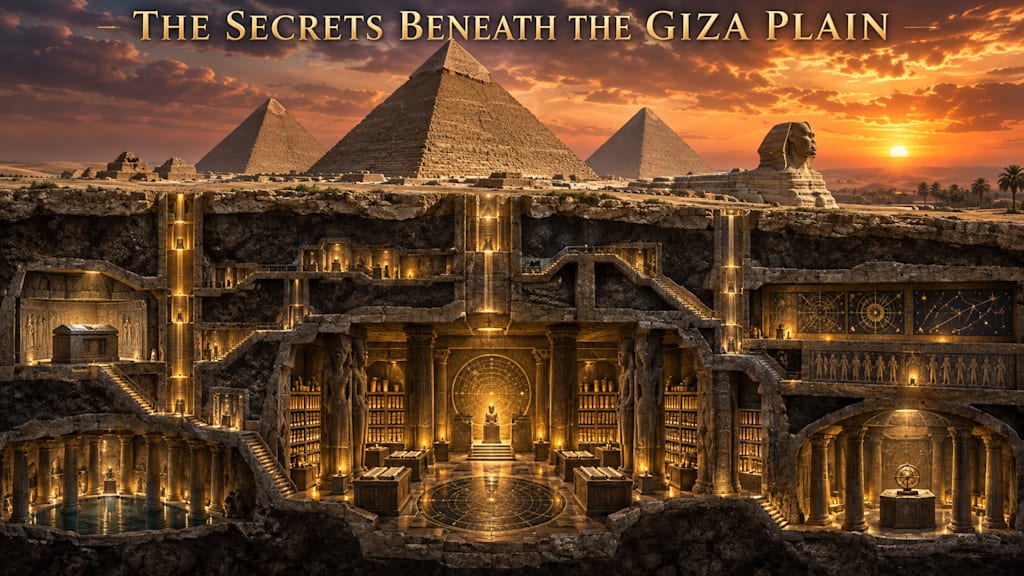
I used ChatGPT to help locate, organise, and examine information relating to the subject. I also used ChatGPT to create the accompanying image.
I wrote the final article in my own words, using the research gathered with ChatGPT's assistance, along with my own interpretation, selection, and presentation of the material. The finished article therefore represents my own work and editorial judgement, with ChatGPT used as a research and image-generation tool.
About the Creator
Alan Spencer
Have been an author and writer for over 20 years. Have been a journalist, editor, proofreader, and a designer and presenter of training courses. Have written over 100 articles, two books, and around 20 training courses.
Enjoyed the story? Support the Creator.
Subscribe for free to receive all their stories in your feed. You could also become a paid subscriber, letting them know you appreciate their work.
Comments
There are no comments for this story
Be the first to respond and start the conversation.