
“The Secret Society That Shaped the Modern World”
How Quiet Networks Have Influenced History More Than You Think

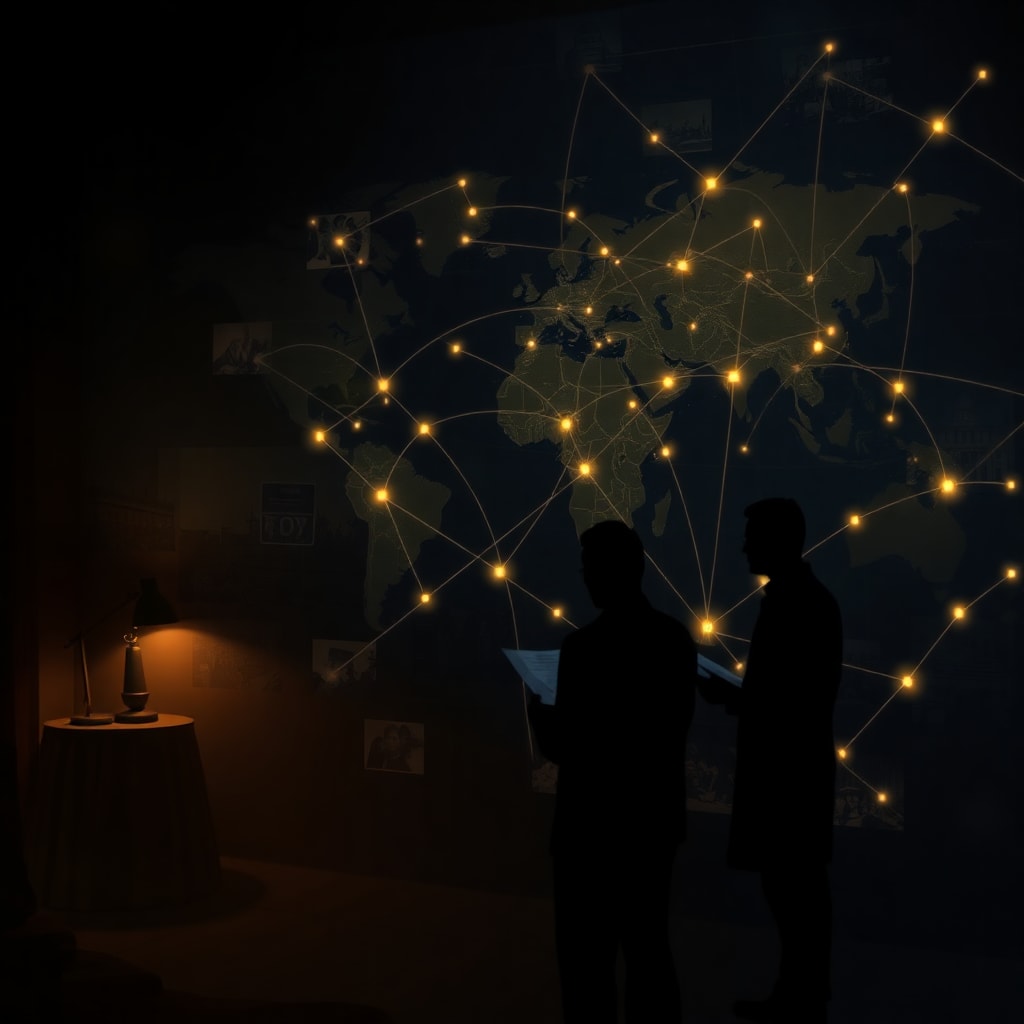
In history books, we often remember the loud moments.
Wars. Revolutions. Elections. Speeches that shook crowds. Leaders standing on stages while thousands cheered.
But beneath all of that noise, there has always been something else shaping the world—something far less visible.
Quiet networks.
Not armies. Not governments. Not headlines.
But people connected through trust, information, and shared purpose—working in silence while the world watched something else.
This is the story of how those quiet networks have shaped history more than most people ever realize.
---
### The Librarian Who Wasn’t “Just a Librarian”
In 1943, during World War II, a woman named Clara worked in a small library in neutral territory. To anyone watching, she was ordinary—organizing books, helping readers, stamping returns.
But Clara was part of a quiet network.
Books entering her library were not just books. They were messages. Some contained hidden notes in margins. Some had coded references. Some were passed from hand to hand with silent understanding.
Clara didn’t lead anything. She didn’t give speeches. She didn’t fight.
But she connected information.
And in war, information can be more powerful than weapons.
Through her network, resistance groups across borders shared intelligence—troop movements, supply shortages, escape routes. Nothing loud. Nothing public.
Just small, careful exchanges.
Historians later discovered that entire evacuation operations depended on networks like hers—chains of librarians, teachers, and postal workers who never appeared in official records.
They didn’t change history through force.
They changed it through connection.
---
### The Merchants Who Moved More Than Goods
Centuries earlier, along ancient trade routes like the Silk Road, merchants were more than sellers of silk and spices.
They were messengers.
A trader moving from city to city didn’t just carry goods—he carried stories, technologies, and ideas.
One merchant might casually mention a new farming method in one town. Another would repeat it hundreds of miles away. A small observation about water systems in Persia might quietly reshape agriculture in China over generations.
No government coordinated this exchange.
No central authority directed it.
It happened through trust.
Through repeated contact.
Through quiet networks of people whose main goal was trade—but whose unintended impact was the spread of knowledge across continents.
Civilizations didn’t evolve in isolation.
They evolved through invisible conversations happening in marketplaces, caravans, and inns.
---
### The Printing Revolution That Wasn’t Just Printing
When the printing press spread across Europe, history often credits it with mass communication and the rise of modern education.
But what is less talked about is how knowledge actually spread in the beginning.
Books were expensive. Literacy was limited. Governments often controlled what was printed.
So how did ideas spread so fast?
Through quiet networks.
Students, monks, and traveling scholars carried texts between universities. A single handwritten copy of a controversial idea could pass through dozens of hands before it was ever officially published.
Coffeehouses became informal information hubs. People gathered not just for drinks, but for ideas.
Letters were copied and passed on quietly. Discussions in small rooms influenced thinkers who would later publish world-changing theories.
Revolutions in thought didn’t start in public squares.
They started in private exchanges.
---
### The Scientists Who Shared in Secret
In the early days of modern science, sharing discoveries was risky.
Ideas could be stolen. Careers could be ruined. Governments sometimes restricted research.
So scientists formed quiet networks.
They wrote letters using careful language. They shared drafts with trusted peers. They encoded ideas in ways only insiders would understand.
One scientist in England might test a theory and send results to a colleague in France. That colleague would refine it and pass it to someone in Germany.
No single person owned the discovery.
It was built collectively, piece by piece, across invisible lines.
Even Isaac Newton famously said, “If I have seen further, it is by standing on the shoulders of giants.”
Those giants were not always visible institutions.
They were often quiet collaborators.
---
### The Modern Version: Invisible Digital Networks
Fast forward to today.
Quiet networks still exist—but they look different.
They are no longer only letters or caravans.
They are digital.
A small group chat where someone shares a job opportunity.
A niche online community where freelancers exchange strategies.
A private forum where developers solve problems together.
Most of these networks are invisible to the public.
They don’t appear in headlines.
They don’t trend on social media.
But they shape careers, businesses, and even industries.
A startup might fail publicly—but inside a quiet founder network, lessons are shared that help ten other startups succeed.
A freelancer might learn a new skill not from a university, but from a stranger halfway across the world in an online group.
The structure is the same as it was centuries ago.
Just faster.
And more global.
---
### Why Quiet Networks Matter More Than We Realize
History often focuses on visible power:
* Governments
* Leaders
* Corporations
* Wars
But quiet networks operate differently.
They are:
* Decentralized
* Trust-based
* Informal
* Often invisible
And because of that, they are incredibly resilient.
When one path breaks, another continues.
When one person disappears, knowledge still spreads.
When one system fails, another quietly replaces it.
They don’t depend on recognition.
They depend on connection.
---
### The Pattern Behind Everything
If you look closely, almost every major shift in history contains both layers:
The loud event—and the quiet network behind it.
A revolution has leaders—but also messengers.
A scientific breakthrough has a name—but also collaborators.
A technological boom has companies—but also communities sharing knowledge long before it becomes mainstream.
The loud part gets remembered.
The quiet part makes it happen.
---
### A Modern Reflection
Today, someone sitting in a small room with a laptop might be part of a network shaping something far bigger than they realize.
They might be:
* Sharing knowledge
* Teaching skills
* Building connections
* Solving problems together
None of it may feel “historic” in the moment.
But neither did the librarian.
Neither did the merchant.
Neither did the letter-writing scientist.
History is often not created by isolated moments of brilliance.
It is built through countless small exchanges between people who never realize the scale of what they are contributing to.
---
### Final Thought
We tend to imagine history as something loud.
But much of it is quiet.
Not written in headlines—but in conversations.
Not shaped only by leaders—but by networks of ordinary people doing small things consistently and together.
Quiet networks don’t demand attention.
They don’t need recognition.
But over time, they shape the flow of ideas, power, and progress more than most visible forces ever could.
And maybe the most important truth is this:
You are already part of one.
The only question is—
About the Creator
Enjoyed the story? Support the Creator.
Subscribe for free to receive all their stories in your feed.
Comments
There are no comments for this story
Be the first to respond and start the conversation.