
The Phantom Host
Sluagh of the Western Winds

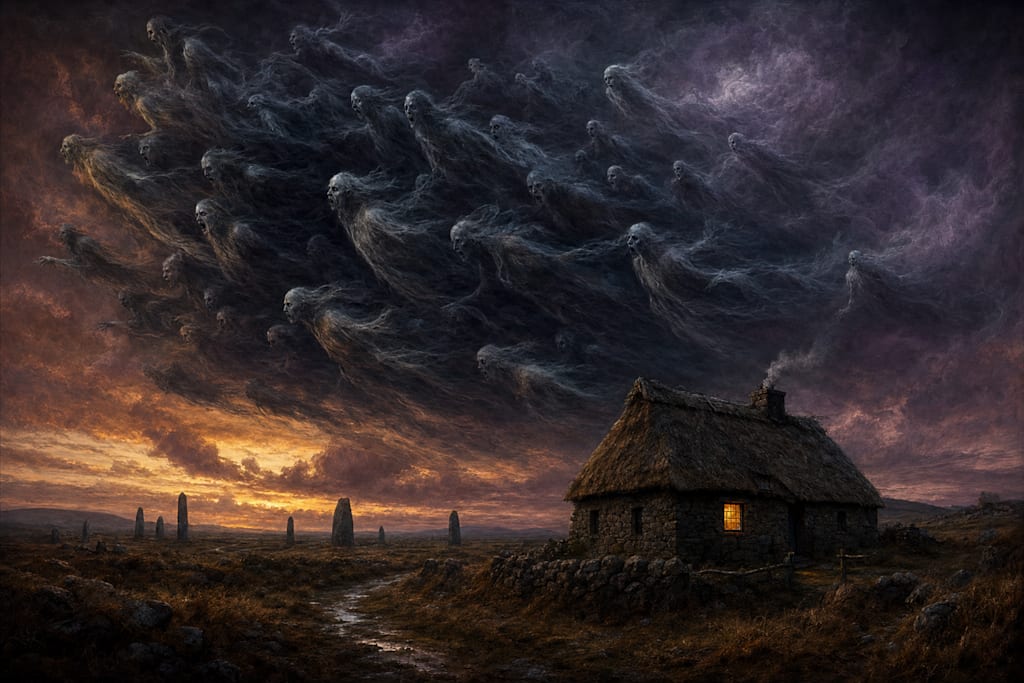
In Gaelic folklore, few supernatural beings are as unsettling as the Sluagh. Their name is often translated simply as “the host” or “the multitude,” but in story they are no ordinary gathering. They are commonly described as a restless company of the dead, moving through the air in dark swarms and traveling on the wind. Their presence is associated with danger, death, and the uneasy spaces between worlds. They are often linked most strongly with Samhain and the dark half of the year, when the boundaries between the living and the dead are thought to grow thin. Yet folklore does not always keep them there. A sudden gust on a bright evening, an unexplained chill in summer air, or a strange movement of birds across the sky could also stir old fears. Even in the bright half of the year, the west wind might carry more than weather.
Hosts on the western wind
The Sluagh are often imagined as a flying host, shadowy and fast-moving, sweeping across the sky like a dark flock. In some traditions they are said to be the souls of the unforgiven dead, or spirits unable to find rest, condemned to wander together through the air. This gives them a special terror. They do not belong peacefully in a grave, nor do they seem fully at home in the Otherworld. They are beings of motion, of passing, of unrest.
One of the most feared things about the Sluagh is their reputation for carrying souls away. In folklore, they are not only a sign that death is near, but sometimes the very force that takes the dying with them. This is why they are so often connected with weakened people, the sick, or those close to death. They are not a local fairy presence tied to one hill or mound. They are a moving danger, a company of spirits that may pass over any place the wind can reach.
Their connection to the west is especially important. In Celtic thought, the west is often associated with endings, sunset, the sea, and the lands beyond ordinary life. To say the Sluagh come on the western wind is to say they arrive from the direction of death, decline, and the unseen. They are not only carried by weather. They are carried by meaning.
Thresholds, windows, and open doors
Because the Sluagh travel through air and openings, the household itself could become vulnerable. In Scottish and Irish folk belief, one of the protections most often mentioned was the closing of west-facing windows. To leave such an opening exposed was thought to risk letting the Sluagh enter. The house, then, was not simply a shelter from cold or storm. It was a defended space, one whose openings had to be watched.
This reflects a larger pattern in Gaelic folklore: thresholds matter. Doors, windows, hearths, and beds are never merely practical objects. They are places where one condition touches another — inside and outside, safe and unsafe, human and supernatural. A westward opening was especially dangerous because it aligned the household with the direction of the host’s approach.
That fear says something important about the older worldview. The supernatural did not always break in by force. Often it entered through what had already been left open. A gust through a window, a door standing unguarded, a family inattentive to the vulnerable — these became more than accidents. They became points of weakness in the barrier between worlds.
Protecting the sick and the young
The Sluagh were especially feared around the sick, the dying, and the very young. These are all states of vulnerability. A child has not yet become fully settled into the social world. The dying stand already close to leaving it. The sick move uncertainly between strength and weakness. In folklore, this made them especially open to supernatural harm or interference.
Protective practices therefore centered on keeping such people from being exposed. A person near death might be watched carefully so they were not left alone. Windows might be shut against the western wind. Family members might remain close, offering prayer, spoken blessing, or silent presence. Beds could be positioned carefully, and in some traditions protective words or charms might be used to guard the room.
Whether taken literally or symbolically, these customs reveal an important truth about folk belief: danger was answered by community. The protection of the vulnerable was not merely magical. It was social. People stayed with the sick. They kept vigil over the dying. They protected children by not leaving them unattended in spiritually dangerous times or places. Folklore expressed these concerns in supernatural language, but underneath it lay a very human instinct: keep the fragile close, and do not leave them alone with the dark.
Winds, spirits, and the summer sky
It is easy to imagine the Sluagh only in autumn darkness, but that misses something important. Summer has its own uneasy moments. Storm clouds can gather suddenly in brilliant weather. A warm evening can turn cold without warning. Birds may wheel oddly in the sky, or a strong wind may move across the land with no clear source. These moments feel uncanny precisely because they interrupt the expected safety of the season.
That is why the Sluagh can matter even in the bright half of the year. Summer is not free from death, fear, or spiritual unease. It simply hides them better. The bright evening still contains shadows. The open window still invites what rides the wind. The healthy season still includes sickness, loss, and sudden endings.
In this sense, the Sluagh become more than a tale of ghostly terror. They are a reminder that the world is never only one thing. The same season that gives warmth and growth can carry storm and dread. The same sky that glows with late light can darken with a moving host. Gaelic folklore does not divide the year into simple halves of good and evil. It knows that even the bright season must guard its thresholds.
The host that does not rest
The Sluagh endure in memory because they speak to one of the oldest human fears: that death is not always still, and that the boundaries of the living world are never entirely secure. They are not comforting spirits of ancestors, nor local fairy neighbors who bargain with milk and courtesy. They are motion without rest, a host driven by wind and distance, always near the edges of life.
In the end, the Sluagh remind us that folklore often gives shape to what weather alone cannot explain. A strange flock, a sudden gust, a chill through an open window, a fear at the bedside of the sick — these become part of a larger story about the dead and the living sharing one world more closely than either side would wish. Even in summer, under a bright western sky, the old tradition remembers: not every wind comes empty.
About the Creator
The Celtic Spirit- A modern Guide to Celtic Belief and Practice
explaining Celtic mythology, druid practice, and reconstructions of paganism for modern readers
Enjoyed the story? Support the Creator.
Subscribe for free to receive all their stories in your feed. You could also become a paid subscriber, letting them know you appreciate their work.
Comments
There are no comments for this story
Be the first to respond and start the conversation.