

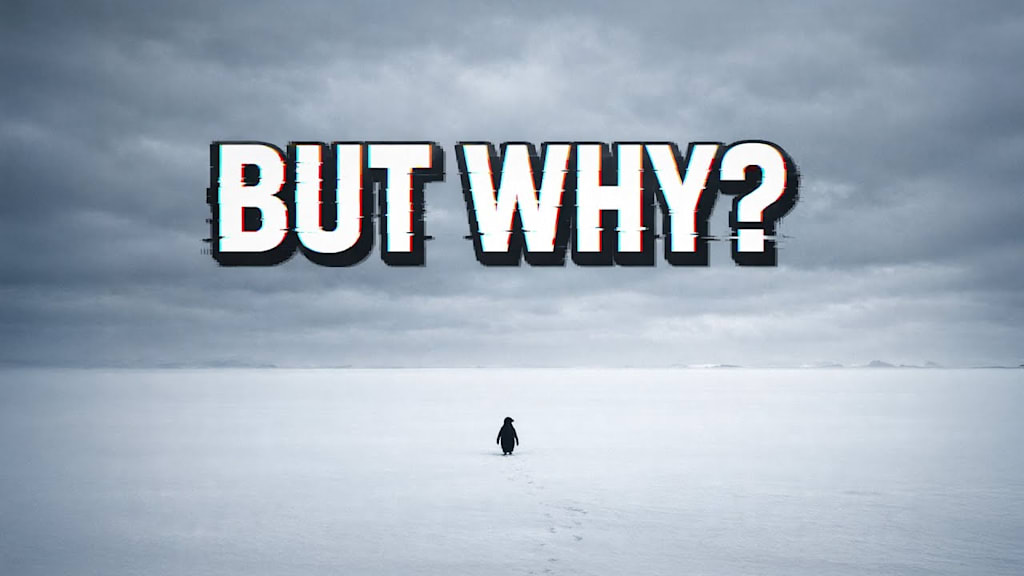
A video that went viral on social media shows a penguin leaving its group and walking alone toward the mountains of Antarctica. Many people connected it with human behavior — like depression, isolation, or making fearless decisions. But the reality paints a very different picture.
This scene actually comes from the 2007 documentary Encounters at the End of the World, released by German filmmaker Werner Herzog. No one knew that nearly 20 years later, a clip from this documentary would become viral across social media platforms.
The lifestyle and nature of these innocent creatures involve so much hardship and sacrifice that it’s difficult to believe.
Welcome once again to .
In 2007, Werner Herzog presented a scene in his documentary that, two decades later, left the internet full of questions. In the clip, an Adélie penguin separates from its colony and walks toward Antarctica’s mountainous interior instead of toward the ocean.
For penguins at the South Pole, the ocean is the source of food and life. But this lone penguin was walking directly toward death, leaving food behind — toward a place where there was neither food nor any hope of survival.
What could be the reason behind this?
To understand that, we first need to learn about the nature of penguins. Why do these creatures live nearly 100 kilometers deep inside Antarctica instead of near the sea?
Antarctica is a place where nature has left almost no room for life. It is the coldest, driest, and windiest continent on Earth. Temperatures there can fall to -90°C, and hurricane-speed winds are normal. In such extreme cold, if the human body is not properly covered, it can begin freezing within 10 seconds. Even a glass of boiling water thrown into the air can freeze before hitting the ground.
So why have penguins made this deadly cold their home?
The answer lies in their predators and their hunger.
Although Antarctica’s land is barren and deadly, the surrounding ocean is full of life. The freezing waters contain enormous quantities of small shrimp-like creatures and fish, which serve as a treasure of food for penguins.
But the real reason penguins live there is because of predators.
Penguins cannot run fast, nor can they fly. If they lived elsewhere, predators would easily eat them or their eggs. Their good fortune is that Antarctica’s brutal cold keeps most dangerous animals away. Penguins have turned this terrifying climate into their shield.
Nature has also equipped them to survive this harsh environment. Under their skin is a thick layer of fat called blubber, and their feathers are so dense that icy winds cannot reach their bodies.
Antarctica may be a gift for penguins, but nature never gives anything for free. If they find protection there, they pay for it every year by fighting a battle between life and death.
Every year, penguins must pass a test of survival.
Not all penguins in Antarctica are the same. There are five major species there.
The largest and heaviest are the Emperor Penguin, which can grow up to four feet tall. Then come Chinstrap penguins, recognized by the thin black line beneath their chins. The third species is the Gentoo penguin, known for its orange beak and white stripe on the head. Then come Macaroni penguins, with stylish yellow feathers on their heads. Finally, there is the species seen in the viral video — the Adélie Penguin, recognized by the white ring around its eyes.
Everywhere else in the world, animals migrate toward warmer places when winter arrives. But in Antarctica, the opposite happens. Almost all penguin species travel away from the sea during breeding season.
They do this because near the ocean there are dangers like leopard seals, killer whales, and birds that prey on their eggs. The coastal conditions are also extremely harsh, and strong winds or waves can wash eggs away.
Especially Emperor penguins travel deep into icy regions during winter for breeding.
Every year during May and June, when Antarctic winters begin, Emperor penguins leave the ocean and travel together in huge numbers toward their breeding colonies — the very places where they themselves were born, nearly 100 kilometers away from the sea.
This journey is so exhausting that their body energy begins to run out. There is no food along the way and none at the destination either.
Once they reach the breeding colony, they select partners. Male penguins try to impress females by making strange calls, puffing out their chests, and moving their necks in dance-like motions. The healthier males are chosen first.
After mating, the female lays just one egg and by that point is completely exhausted. Throughout this entire process, the penguins have eaten nothing for nearly two months. They survive only on whatever they consumed before leaving the ocean.
And all this sacrifice is made simply to continue their species.
But the male penguin sacrifices even more.
After laying the egg, the female carefully transfers it onto the male’s feet without letting it touch the ice. Then all the females head back toward the ocean.
Meanwhile, the males — already starving for two months — stand close together in freezing storms, balancing the egg on their feet.
Imagine this: for the next two months, the father stands in temperatures reaching -60°C without eating or drinking. He barely moves, because if the egg falls onto the ice, it could freeze instantly.
By the time the mother returns, the father may have lost more than half of his body weight due to starvation.
Normally, the mothers return before the chick hatches. But if the baby emerges earlier, the male penguin produces a special milk-like substance from his throat to feed the chick — using the very last reserves of his energy.
This is perhaps the ultimate example of fatherhood in nature: a father risking death to protect new life.
When the chick is about to hatch and the females return full from feeding, they identify their partners through unique calls. The female then takes over caring for the egg, and the starving males finally return to the ocean.
This is why Emperor penguins are often called the best fathers in the animal kingdom.
But not every male penguin is this caring.
Adélie penguins are famous less for sacrifice and more for stealing.
Yes — the same species seen in the viral video.
While Emperor penguins are known for sacrifice, Adélie penguins are considered Antarctica’s most mischievous and clever birds.
Their nesting habits are especially strange.
Since Antarctica’s ice has no grass or twigs, Adélie penguins build nests from stones. The male who builds the best nest has a much higher chance of attracting a female.
In their world, every stone is as valuable as a diamond.
But instead of gathering stones honestly, males often steal them. When a neighboring penguin isn’t looking, an Adélie male sneaks over, steals stones from another nest, and adds them to his own. Sometimes they spend entire days fighting over a single stone.
This behavior shows how social and hyperactive they are.
Their parenting system is also more balanced than Emperor penguins. Instead of the father starving alone, both parents take turns incubating the egg. While one goes to feed, the other stands guard.
Their breeding colonies are not as deep inland as those of Emperor penguins, but they still travel up to 50 kilometers inland.
So then the question arises:
How could such a social and intelligent creature — one that carefully guards every stone — suddenly lose its way and walk toward death?
When Werner Herzog witnessed this scene, even he was shocked. He saw one penguin separate from the crowd and begin walking in the exact opposite direction.
Scientists described this strange behavior as a “psychotic breakdown.”
Whether human or animal, sometimes the brain’s wiring can malfunction.
Penguins possess a built-in navigation system — almost like a natural GPS. Scientists believe penguins can sense Earth’s magnetic field while swimming, similar to a compass. They also use the sun’s position, stars, water flow, and even smell to maintain direction.
When they travel hundreds of kilometers back to their colony, their brains combine all these signals to guide them accurately.
But sometimes, because of brain infections, parasites, extreme stress, or starvation, their navigation system can malfunction.
At that point, the penguin may no longer recognize the ocean or its companions. Instead, its mind becomes locked onto the wrong direction.
But what actually happened to that penguin?
Can animals truly feel grief?
Science says yes.
When a penguin chick dies during Antarctica’s brutal winters, the parents often refuse to leave. They stand beside the dead chick, making mournful sounds. Sometimes their grief becomes so intense that they even attempt to steal other penguins’ chicks.
So is it possible that the viral penguin had lost someone important?
Science describes this behavior as a mental malfunction, but many viewers felt the penguin appeared distressed or depressed.
When Werner Herzog filmed the scene, he did not try to save the penguin because Antarctic law forbids interfering with nature.
The lonely traveler kept walking toward the mountains until it disappeared from sight.
Beyond that point lay thousands of kilometers of frozen wilderness — no fish, no water, no life.
Most likely, the penguin eventually collapsed from hunger and exhaustion, freezing somewhere beneath the Antarctic ice.
The world of penguins teaches us many things.
On one side is the Emperor penguin, risking its life to protect new life. On the other is the lost traveler, abandoning everything and walking toward an unknown destination.
About the Creator
Imran Ali Shah
🌍 Vical Midea | Imran
🎥 Turning ideas into viral content
✨ Watch • Share • Enjoy
Enjoyed the story? Support the Creator.
Subscribe for free to receive all their stories in your feed.
Comments
There are no comments for this story
Be the first to respond and start the conversation.