

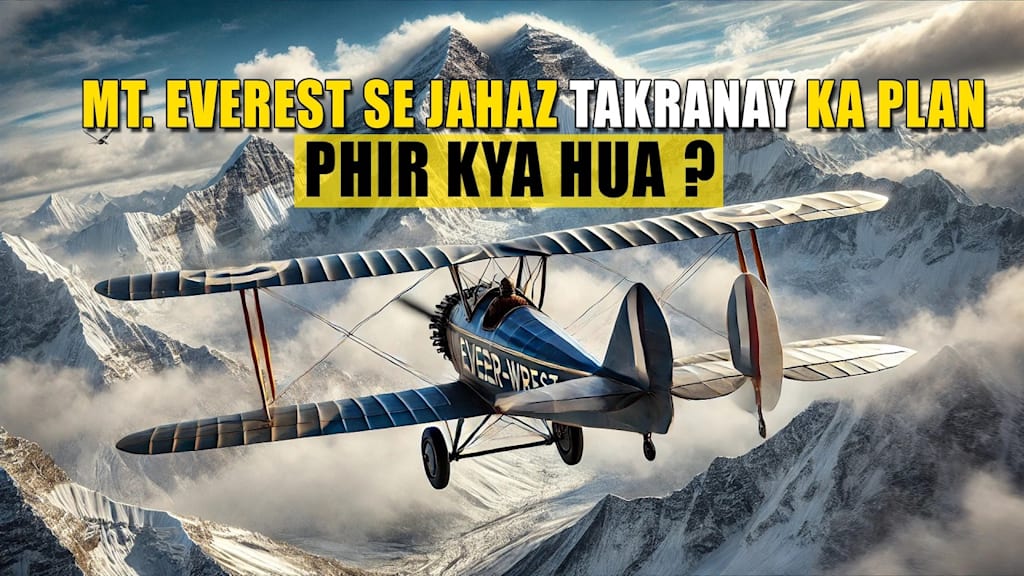
In 1933, a British adventurer named Maurice Wilson embarked on one of the most unbelievable missions in history. Unlike experienced explorers who spent years preparing for dangerous expeditions, Wilson had almost no flying experience, no serious mountaineering training, and no realistic plan. Yet he believed he could achieve what no human had ever done before—reach the summit of Mount Everest, the highest mountain on Earth.
Maurice Wilson was born in Yorkshire, England, in 1898. As a young man, he joined the British Army during World War I. He fought bravely on the battlefields of France and earned the Military Cross for his courage. However, the war left him physically and emotionally scarred. He was wounded in combat and suffered health problems that followed him for years. When he later requested compensation from the British government, his request was denied, leaving him disappointed and bitter.
After the war, Wilson spent years searching for purpose. He traveled widely, tried different businesses, and married twice, but he never found lasting happiness. His health continued to decline, and he struggled with depression. During this difficult period, he met a spiritual healer who convinced him that fasting and prayer could cure illness and solve life's problems.
Wilson began fasting regularly and became convinced that it had transformed his life. He believed his health improved dramatically and that spiritual discipline could help a person overcome any obstacle. This belief soon became the foundation of an extraordinary dream.
One day, Wilson read about the 1924 British Everest expedition, during which climbers George Mallory and Andrew Irvine disappeared while attempting to reach the summit. Their mysterious fate fascinated him. Almost immediately, he decided that he would climb Everest himself. Even more remarkably, he planned to do it largely through faith, fasting, and determination rather than conventional training.
At the time, climbing Everest was considered one of the most difficult challenges on Earth. Successful expeditions required years of preparation, large amounts of money, specialized equipment, and teams of experienced climbers. Wilson had none of these advantages. Instead of accepting these limitations, he looked for shortcuts.
His first idea was to parachute from an airplane onto Everest. When he realized how impossible that would be, he created an even more dangerous plan. He would buy his own airplane, fly it toward Everest, and deliberately crash-land it high on the mountain. By doing so, he hoped to bypass much of the difficult climb and then walk the remaining distance to the summit.
The problem was obvious: Wilson barely knew how to fly.
Nevertheless, he purchased a small de Havilland Gipsy Moth biplane and began taking flying lessons. His instructor reportedly told him that he would never even make it to India, let alone Everest. Wilson ignored the warning.
British authorities quickly learned about his plan and tried to stop him. Concerned that he might cause an international incident—or kill himself—they informed Nepal of his intentions. Nepal immediately withdrew permission for him to enter its airspace. For most people, this would have ended the adventure.
Not for Maurice Wilson.
In dramatic fashion, he publicly tore up an official telegram warning him against the flight and set off anyway. His journey took him across Europe, North Africa, and the Middle East. He encountered numerous obstacles along the way. He was briefly arrested in Tunisia, struggled with fuel problems, and repeatedly faced bureaucratic barriers from British officials trying to halt his progress.
When he reached Bahrain, authorities told him that he could refuel only if he promised to return to London. Wilson agreed, but once airborne he turned east toward India instead. Flying over unfamiliar territory with poor maps and limited experience, he somehow managed to continue his journey.
Eventually, he reached British India. However, government officials caught up with him and confiscated his airplane before he could attempt his planned flight to Everest. With his money running out and no legal way to fly near the mountain, Wilson was forced to sell the aircraft.
Most people would have accepted defeat at this point.
Wilson did not.
Determined to reach Everest by any means possible, he spent months in northern India trying to secure permission to enter Tibet, from where many Everest expeditions approached the mountain. When official permission was denied, he decided to enter secretly. Disguised as a Buddhist monk, he crossed into Tibet and began making his way toward Everest.
The mountain quickly exposed the weaknesses in his plan. Wilson had little experience with high-altitude climbing and suffered from exhaustion and breathing difficulties. Several attempts to reach higher camps ended in failure. Yet his determination remained unshaken.
In 1934, accompanied by two experienced helpers, he made another attempt. They reached a higher camp on Everest, but Wilson insisted on continuing alone. His companions warned him repeatedly that the mountain was too dangerous and that he lacked the necessary skills. He refused to listen.
Before leaving, he told them that if he did not return within two weeks, they should assume he was dead.
Wilson disappeared into the icy wilderness of Everest and never came back.
His companions waited for weeks before finally descending the mountain and reporting his disappearance. A year later, in 1935, members of another Everest expedition discovered his body near the North Col. Beside him were his backpack, diary, and torn tent.
His final diary entry, written shortly before his last climb, contained a simple message:
"Off again. A glorious day."
Maurice Wilson never reached the summit of Everest. Yet his story remains one of the most extraordinary tales in mountaineering history—a remarkable combination of courage, faith, determination, and reckless ambition. While many consider his plan impossible from the start, his willingness to pursue an unimaginable dream continues to fascinate people nearly a century later.
About the Creator
Imran Ali Shah
🌍 Vical Midea | Imran
🎥 Turning ideas into viral content
✨ Watch • Share • Enjoy
Enjoyed the story? Support the Creator.
Subscribe for free to receive all their stories in your feed.
Comments
There are no comments for this story
Be the first to respond and start the conversation.