

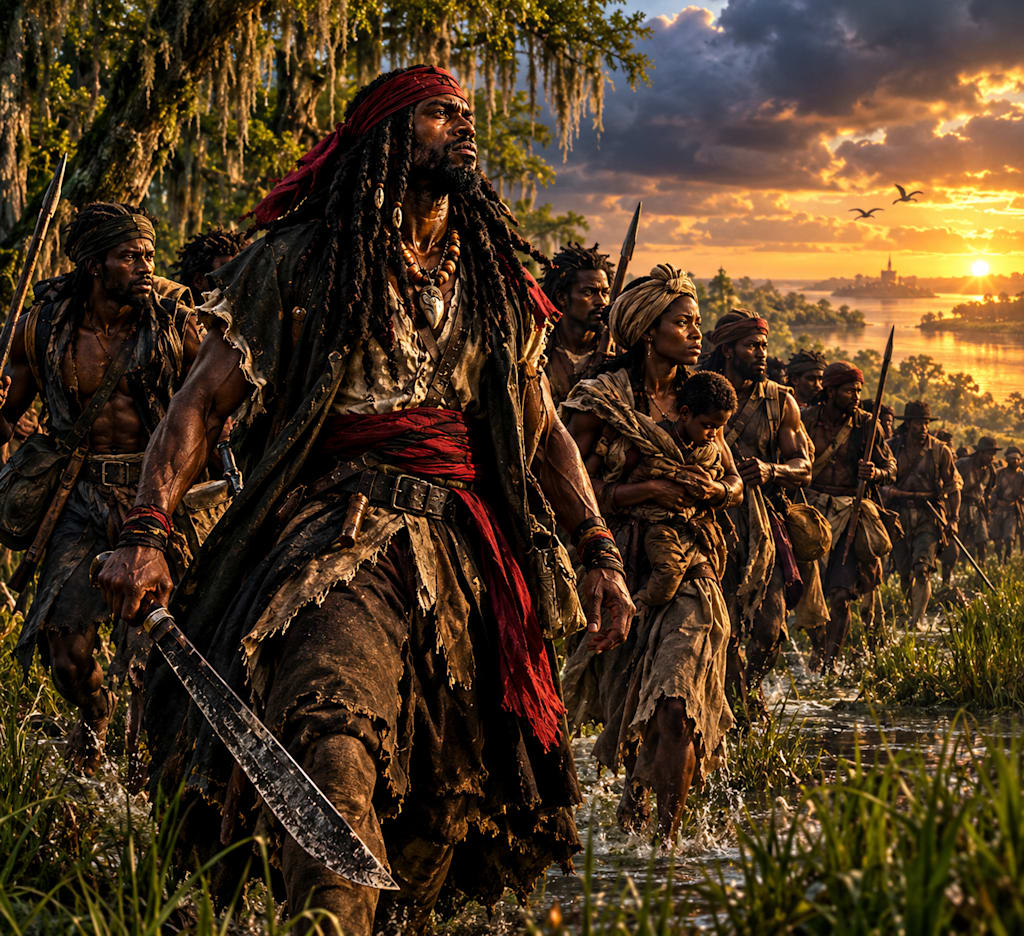
THE MAROON WARRIOR
Guardian of Freedom • Keeper of African Heritage • The Unconquered Spirit of the Americas
I. A People Who Refused to Surrender
Before freedom became a legal principle, it was a living struggle.
Across the Americas, millions of Africans were forcibly transported from their homelands and subjected to systems designed to control their labor, separate families, suppress cultural identities, and deny them the right to govern their own lives. Yet the history of slavery is not simply a history of captivity. It is also a history of resistance.
Among the most remarkable figures in that history was the Maroon.
Maroons were Africans and, in many communities, their descendants who escaped enslavement and established independent settlements beyond the control of slaveholding authorities. They lived in mountains, forests, swamps, and other difficult terrain, creating communities in which freedom could be defended and African cultural traditions could survive.
Their history reaches across Brazil, Jamaica, Suriname, the Caribbean, and parts of North America. Although these communities differed in language, ancestry, political organization, and military experience, they shared a fundamental determination: they refused to accept enslavement as the natural condition of their existence.
Some Maroon communities survived for generations. Others grew into substantial political and military powers. In Brazil, Palmares became one of the most celebrated examples of an independent society formed by people escaping slavery. In Jamaica, Maroon communities resisted British colonial forces and eventually secured treaties recognizing forms of autonomy. In Suriname, Maroon peoples established enduring societies whose descendants preserve distinct cultural traditions today.
These were not merely hiding places. They were communities where people raised children, cultivated food, maintained social relationships, preserved knowledge, and imagined futures beyond bondage.
The Maroon warrior emerged from this larger struggle. He was not simply a fighter carrying a blade. He represented the collective will of a people determined to remain human in a system that sought to treat them as property.
II. The Land Became a Place of Refuge
To understand the Maroons, we must understand the landscapes in which they lived.
Forests, mountains, wetlands, and swamps could provide refuge from colonial authorities, although they also presented formidable challenges. Finding food, maintaining shelter, protecting families, and remaining connected to other communities required knowledge, patience, and cooperation.
The Maroons' relationship with the land was therefore more than geographical. It was a matter of survival and belonging.
People brought knowledge from different African societies, including agricultural practices, healing traditions, spiritual beliefs, social customs, and experiences of collective defense. They adapted what they knew to new environments and learned from Indigenous peoples and others living in the Americas.
These exchanges did not produce one universal Maroon culture. They produced many distinct societies, each shaped by its particular history.
The swamps of the American South, the mountainous interior of Jamaica, and the forests of Suriname were not interchangeable places. Neither were the people who inhabited them. Yet in each setting, knowledge of the environment could help communities sustain themselves beyond the immediate reach of slaveholding authorities.
Women were essential to these societies. They raised children, cultivated food, maintained family networks, transmitted cultural knowledge, and helped preserve the community. Elders carried memories and traditions. Young people inherited responsibilities and possibilities that their ancestors had struggled to protect.
Freedom was never the achievement of a lone warrior. It was the work of a people.
III. Resistance Was More Than Physical Strength
The popular image of the Maroon often emphasizes courage in battle. Courage mattered, but resistance took many forms.
People escaped. They sheltered one another. They maintained family connections. They preserved languages and spiritual practices. They negotiated, organized, cultivated land, and built communities.
Some fought colonial forces directly. Others resisted through daily acts of refusal, cultural preservation, and mutual assistance.
Maroon societies also developed different approaches to collective defense. Their experiences reflected the traditions people carried from Africa, the realities of their environments, and the weapons and resources available to them. There was no single martial system shared by every Maroon community.
The larger lesson is that resistance required more than strength. It required social organization, shared knowledge, leadership, adaptability, and the conviction that life could be different.
That conviction also survived through cultural expression.
Music, dance, storytelling, spiritual traditions, and oral history preserved memories that oppressive institutions could not easily erase. They carried ideas about identity, dignity, ancestry, and freedom from one generation to another.
In this sense, the Maroon struggle was not simply a fight to escape an institution. It was a struggle to preserve the possibility of living as a people.
IV. Capoeira: Movement, Memory, and Cultural Survival
Among the most recognizable Afro-diasporic cultural traditions associated with resistance is Capoeira.
Developed among Africans and their descendants in Brazil, Capoeira combines music, rhythm, movement, ritual, and martial expression. Its history is inseparable from the broader experiences of enslavement, racial oppression, and Black cultural survival.
Capoeira's precise origins remain a subject of scholarly discussion. Researchers have identified similarities between Capoeira movements and Engolo, a traditional movement and combat practice associated with communities in Angola. Other scholars emphasize the complex mixture of African traditions and the conditions of life in Brazil. Capoeira has important connections to the history of quilombos, Brazil's communities established by people escaping slavery.
Its significance reaches beyond any one historical origin story.
Capoeira became a way for African-descended communities to maintain cultural expression under changing and often repressive conditions. Music and movement carried meanings that extended beyond physical performance. The tradition preserved a distinctive cultural identity while adapting across generations.
Other Brazilian traditions, including Maculelê, also preserve stories of African-descended resistance and cultural creativity. Folklore tells the story of Maculelê, a young warrior who was an enslaved African, successfully escaped from a sugarcane plantation. He found refuge and was taken in by a local indigenous village, there he defended village single-handedly against rivals using only two sticks and a combat style now known as Capoeira.
These traditions remind us that cultural survival was itself a form of endurance.
A people could be displaced from its homeland without surrendering every part of its inheritance. Cultural practices could change, combine, and develop new meanings while remaining connected to the experiences of those who carried them.
V. Haiti: The Struggle for Freedom Becomes a Revolution
The Haitian Revolution of 1791–1804 transformed the history of slavery and colonialism.
Enslaved people in the French colony of Saint-Domingue rose against an extraordinarily brutal plantation system and ultimately established Haiti as an independent nation in 1804. Their victory destroyed slavery in the colony and challenged the assumption that enslaved Africans could never overthrow a powerful colonial order.
The revolution involved political leadership, military organization, alliances, changing international circumstances, and the extraordinary determination of the people who fought for their freedom.
Haitian fighting traditions, including the machete-fencing art known as tire machèt, belong to this wider historical and cultural landscape.
Tire machèt is a Haitian martial tradition associated with the use of the machete and with the blending of African and European fencing influences, machetes were significant tools and weapons in the Caribbean. Toussaint Louverture use of the machete during the Haitian Revolution led to the creation of Tire Machete.
The deeper connection is the transformation of ordinary circumstances into instruments of resistance. In plantation societies, tools associated with agricultural labor existed within the same world as the struggle against the system that compelled that labor.
Haiti's revolution demonstrated that the institution of slavery could be challenged by the people it sought to control.
Its victory did not end slavery throughout the Americas, but it permanently changed the political imagination of the Atlantic world.
VI. Colombia and the Wider Atlantic World
African-descended communities in Colombia also preserved traditions of armed movement and fencing.
One example is Grima, a Colombian tradition involving forms of fencing associated with the machete. It includes different regional styles, sometimes described as Juegos, whose movements, distances, and conventions vary.
Researchers have investigated African contributions to these traditions alongside possible European fencing influences. The precise origins of grima remain debated, and no single explanation accounts conclusively for every regional form.
Comparative research into African and Afro-diasporic martial traditions has helped illuminate how cultural practices developed across the Atlantic world.
The histories of Haiti, Colombia, Cuba, Brazil, and other societies demonstrate that African-descended people did not merely inherit the circumstances imposed upon them. They created and transformed cultural practices within those circumstances.
Their histories cannot be reduced to one fighting style, one country, or one heroic individual.
They form part of a larger record of cultural adaptation and resistance.
VII. High John the Conqueror: The Freedom That Could Not Be Chained
Not every resistance figure belongs to documented military history.
Some live in folklore, where communities express truths about oppression, dignity, and survival through extraordinary stories.
High John the Conqueror is one such figure in African American folklore.
In many tellings, High John is a clever, charismatic trickster whose intelligence allows him to overcome those who possess greater physical or political power. Stories portray him as a bringer of hope who confounds oppressors through wit, laughter, imagination, and supernatural cleverness.
Some oral traditions describe him as an African prince captured and enslaved in the Americas. Other versions differ in their details. These stories are part of a changing body of folklore rather than a verified biography of a single historical individual.
Their meaning, however, is profound.
High John represents a form of freedom that domination cannot fully possess: the freedom to imagine, to interpret the world differently, to preserve dignity, and to refuse the oppressor's claim to total power.
Laughter becomes more than amusement. Cleverness becomes more than entertainment. The story itself becomes a place where the oppressed can imagine the powerful being defeated.
The figure of High John also connects to the African American tradition of conjure, in which roots, herbs, charms, and spiritual practices could carry meanings associated with protection, healing, luck, and personal power.
These traditions were diverse, and their meanings varied among practitioners and communities.
Yet High John's enduring place in folklore reveals something important about resistance: the human spirit requires more than the physical means to survive. It also requires hope.
VIII. Frederick Douglass and the Protective Root
The historical record offers a striking example of how spiritual belief and physical resistance could intersect.
In his autobiographical writings, abolitionist Frederick Douglass described an encounter with an enslaved man named Sandy Jenkins, who gave him a root that he believed would protect Douglass from being whipped by Edward Covey, the enslaver known for brutal treatment of enslaved people.
Douglass initially doubted the root's protective power. Nevertheless, he accepted it from Sandy, whose concern and conviction offered him support during an exceptionally difficult period.
Douglass later described a confrontation with Covey in which he physically resisted him. He credited that struggle with marking a decisive change in his sense of himself and his willingness to resist further abuse.
The account does not establish that the root possessed supernatural powers or that it caused Douglass's resistance. Douglass himself reflected on the tension between his earlier skepticism and the significance he later attached to the encounter.
But the story preserves something historically valuable: Sandy Jenkins offered another enslaved man care, counsel, and a symbol of protection when that man was in desperate need.
Sandy's gesture connected spiritual tradition with solidarity. Douglass's resistance demonstrated that the authority claimed by an enslaver was not absolute.
The root became part of the story's enduring symbolism, while the encounter between the two men reveals a more intimate form of resistance: one person helping another recover the courage to stand against oppression.
IX. The Maroons and the Limits of Slavery
Was slavery successful?
If success is measured by the ability to extract labor, accumulate wealth for enslavers, and maintain political control for a period of time, slavery produced enormous material gains for those who profited from it. It inflicted catastrophic harm on millions of people and shaped the economic and political development of the Americas.
It would therefore be historically inaccurate to say that slavery was never economically successful for slaveholders or that Maroon resistance alone ended the institution.
But if success means creating a stable system in which enslaved people willingly accepted permanent subordination, the history is very different.
Enslaved people resisted in countless ways. Some escaped individually. Others joined or established Maroon communities. Some revolted, sabotaged the systems that exploited their labor, preserved forbidden traditions, or worked to secure freedom for their families and descendants.
Maroon communities exposed a central contradiction in slavery: the system claimed complete ownership over human beings, yet people repeatedly escaped its control and established lives beyond it.
Their resistance forced colonial governments to devote resources to pursuit, warfare, negotiation, and containment. Some communities survived long enough to negotiate treaties or secure forms of autonomy. Others were destroyed, displaced, or absorbed into wider societies.
The Haitian Revolution delivered a particularly decisive blow to the Atlantic slave system, while abolition throughout the Americas emerged through many interconnected forces: enslaved people's resistance, rebellions, abolitionist organizing, political conflict, international pressures, and changing economic and legal conditions.
The Maroons were one essential part of this larger history.
The significance of remembrance in them respects the knowledge of each slave rebellion or insurrection possibly being the ending of slavery long before any proclamations were ever signed, and in the evidence they provide that slavery was never a system of uncontested power.
It required expensive force to maintain because human beings continued to resist it.
And it could never completely exist of the system failed repeatedly to erase the desire for freedom. They were never slaves, but warriors.
X. The Warrior Who Leads His People Home
Imagine the Maroon, a warrior standing at the edge of a vast wetland as the sun rises over the trees.
His clothing bears the marks of a difficult journey. His expression is watchful, but his eyes are fixed on the horizon. Behind him are families who have endured separation, people carrying the memories of those they have lost, and children who deserve a future beyond the conditions their ancestors were forced to endure.
He does not stand alone.
He carries the memory of African societies from which people were violently uprooted. He carries the histories of communities that established themselves beyond colonial control. He carries the cultural inheritance preserved through music, spiritual traditions, movement, storytelling, and the everyday labor of building a life together.
He represents the Maroons of the Americas, but he does not erase their differences. He honors the distinct histories of Palmares, Jamaica, Suriname, the American South, and other places where people resisted enslavement and sought independence.
He also represents the wider African diaspora: the communities that transformed their circumstances while preserving fragments of inherited knowledge and creating traditions of their own.
Capoeira reminds us that cultural expression can outlast oppression. Haitian history demonstrates that enslaved people could overthrow a colonial regime and establish an independent nation. Colombian grima and Haitian tire machèt illustrate the complex development of Afro-diasporic fencing traditions. High John and Maculelé represents the enduring power of folklore and imagination. Sandy Jenkins and Frederick Douglass remind us that solidarity and personal courage could meet in a single moment.
Together, these histories tell a story larger than warfare.
They tell the story of people who refused to let their oppressors define the limits of their humanity.
The Maroon warrior's greatest achievement is therefore not the weapon he carries, the enemies he defeats, or the legends told about him.
It is the community he helps preserve.
It is the knowledge passed to the next generation.
It is the possibility that children born into a world of bondage might one day live in a world of their own choosing.
And it is the enduring truth that no system of domination can guarantee the surrender of the human spirit.
The Maroon warrior does not simply fight for freedom. He leads his people toward a life in which freedom can endure.
About the Creator
Enjoyed the story? Support the Creator.
Subscribe for free to receive all their stories in your feed.
Comments
There are no comments for this story
Be the first to respond and start the conversation.