
The Letter J Did Not Exist When Jesus Was Alive — So Did He Even Exist?
Before you answer that question, ask yourself whether you are answering from genuine personal experience or from what you were told before you were old enough to question it.

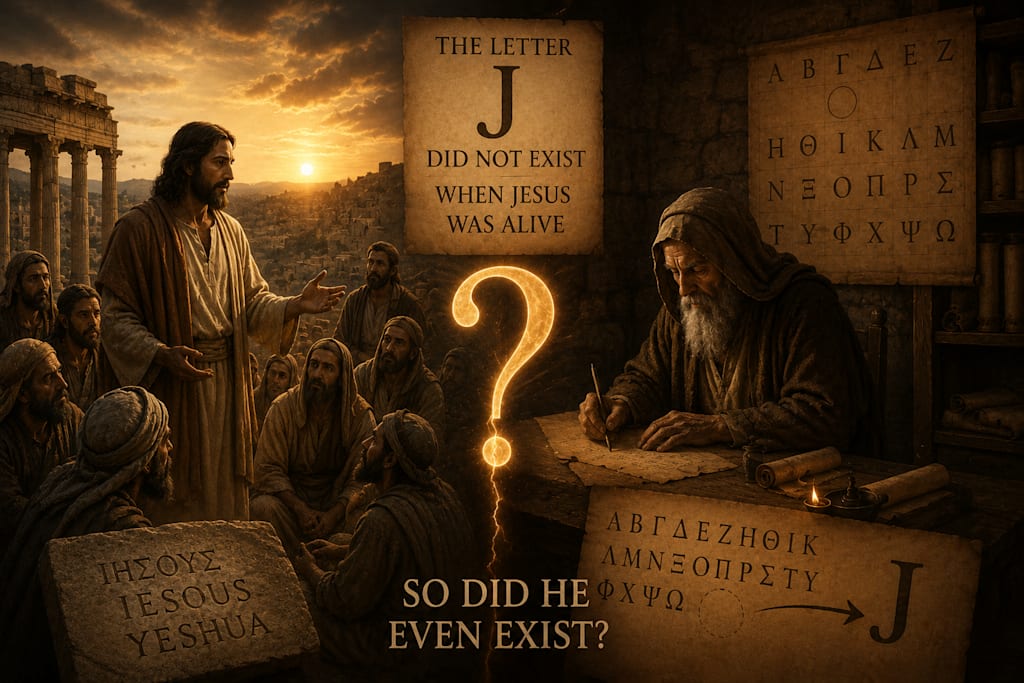
The letter J did not exist until 1524.
Not in English. Not in Hebrew. Not in Aramaic. Not in Greek. Not in Latin. Not in any language that any human being was using to communicate with any other human being at the time the events described in the New Testament are said to have occurred.
The letter J — the tenth letter of the modern English alphabet — was proposed by an Italian Renaissance scholar named Gian Giorgio Trissino in 1524. It did not enter common English usage until the mid-1600s. The original 1611 King James Bible — the most influential English language religious document in history — does not contain a single J. It uses Iesus throughout. The name Jesus — spelled with a J — first appeared in the 1629 revised edition of the King James Bible.
Not 2000 years ago. Not at the beginning of Christianity. Not when the person the New Testament describes was allegedly alive. Not when his disciples were allegedly following him. Not when Paul was allegedly writing letters about him to early Christian communities across the Mediterranean world.
That is a fact. Not a belief. Not a theory. A documented historical fact that you were almost certainly never taught — in church, in school, or anywhere else — because the institution that taught you what to believe about the name had very specific reasons for not drawing your attention to when that name was invented.
If the Name Has Power, It Has to Be the Right Name
Here is the specific contradiction that the institution has never adequately answered.
The people who defend the name Jesus against the letter J problem — who say that the linguistic history does not matter, that the divine knows your intent, that as long as you are directing your prayer toward the right thing the name you use is irrelevant — are almost always the same people who tell you that there is power in the name of Jesus.
That you must pray in the name of Jesus. That you must cast out demons in the name of Jesus. That healing happens in the name of Jesus. That salvation itself comes through the name of Jesus. The name is not incidental in their framework. The name is the specific instrument. It is the key. The channel. The precise point of contact between human petition and divine response.
So here is the question that the institution needs you not to ask.
If the name carries that specific power — if the name itself is the instrument — then which name carries it? The name that existed? Or the name that was invented in 1629?
Because you cannot have it both ways.
Either the name matters — in which case the right name matters, and a name invented 1600 years after the person it refers to allegedly lived is not the right name — or the name does not matter, in which case the entire framework of praying specifically in the name of Jesus rather than in the name of Yeshua, or in the name of the divine by any other designation, requires a level of examination that the institution has never invited and has every reason to prevent.
Think about it this way.
Your mother has a name. Let us say her name is Heather. You have called her Heather your entire life. You know her face, her voice, her presence. The name Heather and the reality of your mother are connected in your experience through decades of genuine relationship.
Now imagine someone — with complete sincerity, with genuine good intention, with the honest belief that they are addressing the same person — calls your mother Kimberly.
Not as a nickname. Not as a term of endearment. As a structurally different name that has no connection to the name she was given, that did not exist when she was born, that was constructed through a series of linguistic decisions made by people who never met her.
Does she answer?
Does the genuine intent of the person calling make Kimberly the same as Heather? Does the sincerity of the belief that the right person is being addressed make the wrong name reach the right person?
You already know the answer. Because the relationship tells you immediately when the name is wrong. The response — or the absence of it — is the evidence.
The institution's answer to the letter J problem is that intent is sufficient. That the divine is sophisticated enough to understand what you mean even when what you say is a name invented in 1629 for a person who — if he existed — was called something entirely different.
Maybe that is true. The divine may well be more sophisticated than any human institutional claim about it.
But notice what the institution is actually asking you to accept. It is asking you to trust its assurance that the name does not matter — while simultaneously building its entire authority structure around the specific power of that name. While requiring you to pray in that name. While telling you that salvation, healing, and deliverance flow specifically through that name.
The name either matters or it does not.
If it matters — use the right one.
If it does not matter — then the institution that has built its power on the specific name needs to explain why it kept telling you it did.
The name itself is a construction
The actual name — the name that the person the New Testament describes would have been called if he existed and if the people around him were calling him anything — was Yeshua. Sometimes rendered Yahshua. A Hebrew name meaning Yahweh saves or Yahweh is salvation.
Yeshua became Iesous in Greek — because Greek has no SH sound and no Y consonant in the position the Hebrew requires. Iesous became Iesus in Latin. Iesus became Iesu in Old French and then Middle English. Iesu became Iesus again in 16th century English. And Iesus became Jesus in 1629 when the revised King James Bible applied the newly invented J to a name that had been an I for its entire existence.
Each step in this chain was a transliteration — an attempt to render the sounds of one language in the conventions of another. Not a translation. Not an inspired transmission of sacred content. A series of linguistic decisions made by human beings working with the alphabetical tools available to them at the time.
The name Jesus is the end product of 1600 years of those decisions — each one moving further from the original Hebrew, each one shaped by the specific linguistic and political context of the people making it, each one accepted by the people who received it because they trusted the institution that delivered it.
No one along the way asked the person the name allegedly referred to whether the new version was accurate.
The template that predates the story
Here is where the letter J fact becomes most significant — not as an isolated linguistic curiosity but as the entry point into a much larger question.
If the name is a 17th century construction built on a chain of transliterations that stretch back 1600 years before that — then what else about the story is a construction?
The virgin birth. The miracles. The crucifixion and resurrection. The divine sonship. The narrative of a god who descends into human form, lives among ordinary people, is betrayed by someone close to him, is killed, and rises from the dead to offer salvation to humanity.
This narrative did not originate with Christianity.
Horus — the Egyptian god whose story predates Christianity by thousands of years — was born of a virgin mother Isis, was visited by wise men at his birth, performed miracles, had twelve disciples, was crucified, and was resurrected. The specific parallels between the Horus mythology and the Jesus narrative are extensive enough that scholars of comparative religion have been documenting and debating them for over a century.
Osiris — also Egyptian, also predating Christianity by thousands of years — died and was resurrected. His story is specifically the death and resurrection template that the Christian narrative follows in its most essential structure.
Mithra — the Persian deity whose cult was among the most widely practiced in the Roman Empire at the time Christianity was developing — was born on December 25th of a virgin birth, performed miracles, had twelve companions, was buried in a tomb, and rose after three days.
Dionysus — the Greek god — was born of a mortal woman and a divine father, turned water into wine, was called the Son of God and the Light of the World, was killed and resurrected.
Krishna — the Hindu deity whose story predates Christianity by at minimum a thousand years — was born of a virgin, his birth was attended by wise men who followed a star, he performed miracles, and he was crucified.
These are not fringe claims from anti-religious conspiracy websites. They are documented in mainstream comparative mythology, in the academic study of religion, and in the historical record of the cultures that produced these narratives. The specific story elements that Western Christianity presents as unique and historically unprecedented appear repeatedly in the religious traditions that preceded it across multiple continents and multiple millennia.
The question this raises is not whether religion is valuable or whether spiritual experience is real. The question is whether the specific story — the one with the specific name invented in 1629 — is a historical account of specific events that occurred to a specific person or whether it is the most recent and most institutionally powerful version of a narrative template that human cultures have been using to organize their understanding of the divine for far longer than Christianity has existed.
The Roman records problem
Rome kept extraordinarily detailed records. The Roman administrative apparatus was among the most sophisticated bureaucratic systems in the ancient world — census records, tax records, legal records, military records, records of executions, records of public disturbances, records of trials before Roman governors.
Pontius Pilate — the Roman governor who the New Testament describes as presiding over the trial and execution of the historical Yeshua — is documented in Roman records. He existed. His tenure as governor of Judea from approximately 26 to 36 CE is historically verified.
The specific trial, the specific execution, the specific person — none of these appear in any contemporary Roman record.
The Jewish historian Josephus — writing in the late first century CE — contains two passages that reference Jesus. Both are disputed by mainstream scholarship. The more significant of the two — the Testimonium Flavianum — is widely considered by scholars to be a later interpolation inserted into Josephus's text by Christian copyists rather than original content written by Josephus himself.
The Roman historian Tacitus — writing in approximately 116 CE — mentions Christians and refers to their founder being executed under Pontius Pilate. This is the most significant non-Christian historical reference to the figure. It was written approximately 80 years after the events it describes and almost certainly reflects what Tacitus had been told by Christians rather than independent Roman documentation of the events themselves.
There is no contemporary documentary evidence — no document written during the lifetime of the person the New Testament describes — that mentions him. The earliest gospel — Mark — was written approximately 40 years after the events it describes. By a person who was not present at those events. In Greek — not in the Aramaic that any historical person from Galilee would have spoken.
None of this proves that no historical person existed around whom the narrative subsequently developed. Absence of evidence is not evidence of absence. But it is worth sitting with the specific quality of the historical record — or the lack of it — before accepting the institutional assertion that the historical existence of this specific person is simply a given.
The institution that needs you not to ask
Here is the thing about the specific questions this essay is raising — the letter J fact, the mythological parallels, the Roman records problem — none of them are new. None of them are secret. None of them are the product of recent conspiracy research or internet rabbit holes.
They are documented in mainstream scholarship. They are available in university libraries. They have been written about by serious historians, linguists, and comparative religion scholars for centuries.
And yet the vast majority of people who were raised in the Christian tradition have never encountered them. Not because the information is unavailable but because the institution that shaped their understanding of this topic had very specific reasons for keeping their attention elsewhere.
An institution whose authority depends on the unquestioned acceptance of a specific historical claim has no interest in encouraging the members it has formed to examine that claim against the available evidence. The examination is the threat. The question is what the institution most needs to prevent.
This is not unique to Christianity. Every institution whose authority derives from inherited belief rather than from verified experience has the same relationship to the questions that could undermine that belief. The specific suppression of inquiry is what distinguishes institutional religion from genuine personal spiritual experience — the difference between being told what is real and being encouraged to find out for yourself.
What genuine spiritual experience actually is
I want to be honest about something before closing.
The questions this essay raises are about institutional religion and about the specific historical claims on which institutional Christianity's authority is based. They are not questions about whether spiritual experience is real or whether the divine is real or whether the specific quality of genuine encounter with something larger than ordinary human consciousness is real.
Spiritual experience is real. I have no doubt about that and nothing in this essay is intended to suggest otherwise. The specific quality of consciousness that genuine prayer, genuine meditation, genuine spiritual practice, and genuine encounter with the divine produces — this is real. It is documented across cultures, across traditions, across every human civilization that has existed. It does not depend on the historical existence of any specific person. It does not depend on the accuracy of any specific institutional claim.
What the chosen ones across every tradition have always carried — the direct, unmediated, personally verified encounter with something genuinely real — is not the same thing as the institutional belief system that has been built around the name invented in 1629. The direct experience precedes the institution. It precedes the name. It precedes the narrative. It is available to any human consciousness that is genuinely open to it regardless of what name they use to address it.
The chosen ones in the Bible — whatever name they used, whatever tradition they operated within — were not primarily people who had been told what to believe and had believed it compliantly. They were people who had direct encounters with something real. Who had been changed by those encounters. Whose authority came from the experience itself rather than from the institution that subsequently developed around similar experiences.
That directness — the primacy of personal encounter over inherited institutional authority — is what every genuine spiritual tradition has always pointed toward as the most essential available thing.
The question you came here to answer
Did the person the New Testament describes — Yeshua of Nazareth, whose name became Jesus only in 1629 — actually exist as a historical individual whose life unfolded more or less as the gospels describe?
I do not know. The honest answer is that nobody knows with the certainty that the institution requires you to accept as given.
What I do know is this — you have a right to ask the question. You have a right to look at the letter J fact and follow it honestly to where it leads. You have a right to examine the mythological parallels and the Roman records and the late gospel authorship and ask what the actual available evidence supports rather than what you were told before you were old enough to examine it.
You have a right to distinguish between what you believe because you were told to believe it and what you believe because you have felt it, experienced it, tested it against the reality of your own life, and arrived at it through your own direct encounter with whatever is genuinely real.
That distinction — between inherited institutional belief and personally verified experience — is the most important available distinction in the entire territory of human spiritual life.
The name Jesus is 500 years old.
The question of what is actually real is much older than that.
And the only authority you have ever genuinely had for answering it is your own direct experience.
Trust that. Not the institution. Not the name invented in 1629. Not the narrative that follows a template thousands of years older than Christianity.
Your own direct experience.
That is the only thing that has ever been genuinely yours.
About the Creator
Enjoyed the story? Support the Creator.
Subscribe for free to receive all their stories in your feed.
Comments
There are no comments for this story
Be the first to respond and start the conversation.