
The King List
Sovereign Chronicles: The True Royal Bloodline of An and Ki — Sumer Series
Sovereign Chronicles Editorial Staff
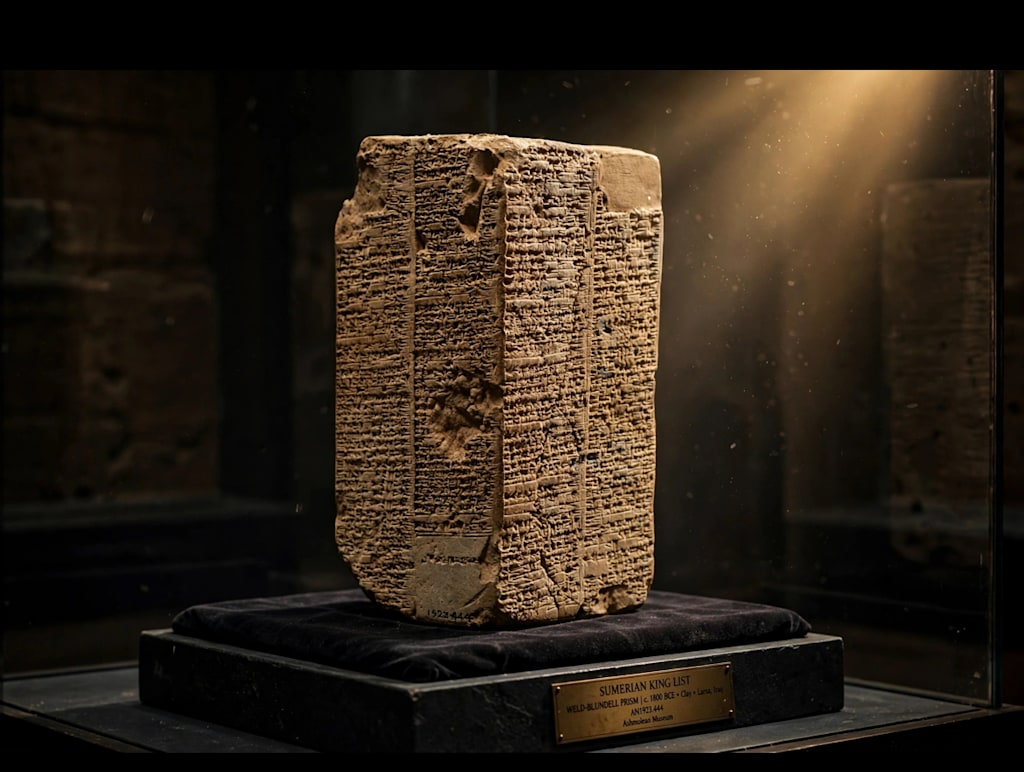
There is a clay prism in the Ashmolean Museum in Oxford. It is small — about twenty centimeters tall, nine across — baked hard, inscribed on four sides in two columns of cuneiform per face. And it contains what may be the most audacious chronological claim ever pressed into clay.
It opens with a sentence that should stop you cold: after the kingship descended from heaven, the kingship was in Eridu.
Then it gives names. Then it gives numbers. And the numbers are impossible.
In Eridu, Alulim became king, and reigned twenty-eight thousand eight hundred years. Alalgar reigned thirty-six thousand years. Then the kingship passed to Bad-tibira, where En-men-lu-ana reigned forty-three thousand two hundred years. Then Larak. Then Sippar. Then Shuruppak, where Ubara-Tutu reigned eighteen thousand six hundred years.
Eight kings. Five cities. Two hundred and forty-one thousand two hundred years.
Then the tablet says, simply: the flood swept over.
This is the Sumerian King List — and what you just heard is only its first page. The prism in Oxford, catalogued as WB 444 and copied around 1800 BCE, goes on. After the flood, it says, the kingship descended from heaven a second time — this time at Kish. And from there the reigns begin to shrink toward something human. Hundreds of years. Then decades. Then the names start matching kings we can dig up: Enmebaragesi of Kish, whose name appears on contemporary inscriptions around 2600 BCE. Gilgamesh of Uruk. Sargon of Akkad, the cupbearer who seized a throne and built an empire. Ur-Nammu, who wrote laws. Shulgi, who ruled forty-eight years and was worshipped as a god in his own lifetime.
Here are the stats of the document itself. It survives in more than a dozen copies, the Oxford prism the most complete. It was compiled in its surviving form around 1800 BCE, but it claims to record kingship from the beginning of time. Its dynasties run: Kish, Uruk, Ur, Awan, Hamazi, Adab, Mari, Akshak, Akkad, Gutium, Uruk again, and Ur again — the whole political history of Mesopotamia compressed into a single royal spine, each dynasty handing the kingship to the next like a baton.
And here is the strangest statistical fact about it. Every one of those impossible reign lengths — 28,800, 36,000, 43,200 — is an exact multiple of 3,600. The Sumerians counted in base sixty, and 3,600 was the sar, a sacred number in their cosmology. Whatever those numbers meant to the scribes who pressed them into clay, they were not guessing. They were calculating.
Now open the lens of this series. The King List says kingship descended from heaven — twice. The Holy Tablets name the heaven it descended from: the court of ANU, the Most High, with his commanders, scribes, and scientists. His firstborn, Enqi, master of waters, comes down to the Persian Gulf and founds Eridu — the very city where the King List says kingship first touched the earth. And the Eridu Genesis, a separate Sumerian text, assigns each of those first five cities to a specific deity: Eridu to Nudimmud — another name of Enqi himself.
That is the lens speaking, and it is marked as such. What the stones establish is this: four thousand years ago, the scribes of Mesopotamia wrote down a continuous royal bloodline running from the gods, through a flood, to kings whose palaces we can still excavate. They believed kingship was not invented. It was delegated — and the delegation had a paperwork trail.
This article was the overview: the stats, the structure, the document. Next, we go inside it — to the first throne on earth, and the royal family who sat on it.
Sources: The Sumerian King List (Weld-Blundell Prism, WB 444, Ashmolean Museum, Oxford, c. 1800 BCE; ETCSL translation) · The antediluvian reigns and the 241,200-year total; the post-flood dynastic sequence (Kish → Uruk → Ur → Akkad → Ur III) · The sexagesimal structure of the reign lengths (multiples of the 3,600-year sar) · The Eridu Genesis (divine assignment of the five cities) · The series' interpretive lens: The Holy Tablets by Dr. Malachi Z. York (ANU's court; Enqi founding Eridu).
About the Creator
Enjoyed the story? Support the Creator.
Subscribe for free to receive all their stories in your feed.
Comments
There are no comments for this story
Be the first to respond and start the conversation.