
The Great Pyramid Through Time
The Sun Did Not Merely Rise Over Giza; It Ignited.
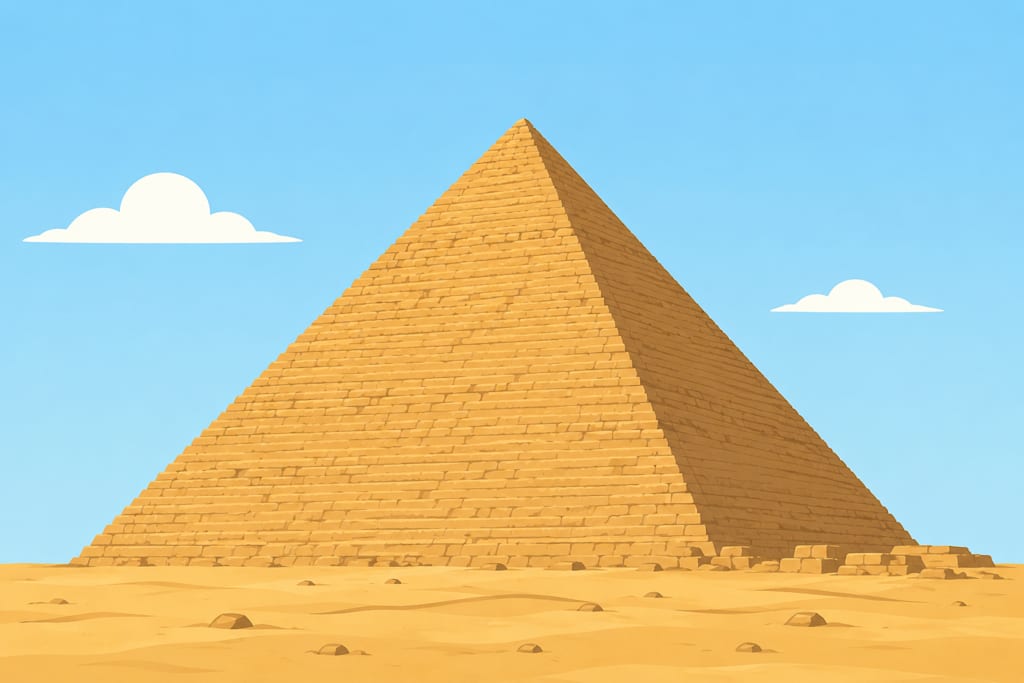
Hemiunu stood on the limestone plateau, his shadow elongated and slender like a needle directing attention toward the Nile. For any other individual, the plateau appeared as a barren expanse of rock and heat. For him, it represented a canvas of immaculate geometry.
"The southeast corner is sinking," a foreman yelled, his voice hoarse from years of inhaling stone dust.
Hemiunu did not turn around. He focused on the papyrus scroll in his grasp, thick with a decade's worth of calculations. "It is not sinking, Merer. The bedrock has a fissure. We will grout it with the slurry of the gods and shift the casing stones two palms to the West. The Earth will support it. It must support it."
For twenty years, Hemiunu had existed in the shadow of a specter. The Great Pyramid—the Akhet Khufu, the Horizon of Khufu—was more than just a monument. It was a mechanism crafted to defy the one entity no Pharaoh could conquer: Time.
The Weight of Ambition
Thousands of men swarmed the structure like ants on a fallen piece of fruit. There was no sound of whips cracking here; these were men compensated with bread, beer, and the promise of eternal life. To construct the King’s house was to secure one’s own position in the Field of Reeds.
Hemiunu ascended the temporary ramps, his lungs aflame. He arrived at the King’s Chamber, deep within the core of the ascending mountain. In this space, the air was tranquil and carried the scent of cedar oil and sweat. He placed his hand on the red granite walls, transported from Aswan, hundreds of miles to the south. Each block weighed as much as twenty oxen.
"If we are off by the width of a hair," Hemiunu murmured to the darkness, "the soul of the King will become ensnared among the stars. He will be trapped in the Duat, the rains will cease, and the Nile will turn to dust."
He was not merely constructing a tomb. He was creating an anchor for the universe. When the final capstone—the pyramidion—was coated in electrum and positioned atop the peak, it would capture the first rays of the sun and reflect them back to the heavens, a signal fire proclaiming: We were here.
The Breath of the Mountain
Centuries flowed into millennia. The once brilliant white Tura limestone, which had the power to blind travelers from great distances, began to creak under the burden of its own eternal existence.
By the time the Roman legions passed by its base, the Pyramid had already become an ancient enigma. They gazed upward and perceived a mountain; they did not recognize the mechanism. Yet deep within the granite core, something stirred. Not a specter, but a force—the gradual, tectonic settling of millions of tons of stone.
In the year 820 CE, Caliph Al-Ma'mun arrived with a contingent of laborers and an insatiable desire for gold.
"The ancients concealed the knowledge of the stars within," the Caliph proclaimed, his silk robes billowing in the desert breeze. "And their gold. It is said that the iron does not corrode and the glass remains unbroken inside."
His engineers struggled to locate the entrance, obscured behind the flawless limestone. Consequently, they resorted to fire and vinegar. They heated the stones with enormous bonfires until they glowed red, then doused them with cold vinegar to induce shattering.
"We have breached it!" a scout shouted.
Al-Ma'mun stepped into the "Robber’s Tunnel," a jagged, charred opening. They crawled through the darkness, their torches casting elongated, flickering shadows that danced like the spirits of Hemiunu’s laborers. Upon finally breaking into the Grand Gallery, the Caliph gasped.
The walls ascended in a stunning corbelled vault. It was a sanctuary of silence. They ascended the steep slope, their boots slipping on the polished surface, until they reached the King’s Chamber. The Caliph raised his torch over the sarcophagus.
It was vacant.
No gold. No scrolls of celestial wisdom. Merely a lidless box of dark brown granite
"The treasure is the silence," the Caliph murmured, comprehending the true magnitude of the achievement. "Seal the opening. We have witnessed enough."
The Muon’s Ghost
The narrative did not conclude with the Caliph. It lingered. It lingered through the Ottoman Empire, through the advent of Napoleon’s scientists, and through the era of the combustion engine.
In the year 2026, Dr. Aris Thorne found himself seated in a dimly lit tent at the base of the plateau, fixated on a computer screen. His gaze was not directed at the stone; rather, he was observing subatomic particles known as muons. These cosmic rays cascaded down upon the pyramid from the cosmos, traversing through stone yet decelerating upon encountering a void.
"There," Aris murmured, gesturing towards a blue bloom displayed on the digital map of the pyramid's interior.
"Another hallway?" inquired his assistant.
"No," Aris replied, his heart pounding against his chest. "It’s a chamber. Positioned above the Grand Gallery. It has remained sealed for four thousand six hundred years. No Robber's Tunnel, no vinegar, no dynamite. It’s untouched.
Employing a fiber-optic camera no broader than a needle, they penetrated a microscopic fissure in the masonry. The feed sprang to life on the monitor.
The world held its breath.
The camera unveiled a room not brimming with gold, but rather containing copper tools, a solitary unfinished papyrus, and a bowl of desiccated grain. It was the "Workman's Ghost"—a staging area preserved exactly as it was on the day the final block was sealed.
At that moment, Aris comprehended that the Great Pyramid was not merely a riddle to be unraveled. It was a dialogue. Hemiunu had conveyed a message, not through words, but through the very existence of the structure's endurance.
The message was straightforward: We anticipated your eventual arrival. We understood your desire to uncover how we accomplished this. And we opted to allow the stone to articulate on our behalf.
As Aris exited the tent, the sun was descending, casting the pyramid into a silhouette of unattainable perfection. The cacophony of Cairo’s traffic receded into the background. For a fleeting moment, the 26th century BCE and the 21st century CE converged. The machine continued its operation, drawing humanity's gaze skyward, reminding them that while flesh is ephemeral, the dreams we harbor can indeed be fashioned from stone.
About the Creator
Enjoyed the story? Support the Creator.
Subscribe for free to receive all their stories in your feed.
Comments
There are no comments for this story
Be the first to respond and start the conversation.