
The Conqueror of Ages
The Rise of Sultan Mehmed fatih and the Fall of Constantinople
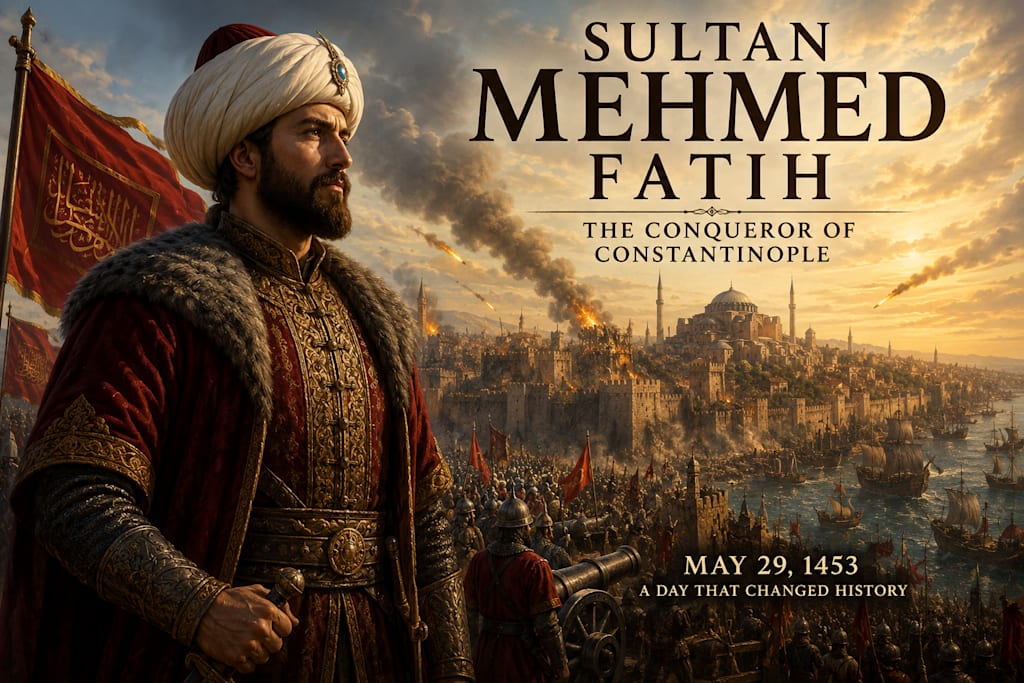
In the heart of the mighty Sultan Mehmed II Empire, a young prince carried dreams greater than kingdoms. While other children played in palace gardens, Mehmed studied maps, battle strategies, science, and the teachings of great leaders. From an early age, he believed he was destined for something extraordinary — to conquer the legendary city of Constantinople, a fortress that many rulers had failed to capture for centuries.
Born in 1432, Mehmed was the son of Sultan Murad II. He grew up in the royal courts of the Ottoman Empire, surrounded by scholars, warriors, and teachers. His mind was sharp, and his ambition burned like fire. He learned several languages, including Arabic, Persian, Greek, and Latin. He read about Alexander the Great and admired brave commanders who changed history.
At only twelve years old, Mehmed briefly became Sultan when his father stepped down from the throne. But the empire faced many dangers, and his young age caused fear among the ministers and enemies. Soon, Sultan Murad returned to rule again. Though some considered Mehmed inexperienced, this period taught him valuable lessons about leadership, patience, and politics.
Years later, after the death of his father, Mehmed became Sultan once more at the age of nineteen. This time, he was determined to fulfill his greatest dream — conquering Constantinople.
Constantinople was one of the strongest cities in the world. Protected by giant walls, deep waters, and experienced soldiers, it stood as the capital of the Byzantine Empire for over a thousand years. Many Muslim rulers had tried to conquer it before, inspired by the prophecy of Prophet Muhammad ﷺ, who praised the future commander and army that would capture the city.
Mehmed believed he could become that commander.
He began preparing carefully. Instead of rushing into battle, he spent years building a powerful army and modern weapons. He ordered the construction of massive cannons, unlike anything seen before. One enormous cannon was so huge that dozens of oxen were needed to move it. He also strengthened the Ottoman navy to control the seas around Constantinople.
The Byzantine Emperor, Constantine XI, knew danger was approaching. Yet he trusted the city’s mighty walls and hoped Europe would send help. But Sultan Mehmed’s determination was stronger than fear.
In April 1453, the great siege began.
Ottoman soldiers surrounded Constantinople from land and sea. Day and night, giant cannons shook the earth as stones crashed against the ancient walls. Smoke filled the skies, and the people inside the city prayed for survival.
But the walls still stood.
Then Sultan Mehmed created one of the most brilliant military strategies in history. A giant chain blocked Ottoman ships from entering the Golden Horn harbor. Instead of giving up, Mehmed ordered his soldiers to move ships across land. Hundreds of men pulled the ships over greased wooden logs during the night. By morning, Ottoman ships appeared inside the harbor, shocking the defenders of Constantinople.
Fear spread through the city.
The siege continued for weeks. Food became scarce, and exhaustion filled both armies. Yet Mehmed never lost hope. He inspired his soldiers with speeches about courage, faith, and destiny.
Finally, on May 29, 1453, the final attack began before sunrise. Drums thundered, soldiers charged forward, and cannons roared like storms. Wave after wave of Ottoman warriors attacked the weakened walls.
During the fierce battle, Emperor Constantine XI fought bravely among his men. Refusing to flee, he died defending his city. Soon, Ottoman flags rose over Constantinople.
After centuries of resistance, the city had fallen.
At only twenty-one years old, Sultan Mehmed achieved what many believed impossible. He entered Constantinople not as a destroyer, but as a ruler with vision. He ordered protection for civilians and respected the city’s churches and culture. He wanted Constantinople to become the heart of a new golden age.
The city was later renamed Istanbul and transformed into the shining capital of the Ottoman Empire. Scholars, artists, traders, and architects from different lands came to live there. Under Mehmed’s rule, the empire grew stronger and more advanced.
Because of his victory, Mehmed earned the title “Fatih,” meaning “The Conqueror.”
Yet his greatness was not only in war. Sultan Mehmed loved knowledge and learning. He invited scientists, poets, and philosophers to his court. He believed a ruler should master both the sword and the mind. His leadership changed the course of world history and marked the end of the medieval era.
Even today, the story of Sultan Mehmed Fatih inspires millions around the world. His courage teaches that age does not limit greatness. His determination proves that impossible dreams can become reality through patience, intelligence, and faith.
From a young prince with a vision to the conqueror of Constantinople, Sultan Mehmed Fatih became one of history’s most legendary rulers — a leader whose name would echo through the centuries forever.
About the Creator
Enjoyed the story? Support the Creator.
Subscribe for free to receive all their stories in your feed.
Comments
There are no comments for this story
Be the first to respond and start the conversation.