
The Case India Never Solved…| Airdrop Mystery!
India Never Solved

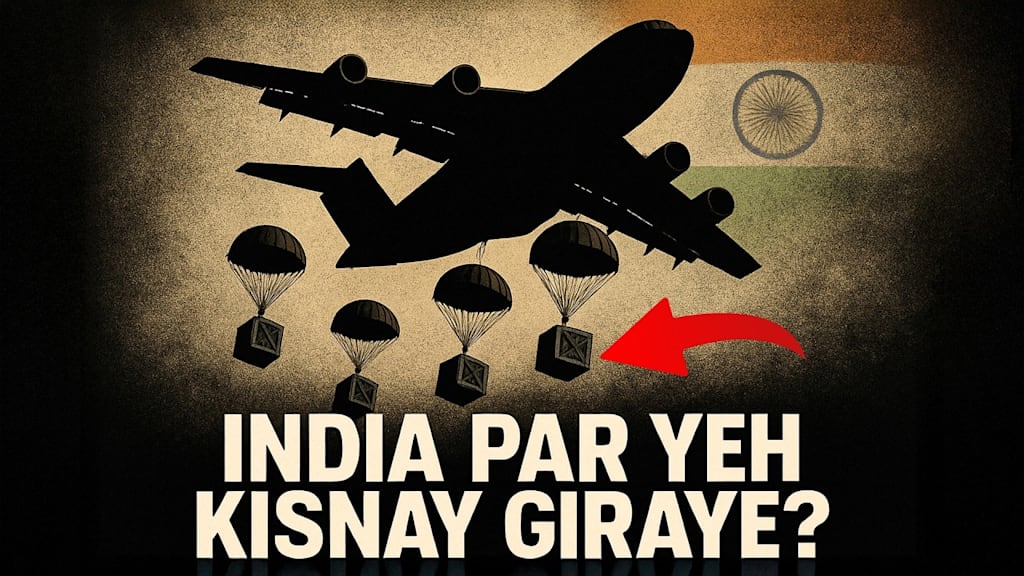
On the morning of 18 December 1995, people in a village in India spotted a shining object lying among the fields. When they went closer, they discovered a strange rifle unlike anything they had seen before. While villagers were still trying to understand how the rifle had appeared there, they found 35 more rifles scattered nearby.
News spread quickly. The entire village gathered, and soon the police arrived at the scene. The situation became far more serious when tank-destroying grenades were recovered from a nearby pond.
This incident took place in the Purulia district of the Indian state of West Bengal, where the mysterious case of weapons falling from the sky remains unsolved to this day.
When police thoroughly searched the surrounding area, they also found broken olive-green boxes attached to parachutes. In total, three such boxes and parachutes were recovered. However, authorities still could not understand who had dropped them there or why.
As the case escalated, the army was called in. One thing was certain: if the boxes had been dropped by parachute, then an aircraft must have been involved.
Investigators learned that during the previous night, an aircraft had been seen flying unusually low over Purulia district. Perhaps the weapons had come from that plane. But whose aircraft was it, and why had it dropped weapons specifically over Purulia?
The recovered boxes contained around 300 AK-47 rifles, twenty-five 9mm pistols, two sniper rifles, two night-vision binoculars, more than 100 grenades, and 16,000 rounds of ammunition. The total weight exceeded four tons.
By now, the media had picked up the story, and everyone was asking the same question: who had dropped four tons of weapons over Purulia, and why?
Investigators examined old flight logs and discovered that an Antonov An-26 aircraft belonging to a Latvian airline had taken off from Karachi, passed through Varanasi, and flown directly over Purulia before exiting Indian airspace near Kolkata. After leaving India, the aircraft headed to Thailand and landed in Phuket.
But there was still no direct proof that this aircraft had carried out the airdrop.
However, after leaving Indian airspace, the plane made a mistake that increased suspicions. When requesting permission to enter Indian airspace, the pilot had declared Cambodia as the destination, as required under aviation procedures. But the aircraft actually landed in Thailand.
A few days later, on 2 December 1995, the same Latvian aircraft again requested permission to enter Indian airspace while returning from Phuket. This time, it claimed its destination was Latvia, though it first intended to refuel in Karachi.
Indian authorities were prepared. As soon as the aircraft entered Indian airspace, two Mikoyan MiG-21 fighter jets from the Indian Air Force intercepted it and ordered it to land at Mumbai airport.
This is where another story began.
For 45 minutes after landing at Mumbai airport, no security force or airport staff approached the aircraft. There were eight people onboard, whose identities became crucial to understanding the case.
One of them was a Danish citizen named Kim Davy. He had spent the previous 18 years working on community-building projects around the world, including projects in Guatemala, Russia, and surprisingly, agricultural projects in Purulia itself — the same district where the weapons had been dropped.
Another man was Peter Bleach, a British citizen and former member of the UK’s Special Air Service. He later became an arms dealer. Years after the incident, it emerged that he had allegedly worked as an undercover agent for MI6.
The third key figure was an Indian-Singaporean national named Deepak Malhotra, a follower of an organization called Ananda Marga.
Interestingly, the headquarters of Ananda Marga was located very close to the area where the weapons were dropped.
The remaining five people onboard were Latvian crew members.
While the aircraft sat at Mumbai airport during those unexplained 45 minutes, Kim Davy allegedly collected some documents and disappeared from the airport. For years afterward, his whereabouts remained unknown.
Soon after Davy escaped, security forces surrounded the aircraft and arrested the remaining seven people onboard.
A search of the plane uncovered photographs of Ananda Marga’s headquarters in Purulia, along with partially burned documents related to the weapons. Authorities became convinced that the three weapons-filled boxes had indeed been dropped from this aircraft.
But the most important question remained unanswered: why was the mission carried out, and who planned it?
During the investigation, Peter Bleach stated that he was an arms dealer and that Kim Davy had asked him to arrange a shipment of weapons from Bulgaria. According to Bleach, he had been told the weapons were intended for the Bangladeshi military.
Bleach claimed he became suspicious that the weapons might be used illegally and informed British intelligence about it. However, he said senior officials instructed him to continue.
This raised another question: if the weapons were genuinely meant for the Bangladeshi military, why were they being airdropped over Purulia in India?
The real reason remains unclear even today.
However, an investigation by BBC suggested that the weapons were actually intended for Ananda Marga.
Later, Indian investigators contacted Interpol to locate Kim Davy and learned that he was living in Denmark.
In interviews, Davy admitted he had worked with members of Ananda Marga, who, according to him, were facing severe persecution in West Bengal. He claimed the weapons were meant for their self-defense.
Controversy intensified when Davy alleged that members of the Indian National Congress party, India’s Prime Minister, and even officials from Research and Analysis Wing (RAW) had helped him.
According to Davy, politicians including Pappu Yadav and Prime Minister P. V. Narasimha Rao assisted him in escaping from Mumbai airport and leaving India safely.
India’s Central Bureau of Investigation rejected all these allegations, stating that Davy fabricated the story to avoid extradition to India.
At the time of the incident in 1995, West Bengal was governed by the Communist Party of India (Marxist). Followers of Ananda Marga were reportedly increasing in number, which some believed posed a political challenge to the ruling party.
Davy later claimed that Ananda Marga followers were secretly attacked by CPI members, while authorities dismissed such incidents as mob violence.
However, there has never been conclusive proof supporting Davy’s allegations that India’s central government or intelligence agencies were involved.
Davy also alleged that the Indian National Congress wanted unrest in West Bengal so the state government could eventually be dismissed under presidential rule.
He claimed that if he had been captured in Mumbai, the truth would have come out, which is why he was allegedly allowed to escape in a black SUV waiting outside the airport before quietly leaving for Denmark.
Meanwhile, the Calcutta High Court sentenced Peter Bleach, Deepak Malhotra, and the five Latvian crew members to life imprisonment for conspiring against India.
Yet over time, all of them were released one by one.
The five Latvian crew members were granted Russian citizenship while in prison, and in 2000 they were pardoned following a request from Vladimir Putin.
In 2004, Peter Bleach was also pardoned and released, leading to speculation that the British government had pressured India for his release.
Former MI5 agent Annie Machon later claimed that Peter Bleach had indeed worked for MI6 and carried out secret missions for them.
Meanwhile, Danish courts refused India’s extradition request for Kim Davy, arguing that he might face torture if sent back.
During raids on Peter Bleach’s property with the help of British police, investigators reportedly found documents linked to the arms shipment carrying signatures of a Bangladeshi military general named Mohammad Shobid Al Bhuiyan. Some recovered boxes also reportedly carried the name of a Bangladeshi military cantonment.
However, the Bangladeshi government dismissed the documents as fake.
To this day, the Purulia arms drop case remains incomplete and mysterious.
Who was truly responsible for dropping four tons of weapons over Purulia? Who planned the operation? Was Kim Davy the mastermind, or merely a pawn?
Who paid for the weapons?
Why did it take security forces 45 minutes to reach the aircraft after it landed in Mumbai?
And despite tight security, how did Kim Davy manage to escape so easily?
These are the questions that still remain unanswered nearly 30 years later.
About the Creator
Imran Ali Shah
🌍 Vical Midea | Imran
🎥 Turning ideas into viral content
✨ Watch • Share • Enjoy
Enjoyed the story? Support the Creator.
Subscribe for free to receive all their stories in your feed.
Comments
There are no comments for this story
Be the first to respond and start the conversation.