
The Beginning of AI-WAR | Khatray Ki Ghanti
Beginning of AI-WAR

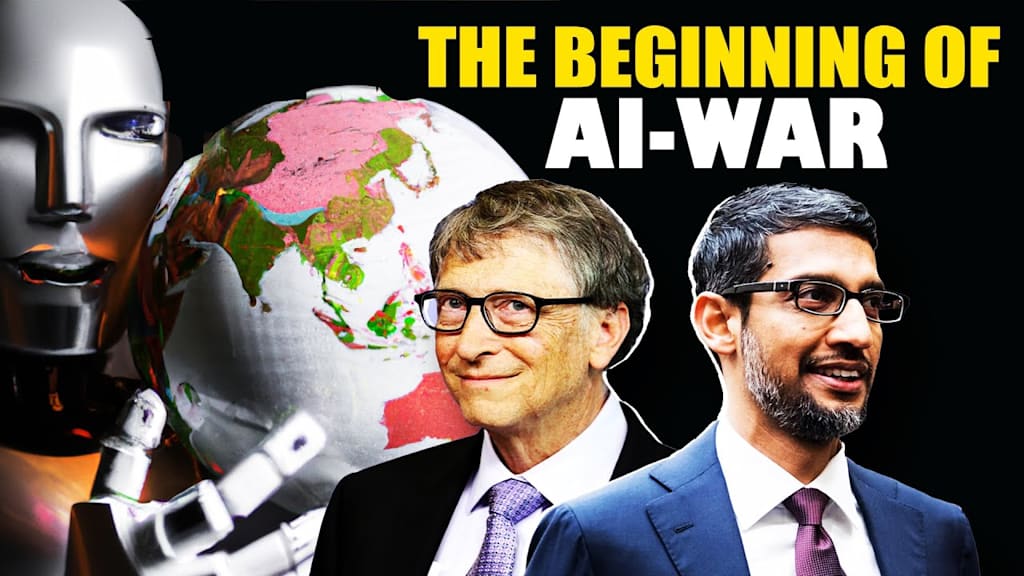
For the past 20 years, Google has been the undisputed king of internet search. Many multi-billion-dollar companies tried to compete with Google Search, but eventually failed.
It seemed like Google had firmly established itself, and removing it from the top position was nearly impossible.
But this time, a new challenger has entered the field—and it’s not just a company, but something much bigger. It’s ChatGPT.
This chatbot is ringing alarm bells not only for Google but also for many industries that could be heavily affected by artificial intelligence in the future.
So what exactly is ChatGPT? How can it benefit ordinary people? Why is a company like Google worried about it? And which industries could be impacted by it?
Welcome back.
It seems like Stephen Hawking’s prediction may be coming true. Before his death, he said that artificial intelligence could become so advanced that human intelligence might seem insignificant in comparison. In short, he warned that machines could dominate humans—and perhaps that era is beginning.
Back in 1997, Google Search was launched from a small room. Its biggest strength has been fast and accurate results. Today, around 90% of global searches happen on Google.
Whether it’s movie reviews, recipes, or school projects—people rely heavily on Google. Although Google owns other platforms like Gmail, Ads, and YouTube, about 60% of its revenue comes from search.
Today, Google’s total value exceeds $1.15 trillion. However, due to ChatGPT’s sudden rise, Google even issued an internal “code red” alert to its employees.
According to reports, Google’s management became concerned about how quickly ChatGPT gained popularity.
ChatGPT is an AI chatbot that communicates like a human. It can instantly answer questions in detail.
Now, you might wonder—Google does that too. So what’s the difference?
The problem is not speed—it’s how information is delivered.
On Google, you often need to visit multiple websites and read several articles to find the exact answer. But ChatGPT provides a direct, detailed response within the chat itself.
Whether it’s solving complex math or physics problems, correcting code, or even generating full programs—ChatGPT can do it within seconds.
In fact, it can even pass exams like MBA tests.
Because of these extraordinary abilities, ChatGPT gained massive attention worldwide. Within just 2 months, it reached 100 million users.
For comparison:
TikTok took 9 months
Instagram took over 30 months
Google Translate took over 70 months
As mentioned earlier, Google depends heavily on search revenue, and ChatGPT’s popularity is becoming a threat.
Another major concern for Google is the company behind ChatGPT—OpenAI, which is backed by Microsoft.
Microsoft already has its own search engine, Bing. In 2019, Microsoft invested $1 billion in OpenAI, and since then, both companies have collaborated on multiple projects.
One such project is DALL·E, which can generate images based on user input.
Microsoft has announced plans to integrate these AI services into Bing, which is a major concern for Google.
In the tech world, users quickly shift to better services. Just like how Facebook replaced earlier platforms.
To respond, Google has also started working on its own AI chatbot called Google Bard (now known as Gemini), as confirmed by CEO Sundar Pichai.
This sets the stage for a major AI competition.
These AI systems don’t just provide stored information—they can “think” in a way. Just like human intelligence improves with time and experience, AI systems also evolve.
Currently, they don’t have emotions, but in the future, they might develop something similar—which could be risky.
While AI offers many benefits, it also has downsides.
Industries that could be affected include:
Writers and content creators
Programmers
Call center jobs
Tasks that once took days or months can now be done in seconds.
There’s also concern that human thinking ability may weaken due to over-reliance on AI.
In conclusion, while artificial intelligence will make access to information easier, it could also lead to job losses for millions of people worldwide.
About the Creator
Imran Ali Shah
🌍 Vical Midea | Imran
🎥 Turning ideas into viral content
✨ Watch • Share • Enjoy
Enjoyed the story? Support the Creator.
Subscribe for free to receive all their stories in your feed.
Comments
There are no comments for this story
Be the first to respond and start the conversation.