World History
The Desperate Decree: How Hitler's October 1944 Order Mobilized the Volkssturm Against the Inevitable. AI-Generated.
The Desperate Decree: How Hitler's October 1944 Order Mobilized the Volkssturm Against the Inevitable October 1944 marked a dark turn in World War II. Allied forces pushed hard from the west, while Soviet troops crushed in from the east. Germany lost vast lands, cities lay in ruins from bombs, and the Wehrmacht bled dry. On October 18, Adolf Hitler issued a stark command: every man from 16 to 60 must join the Volkssturm, the people's storm or home guard. This wasn't a smart plan. It screamed panic as the Reich faced its end. What did this mean for ordinary Germans? It dragged the young and old into a fight they couldn't win, turning homes into battle zones.
By Story silver book 11 months ago in History
The Rise of China: A Historical Perspective
The rise of China is one of the most extraordinary transformations in modern history. In the span of just a few decades, China evolved from a largely agrarian and impoverished nation into a global superpower. Its journey from the chaos of imperial decline to becoming a major player on the world stage represents a story of vision, resilience, and calculated reform. The rise of China is not merely a tale of economic growth; it is a story of national revival — a renaissance that reshaped global politics, economics, and the very structure of world power.
By Muhammad Daud 11 months ago in History
Veil of Shadows Case File #27: The Brownsville Encounter
The last heat of summer still clung to the Willamette Valley when the sky opened over a quiet stretch of Highway 99. In 1954, there was no I-5 slicing through the fields, only a two-lane ribbon of blacktop winding through Brownsville, Oregon; flanked by stubbled farmland that had already surrendered its hay. The air was cool enough to keep the windows rolled up on the old 1938 Packard as three individuals made their way down the highway.
By Veil of Shadows11 months ago in History
The Beauty of Traditions Across Faiths
In a quiet neighborhood where cultures intertwined, the calendar was never empty. Every season brought festivals, ceremonies, and rituals that reflected the rich tapestry of human belief. Families celebrated differently, yet there was a shared rhythm to life—a heartbeat made of devotion, love, and tradition.
By Nangyal khan11 months ago in History
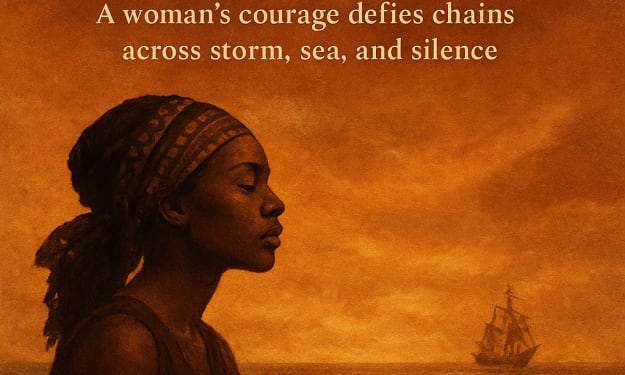
The Drums of Freedom’s Endless Echo
“The Drums of Freedom” The waves of the Atlantic shimmered gold under the morning sun, but for those chained beneath the deck of the Mercy’s Cross, it was a sea of sorrow. The year was 1787, and the slave trade between West Africa and the Americas was at its height. The ship creaked under the weight of despair, its wooden hull soaked with tears and salt. Among the captives was Abeni, a young woman from the Yoruba lands of West Africa. Only a month earlier, she had danced at her sister’s wedding, her laughter echoing through the palm trees. But that joy had been shattered when raiders descended upon her village — men with guns, guided by others who spoke her language but carried the greed of foreign traders in their eyes. Now, Abeni sat in darkness, her wrists raw from the iron cuffs, her body trembling from the stench and heat. Around her, dozens of others breathed in shallow gasps. The air was thick with grief. Yet even there, beneath the suffocating deck, she could still hear it — a faint rhythm, a pulse of life. Someone was tapping quietly on the wooden planks. A message. A memory. A beat of home. That night, as the sailors drank above deck and the ocean whispered below, the tapping grew louder. The rhythm spread — from one prisoner to the next — until the entire hold throbbed like a beating heart. The enslaved spoke no single tongue, yet the rhythm became their common language. It carried courage. It carried defiance. Above, the ship’s first mate, a wiry man named Thomas Blake, frowned. “They’re making noise again,” he growled. The captain, Edward Lowe, waved a dismissive hand. “Let them,” he said. “It breaks no chains.” But in truth, it did — just not the kind of chains they could see. Abeni remembered the stories her grandmother had told — that the spirits of the ancestors traveled on the wind, that even in the deepest darkness, their song could call the lost home. She began to hum softly, her voice trembling at first, then strengthening as others joined in. It was a song of mourning and hope, of rivers and rain, of mothers waiting at the shore. The sailors tried to silence them, but the song returned each night. It became their prayer and their protest. Even as disease spread and the weak were thrown overboard, the rhythm continued. Each beat said, “We live. We endure.” Weeks passed. The Mercy’s Cross neared the Caribbean, its human cargo destined for the sugar plantations. But the sea, it seemed, had other plans. A storm gathered on the horizon — black clouds rolling like angry gods. The wind howled, tearing at the sails. Waves slammed against the ship, and lightning split the sky. In the chaos, one of the iron locks on the lower deck broke loose. Abeni saw her chance. With bleeding hands, she helped others free themselves, passing along the broken chain link like a sacred relic. When the next wave struck, they rose together, bursting onto the deck amid rain and thunder. The sailors shouted, blades flashing, but the storm itself seemed to fight for the captives. Lightning struck the mainmast, setting it aflame. The ship lurched violently, splitting along its side. In that wild, furious moment, Abeni threw herself into the sea — into freedom or death, she did not know which. The next morning, the Mercy’s Cross was gone, swallowed by the Atlantic. Debris floated on the waves — broken wood, torn rope, shattered chains. And among them, clinging to a plank, was Abeni. She coughed, gasped, and stared at the endless horizon. The sea had spared her. Days later, a small fishing vessel from the Bahamas found her drifting near an island. The fishermen, freedmen themselves, pulled her aboard. Though weak, Abeni managed to whisper, “Home.” They did not know where her home was, but they understood what she meant. Years later, stories spread among the enslaved in the Caribbean — of a woman who escaped the Mercy’s Cross, who taught her people the rhythms of freedom. On moonlit nights, they said, she gathered others in secret and beat on drums made from hollowed wood and stretched hide. The rhythm echoed the heartbeat of those who refused to be broken. And so, the legend of Abeni — The Woman of the Drums — lived on. Her song crossed oceans, carried in whispers and work songs, in the pulse of every freedom struggle to come. For as long as the drums beat, the world would remember: The spirit can be bound, but never silenced.
By Mukhtiar Ahmad11 months ago in History
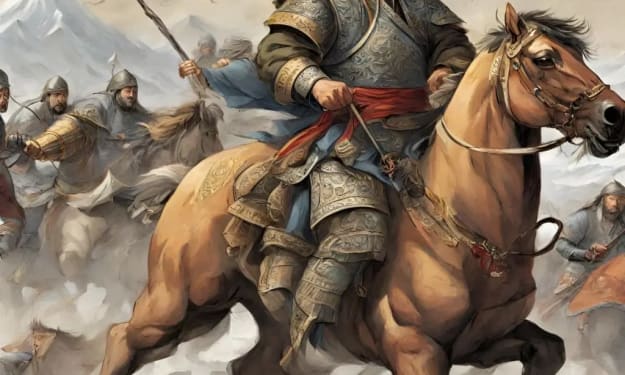
Changez Khan: The Man Who Changed the World
Eight hundred years ago, in the cold, windy lands of Mongolia, a boy was born who would one day shake the world. His name was Temujin, but the world would remember him as Changez Khan — or Genghis Khan, meaning “Universal Ruler.”
By Ghalib Khan11 months ago in History
Changez Khan: The Storm That Shaped the World
In the endless steppes of Mongolia, where the wind howls like a living spirit and life is a battle against the elements, a boy was born who would one day shake the world. His name was Temujin, but history would remember him as Changez Khan — Genghis Khan, the Great King of the Mongols.
By Ghalib Khan11 months ago in History