World History
Mystery of hindenburg
• German Airship Hindenburg, Sovereign of the Skies! On May 1937, around 8 PM. • A Hindenburg airplane takes off from Frankfurt, Germany. This airplane was gone to the opposite side of the Atlantic Sea, to New Jersey, America. It conveyed around 97 travelers, 36 travelers and 61 group individuals. What's more, when I utilize the word 'airplane' here, I don't mean a plane. All things being equal, the word airplane implies an Aircraft. Hindenburg was a carrier. • The world's biggest carrier. 245 meters in length. Contrast its size and the present Boeing 747 airplanes and you will acknowledge how huge it really was. Titanic, which was once the world's biggest boat, Hindenburg was just 24 meters more limited than it. To this end Hindenburg was known as the Sovereign of the Skies and was the pride of Nazi Germany. • The view inside the Hindenburg carrier was astounding. Individuals would see such extravagances while flying overhead, which maybe is lost today. Individuals had separate rooms to stay in bed, a different lounge area where everybody could eat together a different parlor with a fantastic piano. • There was likewise a perusing and composing room and a ticket cost was $700 around then which is more than $7,000 today. Essentially, just the rich could bear to go in this. sixth May 1937 following a 3-day long excursion, Hindenburg arrives at America huge number of miles away. • It needs to land at Lakehurst Maritime Air Station in New Jersey. It begins dropping gradually. It was 7 PM. While landing, individuals on the ground clutch its ropes. It had an alternate approach to landing. Many individuals had assembled around to see it land since it was an extremely noteworthy boat. A few cameramen were likewise present there. • That day, this arrival of Hindenburg was being recorded on camera. The weather patterns weren't ideal.
By Jacks sparrow3 years ago in History
Leadership and Progress
In the heart of Nigeria, a nation pulsating with dreams, diversity, and determination, the year 2023 brought with it a tidal wave of anticipation. The air crackled with excitement as the country stood on the brink of a pivotal moment in its history—the upcoming presidential election. The theme that echoed through every corner was "Leadership and Progress: Inspiring Hope through the 2023 Nigeria Presidential Election."
By Miracle Oluebube3 years ago in History
World's Biggest Explosion
World's Biggest Explosion in the history of world Introduction The year was 1908, a time when the world was on the brink of transformation. Amidst this backdrop of change, an event occurred that defied comprehension and left a mark that would linger for generations to come. On June 30, 1908, a colossal explosion of extraordinary magnitude shattered the tranquility of a remote Siberian wilderness, forever earning its place in history as the world's largest explosion.
By Rocking rocks 3 years ago in History
A Journey Through Time
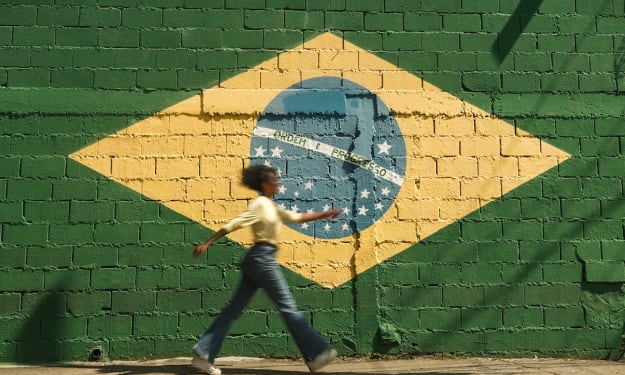
Introduction A century ago, Brazil was a nation in flux, with réis as the prevailing currency and societal shifts in full swing. In this article, we'll embark on a journey through the Brazil of the past, delving into its economic landscape, social transformations, and cultural influences that continue to shape the nation to this day.
By Zanini do Marketing3 years ago in History
CUBAN MISSILE CRISIS
significant showdown that brought the US and the Soviet Union near battle over the presence of Soviet nuclear-armed missiles in Cuba. In the wake of pursuing a fruitful guerrilla battle against the system of Cuban dictator Fulgencio Batista, Fidel Castro came to turn on January 1, 1959. Castro was not yet a socialist, and US policymakers at first took a careful keep a watch out way to deal with his system. Throughout the span of 1959 and 1960, US-Cuban relations deteriorated because of Castro's anti-US way of talking and radical policies, particularly his refusal to hold races. At the point when obviously Castro expected to seek after a coalition with the Soviet Association, President Dwight Eisenhower slice off conciliatory connections to Cuba and started planning alternate courses of action for ousting Castro and supplanting him with somebody more agreeable to the US. Perceiving that Castro and his administration were turning out to be progressively unfriendly and transparently went against to the US, Eisenhower guided the CIA to start arrangements of attacking Cuba and defeat the Castro system. On April 17, 1961, a 1,400-man invasion force of hostile to Castro Cuban exiles, Brigade 2506, arrived at the Bay of Pigs beach on the south bank of Cuba. Immediately wrecked by a counterattack of Castro's military, the invasion force was squashed two days after the fact. Bay of Pigs intrusion bombed totally. The beginnings of the Cuban Missile Crisis lie in the bombed Bay of Pigs attack, As US-Cuban relations crumbled, Castro went to the Soviet Union for help. The Soviets marked numerous exchange and help concurrences with Cuba and furthermore gave political help to the Cuban Revolution in the United Nations and other global associations. Having guaranteed in May 1960 to shield Cuba with Soviet arms, the Soviet head Nikita Khrushchev accepted that the US would find no ways to forestall the establishment of Soviet medium-and intermediate range range Missile in Cuba. Such rockets could hit a significant part of the eastern US inside a couple of moments whenever sent off from Cuba. In October 1962, an American U-2 covert spy plane secretly captured nuclear missile destinations being worked by the Soviet Union on the island of Cuba. President Kennedy didn't believe the Soviet Union and Cuba should realize that he had found the rockets. He met covertly with his consultants for a few days to examine the issue. Kennedy chose to put a maritime barricade around Cuba to keep the Soviets from getting more military supplies. He requested the evacuation of the rockets as of now there and the annihilation of the locales. Nobody was certain how Soviet President Nikita Khrushchev would answer the maritime barricade and US requests. In any case, the heads of the two superpowers perceived the staggering chance of an atomic conflict and freely consented to an arrangement where the Soviets would destroy the weapon destinations in return for a promise from the US not to attack Cuba. In a different arrangement, which stayed secret for more than a quarter century, the US likewise consented to eliminate its nuclear missiles from Turkey. Before very long the two superpowers started satisfying their commitments, and the emergency was over by late November. Cuba's socialist chief, Fidel Castro, was angered by the Soviets' retreat but was powerless to act. In August 1963, the US, the Soviet Union, and United Kingdom marked a settlement restricting climatic and underwater atomic testing. By and by, the test-boycott settlement neglected to stop the weapons contest, as Kennedy all the while approved a huge arms development that immeasurably extended the US atomic munititions stockpile and enhanced US vital prevalence in the Cold War. The Cuban missile crisis denoted the peak of an intensely opposing period in U.S.- Soviet relations. The emergency likewise denoted the nearest guide that the world had at any point come toward worldwide atomic conflict. It is by and large accepted that the Soviets' embarrassment in Cuba had a significant impact in Khrushchev's tumble from power in October 1964 and in the Soviet Union’s assurance to accomplish, in any event, an atomic equality with the US.
By Nikhil Jadhav3 years ago in History
Echoes of the Forgotten:
In the heart of the bustling city of Veridale stood a seemingly ordinary library known as "The Pages Beyond." Unbeknownst to most, this library held a magical secret—a collection of forgotten stories, each brimming with its own world of enchantment and characters waiting to be rediscovered. The librarians of The Pages Beyond were not just keepers of books; they were guardians of lost dreams and untold emotions.
By paul josiah3 years ago in History
Title: Clash of Titans:
In the annals of NRL history, certain matchups transcend the boundaries of sport, carving themselves into the collective memory of fans and players alike. One such unforgettable encounter was the grand final showdown between the New Zealand Warriors and the Manly-Warringah Sea Eagles—a clash that ignited passions, tested limits and etched itself into the hearts of rugby league enthusiasts forever.
By paul josiah3 years ago in History
The Scribe's Secret
In the heart of an ancient kingdom, nestled among the majestic mountains, there was a city steeped in tradition and history. The city had a grand library, a treasure trove of scrolls and manuscripts, meticulously preserved for generations. The custodian of this library was an elderly scribe named Marcus.
By Jansen Chang3 years ago in History