World History
The famous experiment in ancient Egypt, where babies were placed together and no one taught them to speak, would it produce a new language?
I don't know, have you ever heard of human baby language experiments. Although this experiment did not cause any harm to the baby's body, its significant impact on the baby's mental and psychological well-being has long exceeded the significance of the experimental topic itself.
By A godmother3 years ago in History
Julian Eltinge documentary Chapter 2.
I was attending school at the time as there stands on the stage today clothed in extravagant clothing, with his hair puffed up with a band. Oh Louis, your moves were so exquisite, and he was so wonderfully lighted. When the show ended, I decided to go backstage, so I entered an alley.I once met a stern stage manager who told me I was too young to speak to Mr. Lengs. I responded that I knew him, to which he replied, "You're too young. then you can enter and find Elton in a kimono and in a closet. I told him I wanted to be a female impersonator like he was and he said I was too ambitious and I wouldn't recommend it. He then gave me the most fervent and enthusiastic advice.clap my bottom and sign with the warmestI took a picture and came away with excellentreviews He was brought to New York in 1904 for his first Broadway musical, after which he moved into New York vaudeville and was paid a top salary. Audiences were astounded by his quick character changes, and one reviewer declared that they were completely deceived as to Elton's sex until he removed his wig. His act is far superior to what is referred to as female impersonation. By 1910, Elton's had attained the height of vaudeville star He portrayed both the male and female leads of a man disguising himself as a woman to expose a two-timing cat in order to capitalize on his excellent feminine impersonations. Hell His celebrity position and financial success as a Broadway in vaudeville celebrity took him to Hollywood where he appeared in four silent feature films and a sound musical and socialized with the Hollywood elite. He also built huge landmark residences and lavishly spent money on antiques. Ladies and gentlemen, I've been away for three days, but I'm back in Hollywood making my first talking movie. This year, I've been asked by multiple women on the set and in the hallways of several studios who makes my outfit. I suppose that Hollywood now leads the world in the creation of gowns because there are so many amazing movie stars who need so many outfits and costumes. This has brought all the best designers from around the world to Hollywood, despite Elton Jay's reputation for tasteful elegance and high artistry. Some critics vehemently criticized him because they saw his performances as indicators of the foreign social and moral decay invading America's shores, defending thos El Tinges was a boxer, horseback rider, and ladies' man. As the Great Depression worsened, financial problems signaled the start of El Tinges' decline. The trend for female impersonation had peaked, and it was no longer seen as lighthearted entertainment but as a sign of perversion. As a result, municipalities passed laws prohibiting drag. Alcoholism started to threaten Elton Jay's life and health in January of 1940, when a chubby Elton attempted to make a comeback in a somewhat seedy Los Angeles nightclub. However, he was denied permission to appear on stage dressed as a guest of honor in a performance at Billy Rose's Diamond Horseshoe. In 1941,Elton missed two performances and was discovered dead in his New York apartment. Sadly, within a decade of his passing, Julia Elton faded into obscurity. Today, on 42nd Street, the former Elton's dinner has been transformed into the AMC movie Plex. On the original lobby ceiling, a fresco of the three muses can still be seen, all of which feature Julia Elton as a woman. However, when show business professionals and historians discuss the great performers of the past, Elt is always mentioned.you.
By Nora Ariana3 years ago in History
Meet America's most famous female impersonator
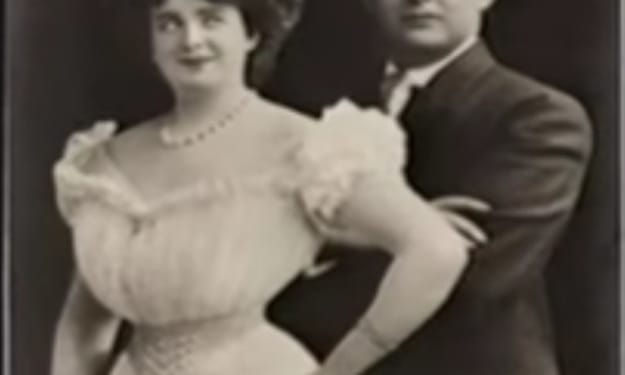
One of the most well-known female impersonators at the beginning of the century is Julian Eltinge. At the conclusion of his performances, he stunned the crowds by taking off his wig and revealing that he was a guy because his mimicry of women was so convincing. Eltinge eventually rose to the position of one of the most paid entertainers in the country and sold out theaters all over the world.His Broadway productions of "Fascinating Widow" and "The Crinoline Girl" enjoyed successful runs, and in the 1920s, he rose to fame in Hollywood.Even King Edward VII requested him to perform. who was so moved by what he saw that he sent Eltinge an English Bulldog to express his gratitude.Despite his fame, Eltinge faded from view in the 1930s as anti-cross-dressing laws spread across America and kept entertainers like Julian from appearing in public. He passed away before drag made a comeback decades later, and his career never fully recovered.Postcards from Eltinge's female imitation presentations, like this one, serve as a reminder that drag has a long history and has endured over the years. Julian Eltinge documentary A short story complex of a feature length documentary project exploring the life and career of Julian Eltinge, the most talented unique,and underrated females illusionist in america show business notwithstanding objections, even. The Empire Theatre, which had been constructed in 1912 on 7th Avenue and weighed 7.4 million pounds, was moved on tracks to a new location near 8th Avenue on Sunday, March 2. Few people who attended the performance were aware that the theater had previously been known as the Elton's Theatre in honor of Julian Elton, a celebrated female illusionist and prominent figure in theater and film during the first third of the 20th century. In contrast to female impersonation in vaudeville, which came from variety shows and saloon entertainments, which consisted of portraying elderly Crohn's and parodies of women in outlandish costumes, style draws its roots from a specialty of the blackface minstrel shows of the 19th century. These shows featured gender impersonations of women played seriously as fashionable, delicate and refined on Jews. Julia squatted happily AddThis completely his impersonations were sophisticated and clever satires of the feminine image as established by a civilization that was controlled by men at the height of gist success of Elton I first saw Elton in a vaudeville performance when I was 10 years old at the Keith Albey theater in Boston on Washington Street. I was attending school at the time and decided to play hooky to see this performance, which was the first one of the day. I purchased his ticket and found myself in a darkened theater. Syme Silverman, the founder and editor of Variety, described Elton as an actor who has no peer as great a performer as there stands on the stage today. Elton Chipiya and the audience, although he was clothed in extravagant clothing, with his hair puffed up with a band. Oh Louis, your moves were so exquisite, and he was so wonderfully lighted. When the show ended, I decided to go backstage, so I entered an alley.I once met a stern stage manager who told me I was too young to speak to Mr. Lengs. I responded that I knew him, to which he replied, "You're too young. then you can enter and find Elton in a kimono and in a closet. I told him I wanted to be a female impersonator like he was and he said I was too ambitious and I wouldn't recommend it. He then gave me the most fervent and enthusiastic advice.clap my bottom and sign with the warmestI took a picture and came.
By Nora Ariana3 years ago in History
This is how the Ukrainians managed the mega-attack!
On Thursday, Ukraine had important progress to report on land: For the first time, tanks crossed Putin’s main defense line, the 200-kilometer-long “Surovikin Line” of armored trenches and dragon’s teeth. Behind the line, fierce Russian shelling awaited. But the first heavy equipment has overcome the defense line that took months to build.
By Brian Andrew3 years ago in History
Sudan's conflict, explained Chapter 2.
Bashir had lost control over, is where the majority of the nation's oil reserves are located.Bashir granted Hemeti and the Janjaweed official status as a paramilitary unit known as the Rapid Support Forces, or RSF, in 2013 to increase his control.The group was initially subordinate to NISS, one of Bashir's security agencies in Sudan.Despite the fact that they were aiding the SAF in the ongoing Darfur war.Then, in 2017, he signed a statute that put Hemeti under his direct control and made it obvious that the RSF's primary duty was to keep him safe. Bashir granted Hemeti financial independence and gave him permission to seize control of portions of Darfur's gold mines, smuggle weapons and minerals into nations like Chad and Libya, and transfer troops into conflict-ridden areas in exchange for cash in order to keep the RSF loyal.Bashir also allowed the SAF to participate in important sectors of the economy, such as the manufacturing of weapons and telecommunications. Civilians still struggle while Bashir is busy enriching these two forces.2018 saw protests start in the midst of a terrible economic crisis.Putting his protective system to the test was the biggest difficulty Bashir had to confront at that time. The budget for the government, which contained a 60–70% allocation for the security sector, which included Bashir's bodyguards, was the decisive catalyst.whereas Sudanese people battled for their most basic requirements.The largest revolution in Sudan's history resulted from this.Random demonstrations started happening all around the nation.Then they changed to the capital city of Khartoum. Bashir resisted leaving his position. He was supported by the RSF, SAF, and other security forces, who also put pressure on the protesters who ultimately favored democracy. But the protestors persisted for months, and the RSF and SAF realized that Bashir's leadership wouldn't be as helpful to them any longer.They therefore made a move on April 11th, 2019 that alarmed both citizens and Bashir.Commanders of the SAF conspired with Hemeti of the RSF to depose Bashir. While protesters welcomed Bashir's ouster, many lacked confidence in the person who brought it about. Abdel Fattah al-Burhan, a recognized regional commander in Darfur, assumed control of the South one day after the coup.The two guys took charge of Sudan together.Since they collaborated during the turmoil in Darfur years ago, people perceived them as participants in it.One as a soldier in the Sudanese military.One as a militia chief on the same side..against significant segments of the Darfuri populace.The two men soon started attacking demonstrators. As Khartoum's pro-democracy demonstrations grew more violent, Hemeti and his forces began to repress them.During a sit-in protest on June 3rd, 2019, the RSF killed around 100 individuals.Massacres kept happening all around the nation.the next.These nations were compelled to intervene to support the transition of Sudan to democracy.The United States put pressure on Sudan's military and demonstrators to accept a power-sharing arrangement together with its Arab allies the United Kingdom, Ethiopia, and the African Union.In this new agreement, a transitional council would include protester and military members.In this scheme, civilians would be in charge for 18 months and the military for 21.This implied that the military would eventually have to cede control to the citizens who govern the nation.The issue was that, despite demonstrators' warnings The council was run by these two soldiers, with Burhan serving as chair and Hemeti as vice chair. At initially, the council carried out its duties in accordance with the agreement... and appointed Abdallah Hamdok as the new prime minister.Hamdok, however, resigned in January 2022 following numerous military interventions by these leaders, including a putsch coup in October 2021.As a result, Burhan became the de facto ruler of Sudan, with Hemeti serving once more...
By Nora Ariana3 years ago in History
Sudan's conflict, explained
Sudan saw a revolution that began spreading there on December 19, 2018. Civilians rebelled after years of tolerating President Omar Bashir's repressive military government.They desired democracy for their nation.A few months later, this man and this man participated in a coup that removed Bashir, promising the demonstrators the future they had called for.The same two men are still at war with one another four years later, tearing Sudan apart and claiming hundreds of innocent lives. Therefore, how did Sudan change from this to this in such a short period of time?How did these two strong guys change from being allies to enemies [overlapping] -Conflicts in Sudan. -a fatal coup...supportingforces..Coups have occurred frequently in Sudan.Military men have brought down leader after leader. The Sudanese Armed Forces, or SAF, are the official military of the nation and have had considerable influence there for close to a century.And not long after Sudan obtained independence from Anglo-Egyptian domination, they began to use that power. "The flags of those two countries have been replaced by the Sudanese flag." In 1958, there was a successful military coup. Former military officer and current prime minister Abdullah Kalil ousted his own civilian government to impose military authority over Sudan.A decade or so later, Colonel Jaafar Nimeiry executed a successful coup once more, overthrowing a transient democracy. Later, in 1985, Nimeiry was released. He was overthrown by this military officer, who then put in place a new democratic government. Four years later, Colonel Omar Bashir overthrew the existing administration and proclaimed himself the new ruler. But Bashir turned out to be distinct from his predecessors.Bashir was aware that, given the history of military coups, he might end up in the same situation as earlier rulers. He therefore employed a tactic known as coup proofing. where he would surround himself with guardians while controlling each one to prevent overthrow.With the SAF, it all began.Bashir strengthened the army and cultivated a close bond with them during his rule.He largely relied on them to put an end to the ongoing civil conflict in southern Sudan, where he ordered the SAF and other militias to brutalize civilians. Then, with the army occupied in the south, a new war in the west began to take shape. Crisis arose in Darfur.In the past, people here have been ignored.They felt uneasy for years due to a lack of medical supplies, basic amenities, and representation in the government of Sudan.Therefore, in 2003, the army was largely stationed in the South. In this Darfur city, rebel factions attacked the armed forces.When Bashir realized this insurrection was happening, he opted to arm the Janjaweed, a local Arab militia in the area rather than relying on the Sudan Armed Forces, or SAF, the regular military.At Bashir's request, this deadly force targeted the annihilation of civilians and rebels in Darfur. According to satellite images, the Janjaweed are probably to blame for the destruction of more than 3000 villages.The destruction in Darfur was also brought on by SAF troops.Both factions are charged with mass murder, rape, and the deliberate eviction of civilians.They killed thousands of Darfuris collectively.Bashir learned how to maintain his position from what happened in Darfur. And in need of a new guardian, he turned to the Janjaweed.There were a few guys Bashir tried to recruit into the central government from the Janjaweed militias.But there was one Janjaweed commander in particular who Bashir had the most faith in.Hemeti or Mohamed Hamdan Dagalo.Bashir referred to him as "my protection".Hemeti, his moniker, is a pun on the Arabic word hemmati, which means "my protection.South Sudan gained independence in 2011 after a protracted and brutal civil conflict, leaving Bashir in a precarious position.The Sudanese economy collapsed shortly after.The South, which..
By Nora Ariana3 years ago in History
The Glorious Legacy: Unveiling the History of the Olympic Games
In the beginning... The Olympic Games, which are frequently referred to as the most recognized sporting event that takes place anywhere in the globe, have a rich history that can be traced back thousands of years. This worldwide show has surpassed the constraints of time and space, bringing people from all over the world together in the spirit of friendly rivalry. In this essay, we look into the fascinating history of the Olympic Games, following their beginnings, evolution, and continued significance over the course of their long existence.
By Stephen Keith B. Labto3 years ago in History
Divisiveness: Haiti's age-old cancer
This September 20, 2023, marks the 265th birth anniversary of Jean-Jacques Dessalines. The one who took up the torch of the struggle for Freedom and the Dignity of the human Being, as general-in-chief of the indigenous Army after the capture and deportation of the genius Toussaint Louverture by the French. However, this date is unknown to the vast majority of Haitians since the date of his death has always been put forward, unlike the day of his birth.
By Louinel Estimable 3 years ago in History
"Sigiriya: Sri Lanka's Majestic Citadel
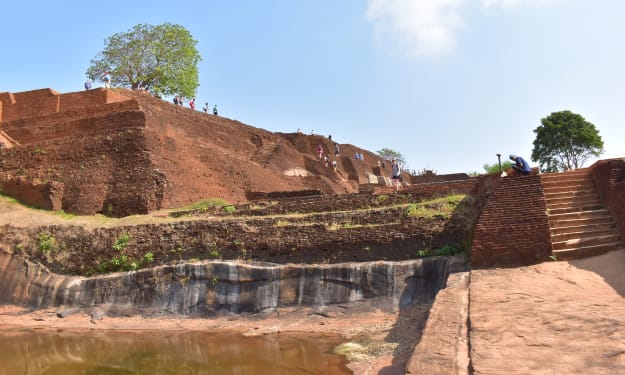
Nestled amidst the lush, tropical landscape of Sri Lanka, the ancient rock fortress of Sigiriya stands as a magnificent testament to the island nation's rich historical heritage. For history enthusiasts, Sigiriya is not just a place of natural beauty but a captivating journey into the annals of time. Join us as we embark on an expedition to explore the profound historical significance of Sigiriya, a UNESCO World Heritage site and an archaeological marvel.
By wijitha bandara vijerathna3 years ago in History
Short history of the Philippines
Once upon a time, in an archipelago known today as the Philippines, a remarkable story of human history began. It was a tale of exploration, migration, and the convergence of diverse cultures that would shape the destiny of these tropical islands.
By Joel Jeffrey Awit3 years ago in History
Abebe Bikila
Abebe Bikila was an Ethiopian marathon runner who won two Olympic gold medals, both while running barefoot. He was born in 1932 in a small village near Addis Ababa, Ethiopia. He began running at a young age, and his talent was quickly recognized. In 1956, he was selected to represent Ethiopia at the Olympic Games in Melbourne, Australia. However, he was forced to withdraw from the race due to an injury.
By Antehun sendeku3 years ago in History
First Official American Cross-Country Automobile Trip Begins - September 22, 1903
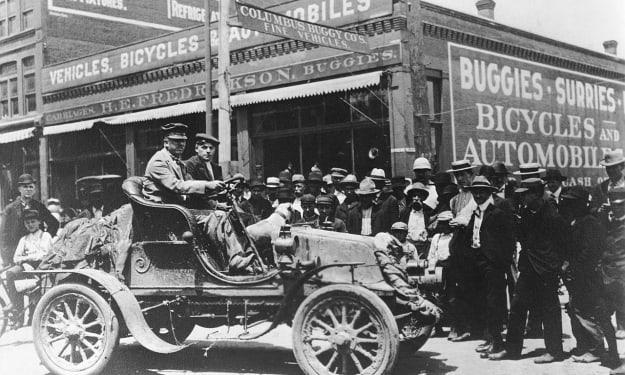
On September 22, 1903, a landmark moment in American transportation history unfolded as Horatio Nelson Jackson and Sewall K. Crocker embarked on the first official cross-country automobile trip in the United States. This audacious journey would transform the way Americans perceived travel and pave the way for the future of automotive exploration.The adventure commenced in San Francisco, California, where Dr. Horatio Jackson, hailing from Vermont, and his trusted mechanic, Sewall Crocker, set out in a used Winton touring car. Undertaking a cross-country road trip in the early 20th century was a daring endeavor. At the time, the nation's road infrastructure was rudimentary, consisting mainly of dirt paths and gravel roads, hardly suitable for automobiles.Challenges were plentiful on this historic voyage. The rugged terrain, absence of reliable maps, and frequent mechanical breakdowns tested the duo's patience and determination. At times, they were forced to employ ingenious solutions to repair their vehicle, such as using a bicycle tire to replace a damaged car tire.As they traversed the vast expanse of the American West, Jackson and Crocker encountered a series of adventures and mishaps. Crowds of curious onlookers often greeted them, and they experienced the generosity of strangers who offered their assistance. Perhaps one of the most famous incidents was their encounter with a bulldog named Bud, who became their unofficial mascot, providing companionship and a touch of whimsy to their journey.The journey extended for a grueling 63 days, and on November 5, 1903, Horatio Nelson Jackson and Sewall K. Crocker triumphantly arrived in New York City, marking the successful culmination of their cross-country odyssey. This remarkable feat captured the imagination of the American public and showcased the potential of the automobile as a mode of long-distance travel.Their expedition also underscored the pressing need for improved roads and infrastructure. It catalyzed increased interest and investment in the development of a national highway system. This, in turn, played a pivotal role in shaping the modern transportation network that seamlessly connects the United States today.The historic cross-country trip of 1903 stands as a testament to the indomitable spirit of adventure and innovation deeply ingrained in American history. It paved the way for the rapid growth of the automotive industry, the construction of iconic highways like Route 66, and the enduring tradition of road trips that continue to captivate travelers across the nation.In commemoration of this groundbreaking journey, September 22 is celebrated as a day to honor the pioneering spirit of those who embarked on the first official cross-country automobile trip, forever altering the landscape of American travel and exploration.The story of Horatio Nelson Jackson and Sewall K. Crocker's epic adventure serves as a reminder of the boundless possibilities that await those willing to venture into the unknown. Their journey is a symbol of determination, innovation, and the enduring pursuit of the American dream—a dream powered by wheels and fueled by the open road.The journey was not without its challenges. The rugged terrain, lack of reliable maps, and frequent breakdowns tested the patience and determination of the travelers. At times, they resorted to creative solutions to repair their vehicle, even using a bicycle tire to replace a damaged car tire.As the duo traversed the vast expanse of the American West, they encountered numerous adventures and mishaps. They were greeted by curious onlookers and experienced the hospitality of strangers who helped them along the way. One of the most famous incidents was when they received assistance from a bulldog named Bud, who became their unofficial mascot.The trip lasted for 63 days, and on November 5, 1903, Horatio Nelson Jackson and Sewall K. Crocker arrived in New York City, marking the successful completion of their cross-country journey. This remarkable feat captured the imagination of the American public and demonstrated the potential of the automobile as a mode of long-distance travel.Their journey also highlighted the need for improved roads and infrastructure, leading to increased interest and investment in the development of a national highway system. This, in turn, played a pivotal role in shaping the modern transportation network that connects the United States today.The historic cross-country trip of 1903 serves as a testament to the spirit of adventure and innovation that has been a driving force in American history. It paved the way for the growth of the automotive industry, the construction of highways like Route 66, and the enduring tradition of road trips that continue to captivate travelers across the nation.
By Nicholas Zeyi3 years ago in History