World History
Alexander the Great – Part 1: Birth, Childhood, and the Making of a Future Conqueror
Birth in a Kingdom on the Rise Alexander was born in 356 BCE in the ancient city of Pella, the capital of the Kingdom of Macedon. At the time, Macedon was not considered the dominant power in Greece. However, this situation was rapidly changing under the rule of Alexander’s father, King Philip II. Philip was a brilliant military reformer and strategist who transformed Macedonia into a formidable kingdom. Alexander’s mother, Queen Olympias, played an equally powerful role in shaping his early life. She was deeply religious and believed in divine signs and destiny. According to ancient legends, Olympias claimed that Alexander was descended from the Greek hero Achilles and possibly even from the god Zeus. Whether these stories were political propaganda or genuine belief, they had a profound influence on Alexander’s sense of destiny. From a very young age, he grew up believing he was meant for greatness. A Childhood Surrounded by Power and War Alexander’s childhood was unlike that of ordinary children. He grew up in a royal court filled with military discussions, political negotiations, and preparations for war. His father, Philip II, spent much of his time campaigning and expanding Macedonian power. As a result, Alexander witnessed firsthand the responsibilities and challenges of kingship. Despite Philip’s frequent absence, he ensured that Alexander received the best possible training. Alexander learned horseback riding, hunting, and combat skills at an early age. One famous story from his childhood illustrates his confidence and courage: the taming of a wild horse named Bucephalus. When no one else could control the horse, young Alexander realized that it was frightened by its own shadow. By turning the horse toward the sun and speaking calmly, he managed to ride it successfully. Philip, impressed by his son’s intelligence and bravery, reportedly said, “My son, you must find a kingdom big enough for your ambitions. Macedon is too small for you.” This moment symbolized the qualities that would define Alexander—observation, courage, and an unshakable belief in his abilities. Education Under Aristotle One of the most significant influences on Alexander’s early life was his education under the philosopher Aristotle. When Alexander was about thirteen years old, Philip invited Aristotle to tutor his son and a group of noble youths. This decision reflected Philip’s understanding that a future king needed not only military strength but also intellectual depth. Under Aristotle’s guidance, Alexander studied philosophy, ethics, politics, medicine, science, and literature. He developed a deep admiration for Greek culture and especially for the epic poems of Homer. The Iliad, which tells the story of the hero Achilles, became one of Alexander’s favorite works. He reportedly kept a copy with him during his campaigns and saw himself as a modern Achilles. Aristotle also instilled in Alexander a curiosity about the world. This intellectual foundation later influenced Alexander’s interest in geography, exploration, and cultural exchange. His campaigns were not only about conquest but also about discovering new lands and connecting different cultures. Early Signs of Leadership Even as a teenager, Alexander showed signs of strong leadership. At the age of sixteen, he was left in charge of Macedonia while Philip led a military campaign elsewhere. During this time, a local tribe rebelled against Macedonian rule. Instead of waiting for his father’s return, Alexander took swift action. He led an army, defeated the rebels, and established a new city to secure the region. This bold response demonstrated his ability to make decisions under pressure and maintain authority. At eighteen, Alexander joined his father in one of the most important battles of the time—the Battle of Chaeronea in 338 BCE. This battle pitted Macedonia against the combined forces of Athens and Thebes. Alexander commanded the Companion Cavalry, an elite unit of horsemen. His decisive charge helped break the enemy’s line and secure victory. The battle confirmed Macedonia’s dominance over Greece and proved that Alexander was not just a prince but a capable military leader. Relationship with His Parents Alexander’s relationship with his parents was complex. He admired his father’s military achievements but also felt pressure to live up to his legacy. Philip’s multiple marriages and political decisions sometimes caused tension within the royal family, particularly with Olympias. She remained a strong influence on Alexander, encouraging his belief in divine destiny and greatness. These family dynamics may have contributed to Alexander’s intense ambition and emotional intensity. He grew up in an environment where power struggles and political intrigue were common, shaping his understanding of leadership and authority. Formation of Ambition and Vision By the time Alexander reached adulthood, he had already developed a strong sense of purpose. He believed that his life was meant for extraordinary achievements. His education, training, and early experiences all pointed toward a future of conquest and glory. He admired heroes like Achilles and sought to emulate their courage and fame. At the same time, he inherited from his father a powerful army and a kingdom ready for expansion. These factors combined to create the perfect conditions for Alexander’s rise. Conclusion Part 1 of Alexander the Great’s story reveals how his early life shaped the leader he would become. Born into a rising kingdom, guided by powerful parents, educated by one of history’s greatest philosophers, and trained in warfare from childhood, Alexander developed the qualities that would later define his conquests. His courage, intelligence, ambition, and belief in destiny all took root during these formative years. Before he ever set foot on a battlefield as king, Alexander had already begun his journey toward greatness. The foundation built in his youth would soon propel him into a series of campaigns that would change the ancient world forever. In the next part of his story, we will see how a young prince became a king—and how that king began his march toward empire.
By Say the truth 7 months ago in History
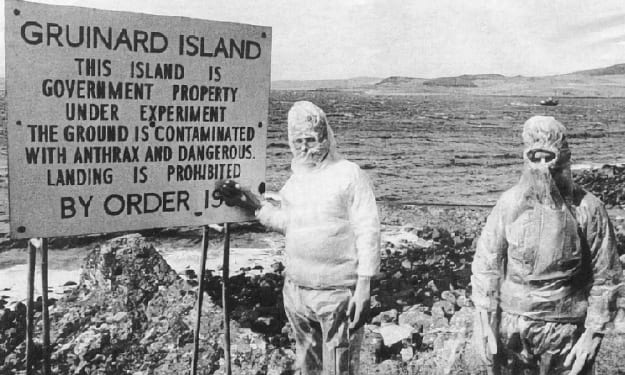
Operation Vegetarian: The Secret Plan That Was Supposed to Starve Germany and Destroyed Gruinard Island
The reason was its role during the Second World War, when its isolated location made Gruinard the ideal site for Britain's first open-air tests of biological weapons.
By Elvira Diggory7 months ago in History
Who is Bashir Zeb, the head of the banned organization BLA?
Before the attacks carried out on several cities including Quetta, the capital of Balochistan, the banned separatist organization Baloch Liberation Army (BLA) had released a video. In this picture , armed men can be seen riding three motorcycles at an unidentified deserted location. Only one of the six individuals’ face is visible. According to the banned organization, this person was the head of the BLA, Bashir Zeb, and it was also claimed that Bashir Zeb personally took part in these attacks. The BLA did not clarify where the video was recorded; however, Balochistan Chief Minister Mir Sarfraz Bugti claimed that the video was filmed in Afghanistan. It should be noted that last Saturday armed militants targeted various installations in Quetta, Mastung, Kalat, Nushki, Kharan, Dalbandin, Turbat, Tump, Gwadar, Pasni and several other areas. According to the provincial chief minister, a total of 31 civilians and 17 security personnel were killed in these attacks, while the government claimed that 145 militants were also killed. The banned BLA has been active in Balochistan for more than a decade, but in recent years the scope and intensity of attacks by the organization and its subsidiary group Majeed Brigade have increased. The BLA has been declared a banned organization by both Pakistan and the United States. It is worth recalling that since the attack on the Chinese Consulate in Karachi in November 2018, Bashir Zeb has been wanted by the Government of Pakistan in numerous cases involving attacks carried out by the BLA. These include the planning of the 2020 attack on the Karachi Stock Exchange, the planning of the female suicide bombing targeting Chinese teachers at Karachi University, and the attack on a convoy of Chinese engineers near Karachi Airport. In the airport attack case, a court has already declared him an absconder. However, there was a time when Bashir Zeb was active in student politics on the streets of Quetta. We spoke to journalists and former and current security officials, and also reviewed Bashir Zeb’s own writings and interviews given as chairman of BSO Azad, in order to understand who Bashir Zeb is and how he became part of this organization. Who is Bashir Zeb?
By Pets and animals 7 months ago in History
Alexander the Great: The Life, Conquests, Vision, and Legacy of History’s Greatest Warrior King
Part 1: Birth and Early Life Alexander was born in 356 BCE in Pella, the capital of Macedonia. He was the son of King Philip II of Macedon and Queen Olympias. From an early age, Alexander was surrounded by power, politics, and warfare. Olympias deeply influenced him, often telling him that he was descended from Achilles and even the god Zeus. These stories shaped Alexander’s belief that he was destined for greatness. His education was exceptional. At the age of thirteen, Philip appointed the philosopher Aristotle as Alexander’s tutor. Under Aristotle’s guidance, Alexander studied philosophy, science, medicine, literature, and politics. This education gave him intellectual depth, curiosity, and respect for different cultures—qualities rare among ancient warriors. Part 2: The Making of a Warrior Alexander showed military talent at a young age. At just sixteen, he was left in charge of Macedonia while his father campaigned elsewhere. When a rebellion broke out, Alexander crushed it decisively, proving his authority. At eighteen, he fought alongside Philip at the Battle of Chaeronea against the combined forces of Athens and Thebes. Alexander led the Companion Cavalry and delivered a decisive charge that shattered the enemy line. This battle demonstrated his bravery, leadership, and tactical intelligence. Part 3: Ascension to the Throne In 336 BCE, Philip II was assassinated under mysterious circumstances. At only twenty years old, Alexander became king. Many doubted his ability to rule, and rebellions erupted across Greece. Alexander responded swiftly and ruthlessly, destroying the city of Thebes as a warning. This act secured his control over Greece and cleared the path for his grand ambitions. Part 4: Conquest of the Persian Empire Alexander’s greatest achievements came through his war against the Persian Empire, the most powerful state of the time. Crossing into Asia Minor in 334 BCE, he defeated Persian forces at the Battle of the Granicus River. This was followed by a major victory at Issus, where he personally confronted King Darius III. The decisive moment came at the Battle of Gaugamela in 331 BCE. Despite being heavily outnumbered, Alexander used superior tactics, mobility, and leadership to crush the Persian army. Darius fled, and the Persian Empire collapsed soon after. Alexander captured immense treasures and took control of cities like Babylon, Susa, and Persepolis. Part 5: Egypt and the Birth of Alexandria In Egypt, Alexander was welcomed as a liberator from Persian rule. He was crowned pharaoh and founded the city of Alexandria, which would later become one of the greatest centers of knowledge in the ancient world. He also visited the oracle of Siwa, where he was declared the son of Zeus, further reinforcing his belief in his divine destiny. Part 6: Campaigns in Central Asia and India After Persia, Alexander pushed east into Central Asia, facing fierce resistance and harsh terrain. These campaigns were among his most difficult. He married Roxana, a local noblewoman, symbolizing his policy of cultural integration. In India, Alexander fought King Porus at the Battle of the Hydaspes River. Although victorious, Alexander was deeply impressed by Porus and allowed him to retain his kingdom. However, his troops, exhausted and homesick, eventually refused to march further east. This marked the limit of his expansion. Part 7: Leadership Style and Personality Alexander was a charismatic and inspiring leader. He fought alongside his soldiers, shared their hardships, and rewarded loyalty generously. However, he also had flaws. His temper could be violent, and he sometimes acted impulsively, most notably in the killing of his close friend Cleitus during a drunken argument. He believed strongly in unity between cultures and encouraged intermarriage between Macedonians and Persians. This vision of a blended empire was revolutionary but controversial among his own men. Part 8: Death and Mystery In 323 BCE, at the age of thirty-two, Alexander died in Babylon after a sudden illness. The cause of his death remains one of history’s greatest mysteries, with theories ranging from malaria and typhoid to poisoning. His empire, lacking a clear successor, quickly fragmented among his generals, known as the Diadochi. Part 9: Legacy and Historical Impact Alexander’s legacy reshaped the ancient world. His conquests spread Greek culture, language, and ideas across vast regions, creating the Hellenistic world. Cities he founded became centers of trade, science, and learning. His influence reached Rome, the Islamic world, and even modern military theory. Alexander became a symbol of ambition, courage, and the limitless potential of human will. He is remembered not only for what he conquered, but for how deeply he changed the course of history. Conclusion Alexander the Great lived a short life, but his impact was eternal. He combined intelligence with courage, vision with action, and ambition with belief. Through every part of his journey—from prince to conqueror to legend—Alexander proved that history is shaped not by time alone, but by those bold enough to challenge it.
By Say the truth 7 months ago in History
AI, Nuclear Weapons, and Accidental War
AI, Nuclear Weapons, and Accidental War In the modern world, wars are no longer fought only with soldiers, tanks, and planes. A new and dangerous element has entered global security: artificial intelligence (AI). While AI brings speed, efficiency, and advanced decision-making, it also introduces a serious risk—especially when combined with nuclear weapons. The greatest danger of the future may not be a planned nuclear war, but an accidental one.
By Wings of Time 7 months ago in History
Future Wars in the Age of Artificial Intelli
Future Wars in the Age of Artificial Intelligence If the new battlefield is hidden inside a nation’s systems, then Artificial Intelligence is becoming the most powerful weapon within it. Future wars will not begin with tanks crossing borders or fighter jets in the sky. They will begin with algorithms, data, and decisions made at machine speed. AI is changing not only how wars are fought, but also who controls power and how quickly conflicts can spiral out of control.
By Wings of Time 7 months ago in History
The Muslim Math a Christian Emperor Refused to Reject
1225, Southern Italy. A Christian emperor sits across from a mathematician trained in the Islamic world. He asks a question about numbers. What happens in the next hour will quietly reshape Europe—though no one in that room realizes it yet.
By Olga Angelucci7 months ago in History
Empire in Ashes
In late summer of the year 476, the Western Roman Empire was already a shadow of its former self, but its final hours still carried the weight of a thousand years of power. Rome no longer ruled the Mediterranean world; its emperors were puppets, its armies filled with foreign mercenaries, its treasury nearly empty. In Ravenna, the imperial capital, the teenage emperor Romulus Augustulus waited behind palace walls while events moved beyond his control. Real authority rested with Orestes, his father and commander of the army, who had seized power only a year earlier. But the soldiers who kept the empire standing had grown restless. They were foederati—Germanic troops who fought for Rome in exchange for land—and they now demanded what had long been promised. When Orestes refused, their leader, a seasoned warrior named Odoacer, turned against him. Within days, Odoacer’s forces marched across northern Italy, crushing resistance with alarming ease. Orestes was captured near Piacenza and executed, and the road to Ravenna lay open. As the final seventy-two hours began, Ravenna was tense but strangely quiet. The once-mighty empire had no legions left to defend its emperor, only thin walls and fading prestige. Odoacer’s army surrounded the city, not with the fury of a sack, but with the confidence of inevitability. Inside the palace, Romulus Augustulus—named after Rome’s legendary founder and its first emperor—stood as a tragic symbol of decline. He was young, inexperienced, and powerless, ruling an empire that existed more in memory than in reality. There was no dramatic last stand, no desperate counterattack. Negotiations replaced battles, and survival replaced pride. When Odoacer entered Ravenna, he did not burn it. He deposed the boy emperor peacefully, an act that was both merciful and final. Romulus was spared, granted a pension, and sent into exile, likely to live out his life in obscurity while history moved on without him. In the final hours, the symbols of empire were quietly dismantled. The imperial regalia—the crown, the purple robes, the insignia of supreme authority—were gathered and prepared for a journey east. Odoacer made a calculated decision that marked the true end of Western Roman rule: he did not name a new emperor. Instead, he sent the imperial insignia to Constantinople, acknowledging the Eastern Roman Emperor, Zeno, as the sole ruler of the Roman world. The message was clear and unprecedented. The West no longer needed its own emperor. What had once been the heart of a global empire was now a kingdom ruled by a barbarian king in Roman clothing. As the seventy-two hours closed, no single moment announced the fall. There were no collapsing walls or burning palaces, only the quiet disappearance of an institution that had shaped Europe, North Africa, and the Mediterranean for centuries. The Roman Senate still existed. Roman laws were still enforced. Cities still stood. But the idea of a Western Roman Emperor—an unbroken line stretching back to Augustus—was gone. The world did not end in 476, but it undeniably changed. Power fragmented, trade routes weakened, and Western Europe slowly entered a new era of competing kingdoms and shifting identities. Rome, once the ruler of the known world, became a memory, a symbol, and eventually a legend. The final seventy-two hours of the Western Roman Empire were not marked by chaos, but by quiet acceptance. Its fall was not a sudden collapse, but the last breath of a long decline. Yet even in ashes, Rome endured. Its language, laws, architecture, and ideas survived its emperors, shaping civilizations long after the crown was laid down. The empire died not with a roar, but with a whisper—leaving behind a legacy that still defines the modern world.
By Talhamuhammad7 months ago in History