World History
How Football Was Created
Football, known as soccer in some parts of the world, stands as a testament to the universality of sports. In this comprehensive exploration, we embark on a journey to uncover the roots of this globally cherished sport, from ancient civilizations to the modern spectacle of the FIFA World Cup.
By Rúni Svabo Egholm3 years ago in History
People who laughed themselves to death
Our collective fascination with death extends beyond its inevitability, often delving into the realm of the bizarre and comical. The annals of history are replete with accounts of peculiar demises that, while morbid, manage to elicit both amusement and incredulity. Among these unusual tales, the phenomenon of individuals laughing themselves to death stands out as a particularly quirky and paradoxical end.
By Rúni Svabo Egholm3 years ago in History
Unraveling the Enigma of Atlantis: A Comprehensive Journey into the Mythical Realm
Introduction The secret of Atlantis, a legendary civilization covered in legend and hypothesis, has continued for centuries, spellbinding the minds of researchers, swashbucklers, and narrators. Established in the compositions of the old Greek savant Plato, the story of Atlantis has risen above time, turning into a getting through puzzle that proceeds to interest and entrance the world.
By Kyrol Mojikal3 years ago in History
The Middle Kingdom of Egypt
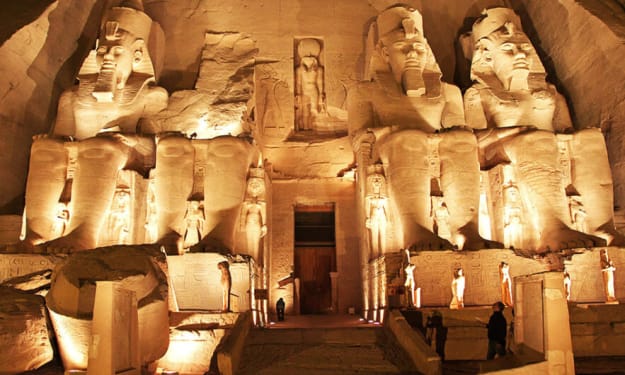
The Middle Kingdom of Egypt The Middle Kingdom of Egypt was a time of great prosperity and cultural achievement. It lasted from approximately 2055 to 1650 BC, following the First Intermediate Period, a time of political fragmentation and instability. The Middle Kingdom was characterized by a return to centralized rule, economic growth, and artistic and literary florescence.
By Hmid Abderrahmane3 years ago in History
Bermuda Triangle
over the past hundred years in the region of the infamous Bermuda Triangle about a hundred ships and aircraft have disappeared while scientists are trying to find the cause of these mysterious disappearances and massive disasters in this area similar anomalies have appeared around the world so what could be more dangerous than the Bermuda Triangle dozens of such messages are stored in the black boxes of planes that crashed over the Bermuda Triangle under mysterious circumstances it covers the territory from the Bermuda Islands in Florida to Puerto Rico.
By peace igwe3 years ago in History
Ikenna Ike- NFL’s financial structure.
The financial foundation of the NFL is built on diverse revenue streams that collectively create a financial juggernaut. The league's primary sources of revenue include broadcasting rights, sponsorships, ticket sales, and merchandising. Broadcasting rights, often the largest contributor, involve lucrative contracts with networks for the exclusive rights to televise games. Sponsorship deals with major corporations, such as PepsiCo and Nike, infuse additional capital into the league. Ticket sales provide revenue directly from game attendance, while merchandising, including licensed apparel and memorabilia, extends the NFL brand globally. The league's ability to diversify revenue streams ensures stability and growth, even in the face of economic fluctuations.
By Ikenna Ike3 years ago in History
Once Popular Foods We Don't Eat Anyone
Consider this scenario: It's a misty, overcast morning in the heart of winter. Tom awakens with a sense of nervous anticipation for the day ahead. He's embarking on a lengthy voyage through unexplored waters. His captain intends to depart England, sailing all the way to the Americas. Fully packed and ready to depart, Tom's wife reminds him to take the biscuits he painstakingly prepared the night before. Let's zoom in on these biscuits for a moment; they have a peculiar appearance, don't they? Known as ship's biscuits, these were the staple sustenance for sailors during extended sea voyages. Astonishingly, these biscuits could last for years without spoiling. How could this be possible, you ask? The secret lies in their ingredients and the method of baking. When sailors embarked on their journeys, uncertain of the duration before setting foot on land again, they needed to prepare adequately in terms of food supplies to avoid perishing from extreme hunger. Thus, bakers devised a simple yet ingenious biscuit primarily made from three ingredients: salt, flour, and a modest amount of water. The key was to keep the dough as rigid as possible. Bakers then subjected these biscuits to hours of baking at exceptionally low temperatures, extracting all moisture from them. This meticulous slow-baking process ensured preservation, combating the typical pitfalls of moisture that lead to spoilage, mold, and attraction of pests. Incredibly, a ship's biscuit could endure for six to eight years without spoiling, aided by the small holes designed to expel moisture during baking. Each day, a sailor, like Tom, would receive a ration of six to eight ship's biscuits, remarkably nutritious and satiating, effectively staving off hunger. However, these biscuits served a survival purpose; they weren't intended for pleasure or to provide comprehensive nutrients; rather, they supplied the essentials. Now, envision life in the 18th century – a vastly different era. Consider a city like New York; it housed a mere 18,000 inhabitants. To travel from New York to Boston meant traversing without convenience stores or established roads. People had to ensure sufficient food provisions for such journeys, giving rise to the utility of portable soup. Unlike what you might envision as a boiling pot of meat and vegetables, portable soup was a condensed, solidified broth, a compact substance predominantly comprised of meat. The optimal choice for making portable soup was meat with ample collagen content, such as beef shank. Its creation necessitated slow cooking to extract the essence without boiling it away. After several hours, the meat was removed, leaving behind nutrient-rich, fat-infused water, which was then reduced for 18 to 24 hours, forming a gelatinous, nutritional substance that solidified upon cooling. A small tablet of this substance dissolved in hot water provided a warm, hearty meal – an incredible transformation to witness from meat to portable sustenance. Curious about the origins of the term "hamburgers" despite their lack of ham? It traces back to the city of Hamburg in Germany, where this dish was initially crafted, albeit different from its modern incarnation. Back in the 18th century, amidst various types of ketchup, one surprising variant was mushroom ketchup. Contrary to popular belief, the definition of ketchup in certain dictionaries denotes a sauce made from mushrooms, not tomatoes. To prepare mushroom ketchup, one could utilize any mushroom variety, including the luxurious shiitake. The process involved smashing, cooking, and infusing the mushrooms with an array of spices like clove, nutmeg, ginger, and pepper. This concoction wasn't intended for tomatoes but complemented meat dishes, poured over steak, akin to a savory gravy, revealing an intriguing culinary history. Surprisingly, mushroom ketchup still finds a place in Great Britain today, albeit forgotten in North America. Ever wondered what individuals consumed when feeling unwell in the past? They turned to something called poset, an ancient remedy with roots dating back to the 15th century. Poset resembled an eggnog with added sweetness. It served as a reliable remedy, so much so that Shakespeare referenced it as a poison in Macbeth. Exploring the phrase "the proof is in the pudding," which signifies experiencing something firsthand to understand its true value, reveals an interesting linguistic note. In Britain, pudding isn't the sweet dessert familiar in America but rather a savory dish resembling a pie. Reflecting on British cuisine, pies were a common delicacy, ranging from apple pies to chicken pot pies. A notable historical favorite was beef steak pie, a pared-down version of the contemporary steak and kidney pudding. This simplified dish comprised richly flavored meat, distinct from its modern-day variations. Shifting to breakfast in the 18th century, the equivalent of today's bacon and eggs was called "cops and eggs." According to the traditional Hannah Glass recipe from famed cookbooks of that era, eggs were poached rather than fried or boiled, accompanied by less processed bacon and a side of toast, constituting an ideal start to the day. In the contemporary world, breakfast varies widely – from avocado toast to hearty broths. However, exploring historical breakfasts provides intriguing insights into the evolution of culinary habits and preferences. If these historical culinary glimpses piqued your interest, sharing this video with friends or delving deeper into similar content might offer further intriguing discoveries. The rich tapestry of culinary history showcases not only diverse tastes but also the fascinating stories and evolution of food habits across centuries. Is there a particular historical culinary aspect that intrigued you the most? Share your thoughts and let's explore more culinary tales together!
By Cudjoe Justice3 years ago in History
Varanasi
With millions of pilgrims and those seeking spiritual comfort, Varanasi—often referred to as the spiritual centre of India—is one of the oldest continuously inhabited cities in the world. Known by many other names, including Banaras or Kashi, Varanasi, is a city in northern India's Uttar Pradesh state that is situated on the banks of the Ganges River. It is renowned for its rich historical, religious, and cultural legacy that has emerged over time.
By The Knowledge 3 years ago in History