World History
Golden Thrones and Hidden Treasures: Estimating the Real Wealth of the Tamil Kings’ Palaces . AI-Generated.
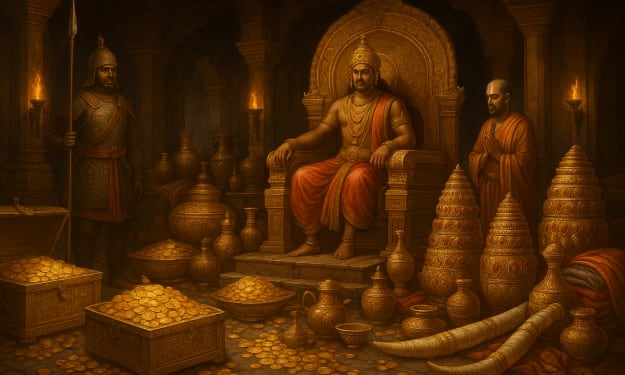
Thrones of Gold: The Genuine Affluence in the Residence of the Great Tamil Sovereigns From the Cholas and Pandyas to the subsequent Nayak rulers, Tamil monarchs once governed extensive and flourishing empires throughout South India and beyond. Their palaces were not merely emblems of authority but also vaults of astonishing wealthfilled with gold, gemstones, armaments, silks, and sacred artifacts. This article examines the authentic historical wealth housed within Tamil palaces, the origins of this prosperity, and presents a contemporary assessment of their net worth in today's currency. Introduction: Palaces of Authority and Abundance The ancient Tamil realmsparticularly under formidable dynasties such as the Cholas, Pandyas, and Cheraswere among the most opulent in pre-modern Asia. With strategic dominance over maritime trade routes, fertile river basins like the Kaveri delta, and conquests extending as far as Southeast Asia, these monarchs accumulated monumental wealth. Their palaces, especially in capitals like Thanjavur, Madurai, and Puhar, served as epicenters of governance, religion, and wealth preservation. The treasures discovered in these regal complexeswhether chronicled in inscriptions, temple donations, or foreign narrativesunveil a tale of economic might unparalleled in the world at that time. Sources of Wealth in Tamil Kingdoms The affluence of the Tamil kings originated from various well-regulated and prosperous sources: Agriculture – The delta of the Kaveri River was among the most fertile areas, yielding abundant rice, sugarcane, and spices. Maritime Trade – Tamil ports like Kaveripattinam (Puhar) and Nagapattinam engaged in commerce with Rome, Greece, Egypt, China, and Southeast Asia. Tributes and Conquests – Victorious kings returned with gold, elephants, and artifacts from Southeast Asia, Sri Lanka, and deeper into the Deccan. Taxation – Advanced systems of land, trade, and labor taxes aided in replenishing royal treasuries. Temple Patronage – Although temples possessed their own wealth, much of it was directly associated with royal bequests and donations, frequently stored adjacent to or within palace grounds. What Was in the Palaces? Historical inscriptions, Sangam literature, and temple records facilitate the reconstruction of the types of treasures contained within royal complexes: Gold Ingots and Coins: Frequently minted with the king’s insignia; utilized in commerce and religious gifting. The Chola coinage system was noted for its purity and weight. Jewels and Gemstones: Including diamonds from Golconda, rubies, emeralds, and pearls from the Gulf of Mannar. Ivory and Elephant Ornaments: The Tamil kings took pride in showcasing royal elephants adorned with intricate armor and embellished tusks. Silks and Foreign Fabrics: Imported from China and Arabia; secured in designated palace vaults. Weapons Composed of Precious Metals: Swords, shields, and lances inlaid with gold and gems for royal exhibition or ceremonial purposes. Sacred Items and Thrones: Thrones embellished with ivory and gold, gold-plated ritual objects utilized in coronation and temple ceremonies. Famous Accounts of Wealth The Chola Empire under Raja Raja Chola I and Rajendra Chola I is reputed to have donated over 500 kilograms of gold and jewelry to the Brihadeeswarar Temple in Thanjavur. Arab traders and Chinese emissaries chronicled the Tamil ports as vibrant with vessels and warehouses overflowing with spices and gold. The Pandyas of Madurai were reputed to possess thrones encrusted with uncut diamonds and accumulated pearls in vast quantities. Assessing the Net Worth Although we cannot account for every factor, we can provide a contemporary estimation based on historical values: Gold: If a Tamil palace retained even 20 metric tons of gold (a modest figure for a significant empire over centuries), at today's valuation of $70,000/kg, that alone amounts to $1. 4 billion USD. Gemstones: With thousands of pieces consisting of diamonds, rubies, and emeralds, the worth could readily exceed $500 million USD. Artifacts and Thrones: Artisan-crafted ceremonial items, weaponry, and thrones, if auctioned today, could aggregate $200–300 million USD as rare antiquities. Silks, elephants, and luxury merchandise: Collectively, these might signify $50–100 million USD in historical worth. Estimated Total Net Worth at Today's Valuation: Exceeding $2. 2 billion USD per significant Tamil royal palace. This approximation excludes temple assets or undisclosed reserves, which could potentially double or triple this figure.
By Say the truth about a year ago in History
Top 10 Surprising Facts About the World's Oldest Bible
Top 10 Surprising Facts About the World’s Oldest Bible – A Glimpse into Sacred History. The Bible is the most widely read and distributed book in the world, but few people know about the Codex Sinaiticus, the oldest surviving complete manuscript of the Christian Bible. Dating back to the 4th century, this ancient text reveals fascinating insights into early Christianity, biblical history, and manuscript preservation. Here are the top 10 surprising facts about the world’s oldest Bible that will leave you amazed.
By Ramesh Mahato about a year ago in History
Archaeologists Discover Hundreds of Metal Objects up to 3,400 Years Old on Mysterious Volcanic Hilltop in Hungary. AI-Generated.
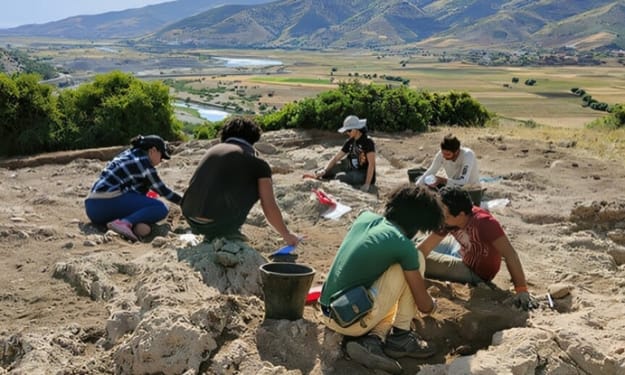
Archaeologists Discover Hundreds of Metal Objects up to 3,400 Years Old on Mysterious Volcanic Hilltop in Hungary In an extraordinary archaeological breakthrough, researchers in Hungary have unearthed hundreds of metal artifacts—some dating back as far as 3,400 years—on a mysterious volcanic hilltop in the Bükk Mountains. This discovery, located near the village of Dédestapolcsány, is offering new insights into the ancient cultures that once inhabited this remote region of Central Europe.
By Adnan Rasheedabout a year ago in History
Will India and Pakistan be able to avoid a war situation like in the past?
Gunmen killed 26 people in Pahalgam, Indian-controlled Kashmir, last week, a deadly attack that has revived a sense of deep frustration among Indian security forces and diplomats.A similar situation arose in 2016, after the killing of 19 Indian soldiers in Uri. At that time, India carried out a 'surgical strike' targeting a militant base along the Line of Control (LoC) between India and Pakistan in Kashmir.Then, in 2019, a similar situation arose after 40 Indian paramilitary soldiers were killed in a bomb attack in Pulwama. At that time, India carried out air strikes in Balakot, Pakistan. That was the first Indian air strike on Pakistani territory since 1971.As a result, the two countries launched retaliatory operations and fought in the air.These events were preceded by the 2008 Mumbai attacks—in which militants from the West besieged several hotels, a railway station, and a Jewish center in India for nearly 60 hours. That attack killed 166 people in India.India has accused neighboring Pakistan of involvement in all these incidents, saying Islamabad had strategically supported these attacks. Pakistan has always denied these allegations by India.Tensions between the two neighbours have increased dramatically since 2016, especially after 2019. India has now given a new name to its border firing and air strikes. India now claims that it carried out the retaliatory strikes in response to provocations from Pakistan.This further intensifies an already unstable situation.Experts say India is once again navigating a delicate balance between heightened tensions and restraint after the Pahalgam gunmen attack. The country is struggling to strike a delicate balance between retaliating and deterring.Former Indian diplomat Ajay Bisaria understands the current situation very well. He was the Indian High Commissioner to Pakistan at the time of the Pulwama attack.On Thursday, Ajay told the BBC, "There are striking similarities between the situation after the Pulwama bomb attack and the situation after the Pahalgam massacre."However, he believes there is one thing worth mentioning about this attack. He said that while security forces were targeted in Pulwama or Uri, the victims of this attack were civilians who had gone to Kashmir as tourists from different parts of India.Ajay Bisaria said, "Even though this is an attack like Pulwama, it has many similarities to the Mumbai incident. And we are once again in a state of war."A week after the attack in Pahalgam, Delhi quickly took retaliatory measures: closing key borders, suspending a key agreement like the sharing of Indus waters,It has cancelled most visas issued to Pakistani citizens and given them a deadline to leave India. Indian airspace has been closed to all Pakistani aircraft.Pakistan has also taken some countermeasures, including closing its airspace to India. In addition, there has been firing between the troops of the two countries on the border for several days.Ajay Bisaria still vividly remembers the aftermath of the Pulwama attack on February 14, 2019. He said he was summoned to Delhi the next day. The Indian government quickly suspended trade with Pakistan.India withdrew the Most Favoured Nation (MFN) status granted to Pakistan in 1996 after the Pulwama attack.A 200 percent tariff was imposed on Pakistani goods and all trade through the Wagah land border was suspended. India took several more retaliatory measures in the following days.Ajay wrote about this, "At that time, I thought how difficult it is to build a relationship of trust, and how easy it is to break it."Ajay wrote about this, "At that time, I thought how difficult it is to build a relationship of trust, and how easy it is to break it."Like this time, after the attack, Indian troops conducted a raid in Kashmir, arresting more than 80 people.On February 26, the Indian Air Force carried out an airstrike in Balakot, Pakistan. It was India's first airstrike across the international border since 1971.Six hours after the attack, India's Ministry of External Affairs announced that many terrorists and commanders had been killed in the Balakot strike, although Pakistan denied India's claim.The situation became more complicated the next morning, February 27, when the Pakistan Air Force carried out retaliatory strikes.Just when an aerial battle was inevitable, an Indian fighter jet was shot down. Wing Commander Abhinandan Varthaman ejected from the crashed aircraft and landed in Pakistan-controlled Kashmir. Abhinandan was captured by Pakistani troops.On February 28, 2019, the then Prime Minister of Pakistan, Imran Khan, announced the release of Indian pilot Abhinandan. On March 1, Abhinandan was handed over to India under the prisoner of war exchange protocol.Pakistan presented the return of Indian pilot Abhinandan as a 'goodwill message' to de-escalate the war. The incident also raised tensions in Indian politics. On March 5, India announced its decision to send its High Commissioner to Pakistan again.Ajay wrote, "I returned to Islamabad on March 10, 22 days after leaving due to the Pulwama (attack). The most serious military tension since Kargil has returned to normal in less than a month."The former Indian diplomat believes that through this, India was once again willing to give traditional diplomacy a chance...at a time when India had achieved its strategic and military goals and Pakistan was able to project a sense of victory among its domestic public.The same situation has arisen again, and Ajay describes this time as a “testing and fascinating time” for diplomats. But this time, he says, there is one important difference: the attack in Pahalgam targeted Indian civilians.And the shocking thing is that this happened at a time when the situation in Kashmir had improved dramatically.So this time, a war situation seems inevitable to him. However, Ajay also mentioned that, for policymakers in both countries, there are reasons for increasing tension as well as reasons for easing it.Ajay said that when India's Cabinet Committee on Security (CCS) meets in such conflict situations, they take into account the economic impact of the conflict and try to take steps that will harm Pakistan.But it will not provoke any negative reaction against India.Ajay said, "While the body language and the scenario are largely the same, the most important step is India's threat to abrogate the Indus Waters Treaty. If India implements this, it will have long-term and profound consequences for Pakistan."The former diplomat added, "We have to remember that we are still in a crisis. But there has been no direct military action so far."
By MD YOUSUB ALIabout a year ago in History
The Great Pyramid of Giza Has MORE Than Four Sides: The Hidden Truth Behind Egypt's Iconic Wonder. AI-Generated.
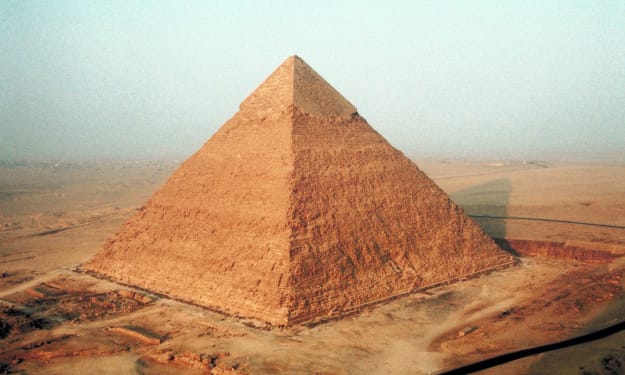
The Great Pyramid of Giza Has MORE Than Four Sides: The Hidden Truth Behind Egypt's Iconic Wonder The Great Pyramid of Giza, also known as the Pyramid of Khufu or Cheops, stands as one of the most remarkable architectural feats in human history. Constructed around 2560 BCE during Egypt’s Fourth Dynasty, this ancient wonder has intrigued scientists, historians, and travelers for centuries. While most people perceive the pyramid as a four-sided structure with a square base and four triangular faces, the truth is far more fascinating: The Great Pyramid of Giza actually has eight sides.
By Adnan Rasheedabout a year ago in History
The Rise and Legacy of the Mughal Empire
The history of the Mughal Empire is one of grandeur, ambition, and complexity. Spanning over three centuries, this dynasty ruled much of South Asia, leaving behind a legacy that shaped the cultural, political, and architectural landscape of the Indian subcontinent. The Mughals, descendants of the great Central Asian conqueror Timur and the Mongol Empire, brought an era of prosperity, artistic brilliance, and remarkable political intrigue that reverberates in India’s heritage to this day.
By Haseeb Mujaddidiabout a year ago in History
Self talk of a River
My name is Kalshi. I am the largest river in India, the most sacred river. The Gomukh glacier in the Himalayas where I was born is very inaccessible. But after entering India, my watercourse is considered sacred everywhere, I am the embodiment of motherhood to the people of India. In fact, I have flowed through the three states of North India,
By Atikul Islamabout a year ago in History
*The Legend of Alexander the Great*. Content Warning. AI-Generated.
*The Conquests of Alexander the Great* Alexander III of Macedon, commonly known as Alexander the Great, was a king of the ancient Greek kingdom of Macedon who ruled from 336 to 323 BCE. He was a member of the Argead dynasty, which ruled Macedon from the 8th to the 4th century BCE. Alexander was born in Pella, the capital of Macedon, to King Philip II and Queen Olympias. His father was a renowned military leader who had unified the fractious city-states of Greece under his rule. Alexander's mother was a member of the royal family of neighboring Epirus. From a young age, Alexander showed a keen interest in philosophy, literature, and science. He was tutored by the famous philosopher Aristotle, who instilled in him a love of learning and a desire to explore the world. Alexander's military career began when he was just 18 years old. His father, King Philip II, appointed him as the commander of the Companion Cavalry, an elite unit of horsemen who served as the king's bodyguards. In 336 BCE, King Philip II was assassinated, and Alexander succeeded him as king of Macedon. He was just 20 years old at the time. Alexander's ambition was to conquer the Persian Empire, which at that time was the largest empire in the world. He began his campaign in 334 BCE, when he crossed the Hellespont (now known as the Dardanelles) with an army of 40,000 men. Over the next few years, Alexander conquered a vast portion of the known world, creating one of the largest empires in history. He defeated the Persian satraps (governors) at the Battle of Granicus, the Battle of Issus, and the Battle of Gaugamela. In 332 BCE, Alexander conquered Egypt, which was then a Persian satrapy. He was welcomed as a liberator by the Egyptians, who were tired of Persian rule. Alexander's conquests took him as far east as India, where he defeated the ruler of the Paurava kingdom, Porus, at the Battle of the Hydaspes in 326 BCE. Alexander's empire stretched from Greece to India, and it included many of the city-states of ancient Greece, as well as the Persian Empire and Egypt. Alexander's legacy extended far beyond his military conquests. He spread Greek culture and language throughout his empire, establishing over 70 cities, including Alexandria in Egypt, which became a major center of Greek culture and learning. Alexander's military tactics and strategies are still studied by military historians and strategists around the world. He is considered one of the greatest military commanders in history. Alexander died in 323 BCE, at the age of 32, in Babylon, Persia (now modern-day Baghdad, Iraq). The cause of his death is still a matter of debate among historians, with some attributing it to a fever, while others believe he was poisoned. After Alexander's death, his empire was divided among his generals, who went on to found their own kingdoms. The Ptolemaic Kingdom in Egypt, the Seleucid Empire in Mesopotamia, and the Antigonid dynasty in Macedon were all founded by Alexander's generals. Alexander's legacy continues to be felt today, over 2,300 years after his death. He remains one of the most famous and influential figures in history, and his conquests and achievements continue to inspire and fascinate people around the world. *Conclusion* Alexander the Great was a remarkable individual who achieved greatness through his military conquests, his spread of Greek culture and language, and his enduring legacy. His story continues to inspire and fascinate people around the world, and his impact on history is still felt today.
By Thousand heartsabout a year ago in History
Africa's history could be rewritten by a huge discovery in Morocco.
The long-held belief that the Maghreb (northwest Africa) was an empty land prior to the Phoenicians' arrival in the area around 800 BCE is thrown into doubt by a new archaeological find at Kach Kouch in Morocco. It reveals a history that is significantly more complex and rich than previously thought. Everything found at the site suggests that stable agricultural settlements on the African coast of the Mediterranean existed more than 3,000 years ago, during the Bronze Age. At the same time, societies in the eastern Mediterranean like the Mycenaean thrived. We now have a better understanding of the recent prehistory of north Africa thanks to our discovery, which was led by a group of young researchers from Morocco's National Institute of Archaeology. Additionally, it reframes our understanding of the ancient connections that existed between the Maghreb and the rest of the Mediterranean. What led to the discovery? In 1992, Kach Kouch was first discovered and excavated for the first time. At the time, researchers thought that the area had been occupied from the 8th to the 6th century BCE. This was based on the found Phoenician pottery. Our team carried out two additional seasons of excavation in 2021 and 2022, nearly 30 years later. Drones, differential GPS (global positioning systems), and 3D models were used in our investigations. For the purpose of collecting samples, a stringent procedure was followed. Because of this, we were able to find charcoal and seeds that had been fossilized. After that, a series of analyses enabled us to re-create the prehistoric economy and natural environment of the settlement. What was found in the remains The settlement was occupied three times between 2200 and 600 BCE, according to the excavations and radiocarbon dating. The earliest known remains date from 2200 to 2000 BCE. They include a cow bone, three unadorned pottery sherds, and a flint flake. Either erosion or a brief occupation of the hill during this time period could account for the lack of materials and contexts. The Koch Koch hill was permanently occupied beginning in 1300 BCE during its second phase, following a period of abandonment. Farming and animal husbandry were the primary occupations of its fewer than one hundred inhabitants. They lived in wattle and daub, a method that combines mud, reeds, and wooden poles, in circular dwellings. To store their agricultural goods, they dug silos into the rock. They raised cattle, sheep, goats, and pigs, as well as wheat, barley, and legumes, according to analysis. Additionally, they used flint tools, decorated pottery, and grinding stones for cereal processing. In addition, it has been documented that north Africa, excluding Egypt, has the oldest known bronze object. It's probably a piece of scrap metal taken out of a mold after it was molded. encounters with the Phoenicians The inhabitants of Kach Kouch maintained the same material culture, architecture, and economy as in the preceding phase throughout the so-called Mauretanian period, which occurred between the 8th and 7th centuries BCE. New cultural practices, on the other hand, were brought about by interactions with Phoenician communities that were just beginning to settle in nearby locations like Lixus. Combining Phoenician and local building methods, for instance, circular and square stone and wattle and daub structures coexisted. Additionally, the cultivation of new crops like olives and grapes began. The use of iron objects and wheel-made Phoenician ceramics like plates and amphorae (storage jugs) stand out among the new materials. Kach Kouch was peacefully abandoned around 600 BCE, possibly as a result of changes in social and economic conditions. The people who lived there probably moved to other towns nearby. Who then lived in the Bronze Age? It is not clear if the Maghreb people in the Bronze Age lived in tribes, as the Mauretanian people did later. It's likely that they were organized as families. According to the burials, there were no obvious signs of hierarchy. They may have spoken a language that was similar to the Amazigh, a native language of North Africa that was not written until the Phoenician alphabet was introduced. These populations may be the direct ancestors of the Mauretanian peoples of north-west Africa, as evidenced by the cultural continuity that has been documented at Kach Kouch. Why this is important Not only is Kach Kouch the first and earliest known Maghreb Bronze Age settlement, but it also reshapes how we understand prehistory in this region. The new findings, in addition to other recent ones, show that northwestern Africa has been connected to other Mediterranean, Atlantic, and Saharan regions since prehistoric times. Our findings cast doubt on conventional narratives, many of which were shaped by colonial perspectives that portrayed the Maghreb as an uninhabited, isolated region until it was "civilized" by other peoples. As a result, discussions about the Mediterranean's later prehistory have largely ignored the Maghreb. Not only do these new findings signal a breakthrough for archaeology, but they also make it necessary to reevaluate the dominant historical narratives. The opportunity to rewrite north Africa's history and give it the visibility it has always deserved is provided by Kach Kouch. We believe that this is a pivotal time for research that has the potential to forever alter our understanding of not only the history of north Africa but also its relationship to other Mediterranean regions.
By MD IMRAN KHANabout a year ago in History
The Lost City of 200,000 Years: Africa’s Forgotten Civilization
A Lost Chapter of Human History In the rolling hills of South Africa, far from the eyes of the world, lie thousands of circular stone structures that have puzzled scientists, historians, and seekers of truth for decades. These ruins stretch over hundreds of kilometers and form an intricate network of ancient walls, roads, and complex settlements. They whisper of a past that is far older than we ever imagined, a past that may rewrite the story of humanity.
By The Secret History Of The Worldabout a year ago in History