Places
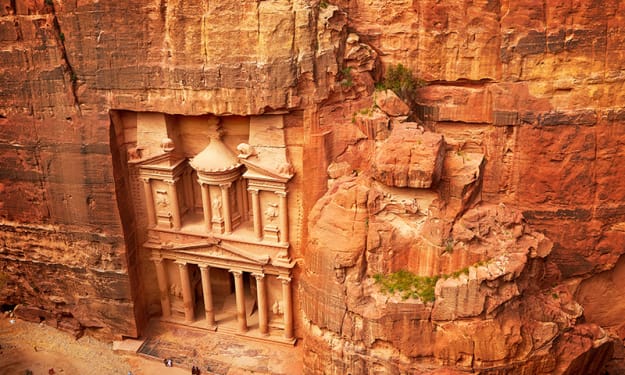
6 beautiful Mughal monuments to visit in Asia
The Mughal Empire went down in history books for multiple reasons, one of which was the mastery of architecture which gave rise to mesmerising buildings that skilfully combined Persian, Islamic, and Indian elements. With its rich legacy of artistic grandeur, political intrigue, and culture, the Mughals have left a lasting impression on South Asian heritage.
By Jahangir Alam3 years ago in History
Amazonian Origins: A Geological Journey"
Known as the "Lungs of the Earth," the Amazon Rainforest has a rich and intricate history spanning millions of years. With a total area of over 6.7 million square kilometers spread over nine South American countries, it is the largest tropical rainforest. This is a brief synopsis of its past: 1. Geological Origins: The rainforest began to emerge some 10 million years ago, as the Amazon basin was developed throughout geological time. The emergence of many ecosystems was facilitated by the shifting terrain and climate. 2. Indigenous Peoples: For thousands of years, a variety of indigenous tribes have called the Amazon home. Certain communities, such as the Yanomami and Kayapo, are deeply entwined with the forest, depending on its resources for both traditional practices and daily needs. 3. European Exploration: In the 16th century, Francisco de Orellana was one of the European explorers who successfully traversed the Amazon River, bringing the area to the attention of the outside world. However, large-scale colonization took some time because of the difficult environment. 4. Rubber Boom: The Amazon saw commercial interest during the late 19th and early 20th centuries due to the rubber boom. As rubber extraction from rubber trees became profitable, human activity and deforestation grew. 5. Environmental Awareness: In the second part of the 20th century, people all around the world became more conscious of how crucial rainforests are to maintaining biodiversity and controlling climate change. The necessity of shielding the Amazon from unsustainable development was emphasized by environmentalists. 6. Deforestation Challenges: Despite conservation efforts, deforestation brought on by logging, agriculture, and infrastructure projects continues to pose a threat to the Amazon. Concerns have been expressed on how this may affect biodiversity, indigenous people, and patterns of global climate. 7. Conservation Efforts: To combat deforestation, governments and international organizations have launched conservation programs. The goal of sustainable development initiatives and protected areas is to strike a balance between meeting human needs and maintaining the biological integrity of the rainforest. 8. Current Issues: Discussions on how to strike a balance between environmental preservation and economic development persisted as of January 2022, when I last updated my understanding. Policies and actions affecting the Amazon are influenced by social, political, and economic forces. 9. Global Significance: By absorbing and storing enormous amounts of carbon dioxide, the Amazon Rainforest is essential in controlling the Earth's climate. Its unparalleled biodiversity is home to innumerable species, many of which have not yet been identified. 10. Future Challenges: Sustainable management of the Amazon is crucial as the world deals with climate change. It is still difficult to strike a balance between the demands of local populations, the protection of biodiversity, and global environmental issues. In conclusion, the evolution of the Amazon Rainforest is a reflection of the complex interactions between biological, cultural, geological, and economic factors. Its future rests on cooperative efforts to resolve the intricate problems of the twenty-first century. Indeed, the Amazon Rainforest has changed over millions of years due to climatic and geological shifts. The remarkable biodiversity of the area is a result of the adaptations made by the region's flora and animals over time. For thousands of years, the region has been home to indigenous people who have depended on its resources for both cultural rituals and sustenance. Threats to the Amazon's long history are relatively new, and include issues like deforestation and environmental deterioration. The main issues facing the Amazon Rainforest today are related to deforestation, which is fueled by logging, infrastructure development, and increased agricultural production. This damages ecosystems, endangers biodiversity, and fuels climate change. With an emphasis on maintaining the Amazon's biological balance and aiding the indigenous tribes that rely on it, conservation initiatives and sustainable practices seek to address these issues. Indeed, one of the biggest threats facing the Amazon Rainforest today is deforestation. It is fueled by operations like logging, farming, and building infrastructure, which results in a loss of habitat, a decrease in biodiversity, and a contribution to climate change. The critical Amazonian ecology is being protected through international cooperation, conservation programs, and sustainable land-use practices.
By Mohammad fayaz3 years ago in History
Secrets of Isaac Newton
He disappointed his mother by not pursuing her dream of becoming a farmer. His relationships with others were so complex that he ended up living a solitary life. However, his passion for alchemy led him to become one of the most renowned scientists in history. Yes, I'm referring to Isaac Newton, the famous English physicist and mathematician who revolutionized modern physics. Newton was born in the small village of Wol Thorp in 1643. Unfortunately, he never had the chance to meet his father, who passed away before his birth. Around the same time, another brilliant scientist, Galileo Galilei, took his last breath in Florence. Little did Newton know that he would later build upon Galileo's ideas and make them legendary. From the very beginning, Isaac faced challenges as he was born prematurely and had to fight for survival. He was so tiny that he could fit inside a large mug. His mother remarried shortly after his birth, and he ended up living with his grandmother, separated from his mother for nine years. This solitude had a lasting impact on his life. Years later, when reflecting on his past, he even confessed to having fiery thoughts about his stepfather, such as wanting to burn down the house. On the bright side, his isolation sparked his interest in books on mechanics and technology. He even developed a highly accurate system of sundials. Recognizing his intellectual potential, his uncle and school headmaster encouraged him to pursue his studies instead of tending to the family property. Despite his mother's initial resistance, she eventually gave in, and Newton returned to grammar school. At the age of 18, he was admitted to Trinity College, Cambridge. To support his education, Newton worked and studied, waiting tables and taking care of other students' rooms.
By Angelo Valentino Krause3 years ago in History
Mysore Palace: A History and Stone Fusion of Cultures"
The stately Mysore Palace, also called the Amba Vilas Palace, is a testament to the rich cultural legacy and history of Mysore. The palace, which dates back to the 14th century, has had a number of changes that have reflected the region's political importance and architectural genius. Yaduraya Wodeyar, a local chieftain, constructed a fort on the same location in the fourteenth century, and this is where Mysore Palace had its start. Nonetheless, the current palace's foundations were set in the late 16th century, under the rule of King Raja Wodeyar I. The original building was a modest wooden fort, which under following kings developed into a more elaborate stone palace. When Tipu Sultan, the Tiger of Mysore, took power in the late 18th century, the history of Mysore Palace underwent a sea change. He rebuilt the palace with Islamic architectural elements, demolishing the old one in the process. During the Anglo-Mysore Wars, the palace saw turbulence that resulted in its seizure by British forces in 1799. Following Tipu Sultan's demise, the Wodeyars were once again crowned emperors under British protection. An important factor in the Indo-Saracenic renovation of Mysore Palace was the work of British architect Henry Irwin. The palace that remains now is a magnificent example of the fusion of Hindu, Islamic, Rajput, and Gothic architectural styles. Mysore Palace's elaborate carvings, vivid paintings, and large courtyards all demonstrate its richness. The elephant-themed golden arch at the main entrance, called the Elephant Gate, is adorned with images of elephants. The majestic ceiling-adorned Durbar Hall served as the location of royal events and festivities. The marriage hall, Kalyana Mantapa, has elaborate rosewood doors and a stained glass roof. The Diwan-e-Khas, also known as the Ambavilasa, is one of the main attractions of Mysore Palace and is where the royal throne is seen on special occasions. With their rich murals that portray legendary scenes, carved arches, and complex columns, the palace's interiors are a visual marvel. Through antiques and personal possessions, the Residential Museum—private royal quarters—offers a look into the Wodeyars' way of life. In addition to being a work of architectural wonder, Mysore Palace is essential to the city's cultural scene. The palace grounds are the scene of the yearly Mysuru Dasara festival, which celebrates the triumph of good over evil. During Dasara, the illuminated palace is a stunning sight that draws tourists from all over. Mysore Palace has endured numerous repairs and catastrophic disasters, but it has remained a symbol of resiliency and cultural continuity across time. It continues to be a vital component of Karnataka's historical heritage, attracting visitors, academics, and art lovers in equal measure. In summary, Mysore Palace provides evidence of the region's rich historical and cultural legacy. From its modest origins as a timber fort to the opulence it radiates now, the palace has seen the rise and fall of empires, the effects of conflicts, and the blending of different architectural forms. Mysore Palace invites tourists to discover the magnificence of its history and serves as more than simply a physical building—it is a living chronicle of Karnataka's past.
By Mohammad fayaz3 years ago in History
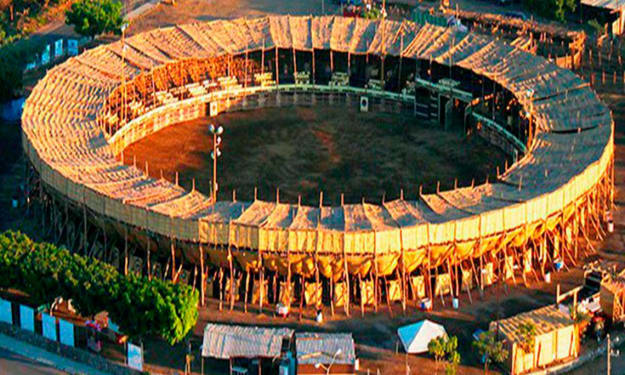
"La Plasa Petatera: Tradition, Culture and Encounter in the Heart of the Community".
Is it really any wonder that the largest handicraft in the world is located in Mexico? And we are talking about a magnificent work registered as a World Heritage Site, which is protected by none other than UNESCO. Find here all the information you need about La Petatera, a unique bullring in the world.
By diego michel3 years ago in History
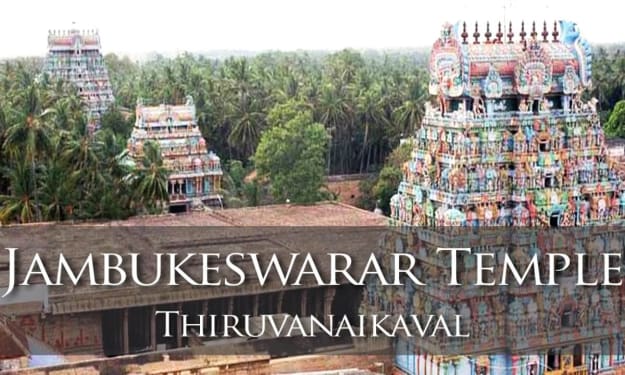
Importance of Jambukeswarar Temple, Thiruvanaikaval
Caption: In the ancient city of Tiruchirappalli there once lived a showing love for deity, Dharma Varma and his wife Sundari. Despite their merger resources, they dedicated their lives to the worship of Lord Shiva. One hot summer day, when Sundari went into the forest to fetch water from a nearby river, she came across a beautiful Jambu tree whose branches were full of ripe fruits. Overwhelmed with gratitude, Sundari offered prayers to Lord Shiva and vowed to build a temple under the sacred tree of in his honor. Lord Shiva was impressed by her devotion and appeared before her as Jambukeswarar, the presiding deity of the Jambu tree. This is how the Sri Jambukeswarar Temple (Thiruvanaikaval) came into being, a testimony to the unshakable faith of Dharma Varma and Sundari.
By Nagarathinam B3 years ago in History
Significance of Sri kalahasti Temple
Legend: In the heart of the mystical city of Sri Kalahasti lies a temple surrounded by legends and traditions. According to ancient stories passed down from generation to generation, the origins of the Sri Kalahasti Temple date back to the age of three, a time of divine intervention and celestial battles. It is said that at this time a great sage named Kannappa went on a pilgrimage to Mount Kailash, the abode of Lord Shiva.
By Nagarathinam B3 years ago in History