Perspectives
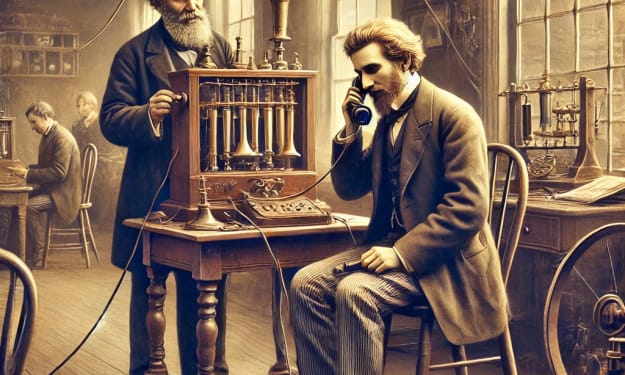
Alexander Graham Bell’s Greatest Invention. AI-Generated.
The Call That Changed the World On a chilly March afternoon in 1876, in a modest laboratory filled with wires, batteries, and the scent of burning metal, a moment of history unfolded. Alexander Graham Bell, a Scottish-born inventor with an insatiable curiosity for sound and communication, leaned over a peculiar contraption—a device that would soon change the world forever.
By Ahmet Kıvanç Demirkıran2 years ago in History
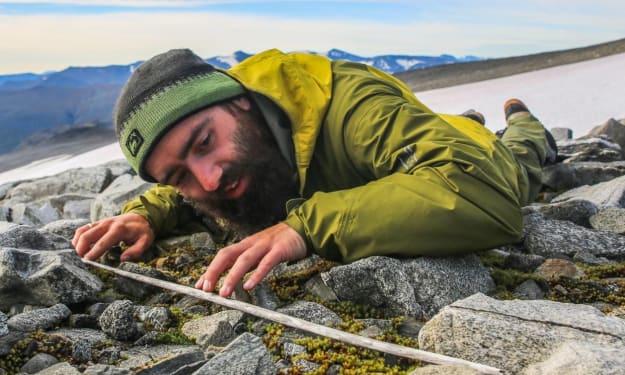
Archaeologists are finding mysterious ancient objects on Norway's melting glaciers.
Archaeologists are finding mysterious ancient objects on Norway's melting glaciers. The melting glaciers of Norway are exposing a hidden world frozen in time objects from the Stone Age Iron Age and medieval periods that provide rare glimpses into the lives of ancient humans. As climate change accelerates glacial melt archaeologists are racing against time to recover and study these remarkable artifacts before they are lost forever. From primitive wooden tools and well preserved textiles to weapons and human remains each discovery helps researchers unravel the mysteries of the past.
By Adnan Rasheed2 years ago in History
"Forbidden Love Triangle."
[Begins.] It was a cold, dark and dank morning. My platoon had finally arrived at our designated duty station. As I caught myself trying not to yawn while removing the crusty cold from my left eye. I just realized that it was a tidbit smidgen past 5 something o'clock. Boy, I almost had forgotten the letter tucked away -- crumpled more like it, in my left coat pocket. How could I have even forgotten I had put it there. Certainly, I did not have time to properly place it in my US Army issued backpack.
By Shane J Charbonnet, Ph.D.2 years ago in History
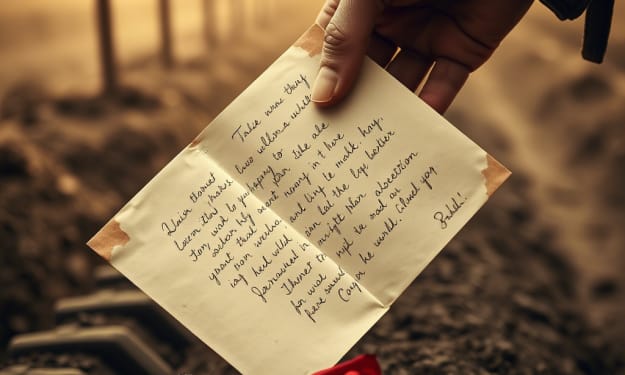
January 18, 1945 – A Soldier’s Last Goodbye from World War II
January 18, 1945 – 101st Airborne Division, Bastogne Somewhere in a frozen battlefield, with life slipping away… My dearest Eleanor, If you are reading this, it means I did not make it home. My hands tremble as I write, my fingers stained with blood—some mine, some from the brothers I fought beside. The battle still rages on in the distance, but for me, it is over. My leg is gone, taken by a landmine, and the cold is creeping into my bones faster than I can stop it. I do not have much time. But before I go, before the darkness takes me, I need to speak to you one last time. I don’t know if this letter will ever reach you, but I have to believe it will. I have to believe that some part of me will make it back to you, even if my body never does. Eleanor, my love, I am so sorry. I promised you I would return. I swore I would hold you again, that I would kiss you beneath the oak tree where I first asked you to be mine. I told you I would come home and hold our son in my arms. But fate is cruel, and war is even crueler. Our little boy is only five months old, and I have never even seen his face. That is the pain that cuts deeper than any bullet ever could. I close my eyes, and I try to picture him. Does he have your golden hair? Your warm, kind eyes? Does he have my stubbornness, my laugh? I will never know. I will never hear his first words, never watch him take his first steps. I will never get to tell him how much I love him. That is why I need you, Eleanor. You must tell him for me. Tell him that his father was not just a soldier, not just another name carved into a memorial. Tell him I was a man who dreamed of coming home. A man who fought not for war, but for peace. A man who loved him, even before he took his first breath. I am alone now. The others have moved on, charging into the fight, leaving me behind in the snow. The sky above is gray, the wind howling like the cries of the fallen. The warmth is leaving my body, but in my mind, I am not here. I am with you. I am back in our little house, sitting by the fire with you curled up beside me, your head on my chest, listening to my heartbeat. It is still beating, Eleanor. Faint, weak, but still beating. But not for long. I wish I could hold you one last time. I wish I could press my lips to yours, feel the softness of your skin, run my fingers through your hair. I wish I could watch the way your eyes crinkle when you laugh, hear you call my name, tell me everything will be alright. But I know better now. War takes everything. It takes young men and turns them into ghosts before they even die. It takes love and replaces it with silence. It steals fathers from sons, husbands from wives, leaving behind nothing but grief. But promise me one thing, my love. Promise me you will live. Do not let my death steal your joy. Do not let it darken the life we dreamed of building together. Raise our son in laughter, in love. Let him know happiness, let him chase dreams. Tell him it is okay to miss those who are gone, but that life must go on. And Eleanor, if one day you hear my name in the wind, if you feel a soft touch when no one is there, know that it is me. I will always be with you. Watching, waiting, loving you from beyond. This is not goodbye, my love. This is just a pause—a brief moment of separation—until we meet again. Forever yours, James
By News Vortex 2 years ago in History
Archaeologists Discovered 22000 Year Old Tracks That May Be From the World’s First Vehicle.
Archaeologists Discovered 22000 Year Old Tracks That May Be From the World’s First Vehicle. The discovery of 22000 year old tracks at White Sands National Park in New Mexico has shed new light on early human innovation and transportation methods. These tracks as revealed in a recent study published in Quaternary Science Advances suggest that ancient humans used a rudimentary vehicle known as a travois to transport goods or belongings. This finding challenges conventional perspectives on early transportation pushing back the timeline of non wheel based vehicles much further than previously thought. At the heart of this discovery are the linear impressions found alongside human footprints. Unlike ordinary tracks left by people walking these marks suggest the dragging of wooden poles indicating the use of a travois. This is a simple yet effective means of carrying heavy loads by lashing two poles together often in the shape of a triangle and pulling them along the ground. Such a transport method was widely used by Indigenous peoples in North America well into recent history particularly among the Plains tribes who adapted it for use with horses. However, this new discovery suggests that its use dates back much further to a time when humans were still navigating the challenges of Ice Age survival.
By Adnan Rasheed2 years ago in History
The forgotten history of The Kingdom of Cambodia. . Content Warning.
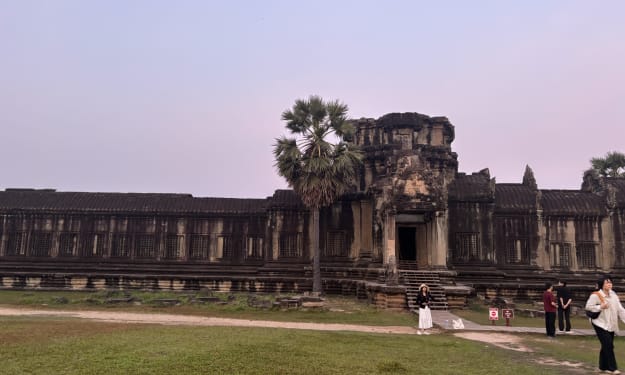
For those of us in the West who have heard of Cambodia without visiting, it may be seen as just a country in South East Asia that is not too well off. Those of us who have been lucky enough to travel to or simply read about this humble hidden gem, may know the rich yet dark history surrounding the Kingdom itself. I myself have been fortunate enough to travel here recently and spent about 3 weeks travelling throughout the country. From border towns and bustling cities with wild nightlife, to the vast green fields of rice paddies, all the way to the coast with some of the most gorgeous water I have ever seen. In my time spent in the country my eyes have been opened in more than one aspect.
By Jacob Newson2 years ago in History
A collection of love letters from Ayn Rand to Nathaniel Branden
May 13th, 1953 Wonderful Nathaniel, I'm writing with the very best news!My husband, Frank has conceded to the unassailable might of my elevated, rational mind! He has admitted utter congruence with my proposal and has told me directly in no uncertain terms that he willingly condones a sexual relationship between you and I.At first I thought Frank hadn't the mental gifts to follow my line of reason... but it is a testament to my own formidable intellect that even a simple man like Frank could eventually understand my infallible logic. It helps that at his core Frank truly believes in objectivism. Even with his lesser brain, he understands that man's truest, most heroic purpose is to pursue his own happiness! After meeting on the basics, I simply explained that a sexual relationship with you would allow me to more entirely pursue the moral absolute of my own happiness. At first he did not understand. But I explained: as much as I value him for his honesty and his spirited commitment to the moral perfection of objectivism, I have yet to experience the fully impassioned joy of a sexual relationship with someone who truly embodies the virtue of reason! When I told Frank that I have never been physically intimate with one as intellectually gifted as you he nodded. He seemed a little hurt, but there was no way he could argue against my appeal to the facts. I explained it wasn't about him, so his feelings didn't really matter. I explained that this venture was not intended to harm him and that standing in the way of my pursuit of individualist happiness with you would be a moral failing on his part. Frank knows his gifts run out where yours begin. He is honest enough to admit that compared to you he is an intellectual midget, and after making that concession the irrefutable path of reason carries us to this absolute: it would be a wonderfully freeing and a wonderfully objectivist act for you and I to entertain an honest, unabashed sexual relationship. What a brave man my husband! He may not be the cleverest among us, but what he lacks in mental faculties he makes up for in emotional sturdiness. Imagine how formidable he'd be if he were as brilliant as you and I!Well, I know you'll be as pleased by the good news as I am. We may soon commence our sexual union, with the fully willing foreknowledge of my husband! All that remains is to bring your wife onboard. I hope that you have had as much luck with Barbara. Though she is dim like Frank, I will always consider her a friend. I truly hope that she can reach the same conclusion as he did. It might be hard for her, not to feel the impulsiveness of jealousy. But I believe her commitment to objectivism is sincere! If you explain to her your own desire to be physically intimate with someone of my intellectual caliber I believe she will concede as Frank did. Yours in moral truth, -Ayn R
By Sam Spinelli2 years ago in History