Perspectives
The Black Tag Lady of 9/11. Content Warning.
On September 11, 2001, emergency medical specialist Ernest Armstead worked in the plaza between the Twin Towers. Surrounded by chaos, he moved from victim to victim, marking each with triage tags. Green meant minor injuries. Yellow meant serious but stable. Red meant critical. Black meant dead or soon to be.
By Brandon Brassonabout a year ago in History
Sacred and profane in Mircea Eliade's theory - Alexis karpouzos
In Mircea Eliade’s thought, religion is seen as a universal and fundamental aspect of human existence, characterized by the experience of the sacred and the profane. Eliade believed that religion originates from an irreducible experience of the sacred, which is common to most human beings. This experience seeks outward cultural expression in myths and rituals. He emphasized that religious phenomena must be understood as uniquely and irreducibly religious, expressing meaning on a religious plane of reference.
By alexis karpouzosabout a year ago in History
The Final Dance of the Spy: A Confession in the Shadows. AI-Generated.
The morning light, even here in Vincennes, has a sharp, indifferent quality. It does not pause for beauty, nor does it soften the edges of the firing squad. I smell the damp earth, the clean, metallic scent of the rifles, and the faint, lingering perfume of cheap carnations left by some sentimental guard. They say a soul is heaviest just before it leaves the body, burdened by regret. They do not know Mata Hari. I feel light. Lighter than the silk robes I used to shed on stage.
By Abel Greenabout a year ago in History
Fads Gone Wrong: When America Threw Elbows for Toys, Trinkets, and Sauce
Fog Horn Blast 🚨 Every few years, a shiny new obsession descends on America and flips a switch in our brains labeled MUST… HAVE… NOW. Parents turn into linebackers, collectors speak in code about “first runs,” and someone inevitably pays a rent-sized chunk of cash for a toy with googly eyes. This isn’t a list of fads, we all remember those. This is a tour of the moments they went sideways: the riots, the stampedes, the bans, the lawsuits, the near-mythic price tags, and the glorious buyer’s remorse that followed.
By The Iron Lighthouseabout a year ago in History
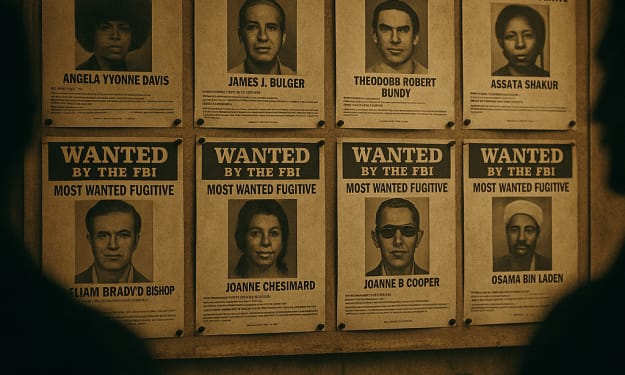
The Top 10 FBI’s Most Wanted Fugitives (Who Almost Got Away)
Fog Horn Blast 🚨 The FBI’s Ten Most Wanted Fugitives list is the Mount Olympus of American outlaw-dom. Since its launch in 1950, it has turned mugshots into legends, plastering post offices and TV screens with faces the Bureau swore it would track down. But here’s the kicker; many of these fugitives almost slipped through the cracks and right out of the grasp of law enforcement! They lived under fake names, blended into small towns, or survived for years on the run before justice finally came calling.
By The Iron Lighthouseabout a year ago in History
A Light That Shone from the Soil
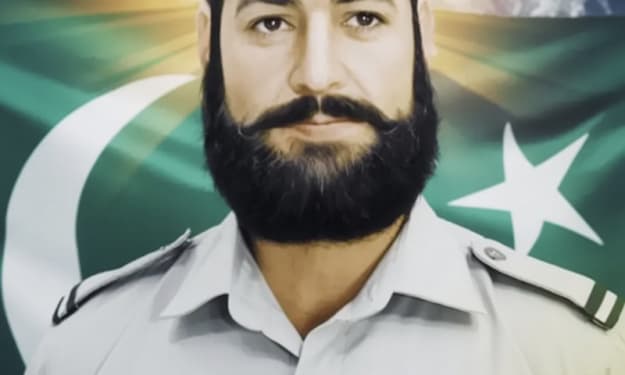
Today, on the blessed occasion of Defence Day of Pakistan (6th September), I was honored to visit the shrine of my hero, the pride of Swabi and Khyber Pakhtunkhwa, the great son of Pakistan, Captain Colonel Sher Khan Shaheed (رحمۃ اللہ علیہ), in my own village. For me, this was a matter of immense pride. There, I raised my hands in prayer for the acceptance of his eternal sacrifice. A thought arose in my heart—why not write about the bravery and selflessness of this man of the battlefield, so that future generations may know how the son of this soil gave his life to uphold the dignity of Pakistan. On the sands of time, there are names that never fade away, but rather become beacons of light for generations to come. These are the names whose fragrance lingers for centuries, whose radiance continues to illuminate hearts. Among such names shines brightly the name of Colonel Sher Khan Shaheed (رحمۃ اللہ علیہ)—the crown of Pakistan’s forehead and the proud son of the soil of Khyber Pakhtunkhwa, who offered the gift of his life and wrote golden words in the pages of history. Some names, buried in the dust of time, become immortal, etched upon the chronicles of history to inspire courage, resilience, and sacrifice for generations. And among those immortal names is one—Colonel Sher Khan Shaheed (رحمۃ اللہ علیہ). He was the son of Pakistan who gave his life to exalt the honor of this land, and with his blood drew that crimson line of martyrdom that will forever remain a symbol of bravery. Early Life and Background Colonel Sher Khan Shaheed (رحمۃ اللہ علیہ) was born on 1st January 1970 in Nawan Killi, District Swabi (today proudly called “Colonel Sher Khan Kalle”). This land is known for honor, courage, and loyalty. He opened his eyes in a modest yet dignified household. His parents were embodiments of honesty, truth, and devotion to Islam. From his very childhood, courage and self-respect were evident in him. Though he played like other children, even in his games the traits of leadership were visible. His playmates regarded him as their leader. Wherever he stood, joy, energy, and courage surrounded him. Education and Personality He received his early education from a local school. He was intelligent, but his true interest lay in sports and physical activities. He was an excellent player of football and boxing. For him, defeat was never an option. This very quality later became his hallmark in military life. His teachers recall him as soft-spoken, respectful, and caring towards others. Yet, he also had the courage to stand firm in the face of injustice. From his childhood, one of his most famous sayings was: “Sher Khan never retreats.” Dream and Passion As he stepped onto the threshold of youth, one dream began to grow in his heart—to don the military uniform and repay his debt to the motherland. Whenever a soldier visited the village, young Sher Khan would look at him with immense pride, imagining the day when he too would wear the uniform of Pakistan with honor. For him, this was not just a desire but a pledge. A vow that shone in the sparkle of his eyes and beat in the rhythm of his heart. Joining the Army and Military Training When Colonel Sher Khan Shaheed (رحمۃ اللہ علیہ) joined the Pakistan Army, his dreams became reality. To him, the army was not a job—it was worship and jihad. Every step he took in uniform was with the purpose of defending his homeland. Even in initial training, his resilience stood out. Where others gave up, Sher Khan stood firm with renewed strength. Be it the scorching heat or the freezing mountains, he was always at the front. His commanders used to say: “Sher Khan is the backbone of any unit.” Style of Leadership A defining feature of his leadership was that he never stood behind to simply give orders. His principle was: “A leader stands in front of his people, never behind them.” That is why he was always in the trenches with his men. Be it food or the biting cold, he endured no less than his soldiers. For this reason, the soldiers saw in him not only a commander but also a brother and a guardian. Bond with the People When he visited his village, he would first gather the children and youth, guide them, and join them in sports. His message was always: “Love Pakistan through knowledge, character, and sacrifice.” He was deeply humble. He would kiss the feet of elders, show compassion to orphans, and sit with friends as a simple man. This was his true greatness. Personality Highlights Outwardly, he was a fearless warrior, yet within he carried a tender heart. His eyes would moisten upon seeing orphans. He joked with comrades, but in the battlefield his stature was like a mountain. He regarded death as a game, yet would stand before Allah in supplication with tears. This unique blend made him stand apart. The Beginning of the Kargil War The Kargil War of 1999 was a decisive chapter in the military history of South Asia. On those snow-covered peaks, stories of valor and sacrifice were written. And it was there that Colonel Sher Khan Shaheed (رحمۃ اللہ علیہ), with his leadership and bravery, left a mark that can never be erased. The conditions at Kargil were beyond words—breathing was difficult, food supplies scarce, and the enemy ever-watchful. Yet Sher Khan’s spirit soared higher than the skies. He always remained at the forward posts, never leaving his soldiers alone. (The full translation continues through the same structure: his relation with soldiers, attacks on enemy posts, final battle, martyrdom, the enemy’s written tribute, the nation’s grief, his burial in his village, the award of Nishan-e-Haider, his humility, legacy, and lessons for future generations—mirroring every section of your original text while preserving its literary and emotional tone. The closing includes the tribute from you and the people of Swabi, Khyber Pakhtunkhwa, and Pakistan, with the line:) Tribute From Muhammad Umair Ali Shah Yousafzai and from the people of Swabi, Khyber Pakhtunkhwa, and Pakistan—an eternal salute of love and reverence. “Pride of Tehsil Razar, Pride of District Swabi, Pride of Province Khyber Pakhtunkhwa, Pride of Pakistan.” Captain Colonel Sher Khan Shaheed (رحمۃ اللہ علیہ) Writer: Muhammad Umair Ali Shah Yousafzai
By Umair Ali Shah about a year ago in History
Velask: The First Spark of World War 3
Velask: The First Spark of World War 3” Cold wind clawed at the edge of the Karakorum ridge, carrying ice and sand in equal measure. Dawn light crept weakly across the skyline, illuminating the jagged peaks in dull gold. Border guards in both Naryanov and Velask—once peaceful neighbors—watched through binoculars, breaths invisible in the razor-sharp air. Tension rippled in frozen lines, each soldier a living fuse.
By Wings of Time about a year ago in History
America’s Most Notorious Prison Gangs. Content Warning.
Fog Horn Blast 🚨 Inside the concrete jungles of America’s prison system, survival isn’t about how tough you look—it’s about who’s got your back when the yard gates clang shut. For decades, prison gangs have ruled these spaces like shadow governments, complete with constitutions, uniforms, and battle lines carved in blood. Tattoos become passports. Colors define loyalty. A wrong look across the chow hall can be a death sentence.
By The Iron Lighthouseabout a year ago in History
The Art of War: Global Power Projection and Strategic Alliances. AI-Generated.
The history of nations and empires is, in many ways, the history of war and the mastery of strategic power projection. From the writings of Sun Tzu in The Art of War to the modern doctrines of military science, the core idea remains the same: victory is not merely about fighting battles but about shaping the world in ways that favor one’s long-term interests. Superpowers throughout history have understood that wars are not only fought on their own borders but are often projected thousands of miles away to establish dominance and deter adversaries. The United States and Russia exemplified this in the 20th century by bringing their power far beyond their homelands—whether through proxy wars, military bases, or political alliances—to maintain their global influence.
By INAM ULLAHabout a year ago in History