Narratives
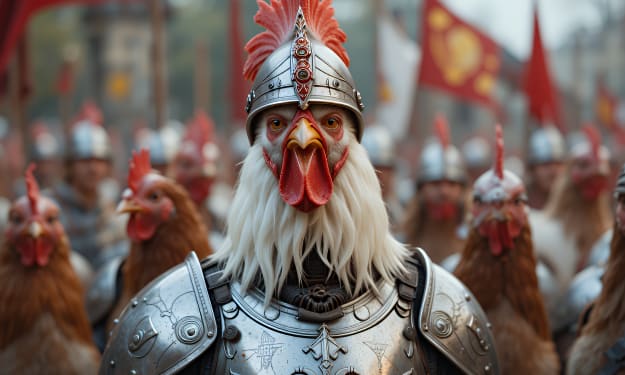
The Chicken War of 1325: When Clucking Chickens Sparked a Noble Revolt
I. A Crown Perched Precariously: Poland Before the Storm In the first decades of the 14th century, Poland was a kingdom stitched together with threadbare seams. Once a mighty and unified entity under the Piast dynasty, it had fractured during the "Period of Fragmentation" - a two-century-long brawl between dukes, princes, and churchmen, each more interested in carving up territory than fostering national unity. From the late 1100s through the 1200s, Poland resembled not a kingdom, but a jigsaw puzzle in a windstorm. Petty dukedoms rose and fell like the tides, and foreign powers nibbled greedily at Polish borders.
By History Seekerabout a year ago in History
🏰The London Beer Flood of 1814: When a River of Ale Drowned a City Block
Part I: The Day London Drowned in Beer In the early afternoon of October 17, 1814, the ordinary hum of life in St. Giles, one of London's most densely populated and impoverished neighborhoods, was about to be shattered - not by war, fire, or famine, but by something far more absurd and sinister. A freak disaster was brewing behind the brick walls of the Horse Shoe Brewery on Tottenham Court Road. Unbeknownst to the workers inside or the families living nearby, a monstrous force was growing - pressurized, fermented, and lethal. The day would soon turn from mundane to macabre as 320,000 gallons of beer burst into the streets, sweeping away buildings, lives, and any sense of normalcy.
By History Seekerabout a year ago in History
An Epic Medieval Beard Battle Expanded. The War of the Whiskers (1325–1327)
The early 1300s in Europe were marked by rapid social changes and simmering tensions. Feudalism was still the dominant social order, but towns like Compiègne were growing in wealth and influence due to trade. This economic shift empowered a new middle class of merchants, artisans, and guild members, who often challenged the old aristocratic customs.
By History Seekerabout a year ago in History
A Brief History of the Wheel: The Turning Point in Civilization
The wheel is one of the most important inventions in human history. It is a simple object, yet its impact on the development of civilization is profound. The invention of the wheel helped humans move from a primitive lifestyle to a more advanced society. It played a crucial role in transportation, agriculture, industry, and technology, allowing people to achieve things that were once impossible.
By MD BILLAL HOSSAINabout a year ago in History
Living Through the Storm: Survival Skills for the 21st Century
It wasn’t always this loud. The world, I mean. There was a time when mornings weren’t accompanied by a flood of notifications, when conversations didn’t compete with scrolling thumbs, and when uncertainty was the exception—not the air we all breathed. But somewhere between the rapid rise of technology and the unraveling of once-solid structures—jobs, relationships, the environment—it began to feel like life itself had turned into a storm. And we, unwittingly, were learning how to live through it.
By Muhammad Faizullahabout a year ago in History
Devil`s Rock Lighthouse
Devil's Rock Lighthouse On the northern coast of Maine, where the Atlantic crashes against jagged cliffs, stands a long-abandoned lighthouse—Devil’s Rock Lighthouse. Locals say the devil himself lives there. Built in 1874, the lighthouse once guided countless ships safely to shore. But on a stormy night, everything changed.
By Books Loverabout a year ago in History
Fire: The Most Important Invention of Ancient Society
Throughout human history, few discoveries have been as transformative as fire. It is easy to take fire for granted today—it flickers in our stoves, warms our homes, and powers our industries. But there was a time when fire was a mystery, a force of nature both feared and admired. When early humans first harnessed fire, it marked a turning point unlike any before. In that single moment, humanity took a bold step into the future. It was the beginning of transformation—from survival to society, from darkness to light.
By MD BILLAL HOSSAINabout a year ago in History
The Real Highthouse Story
For years, the tale of the Highthouse has intrigued thrill-seekers, paranormal enthusiasts, and local historians alike. Tucked away in the woods of an unnamed rural area, this crumbling structure has inspired countless ghost stories, urban legends, and even a few amateur documentaries. But what’s the real story behind Highthouse? The Origins of Highthouse Contrary to what many believe, Highthouse wasn’t always a haunted ruin. Built in the late 1800s, it was originally the estate of a wealthy but reclusive industrialist named Elias Hightham. Hightham, known for his eccentric ways, designed the house with towering spires and narrow windows, giving it a spooky, gothic vibe even in its heyday. Local records hint that Hightham was a secretive figure, rumored to have conducted bizarre experiments within his home. Some stories suggest he dabbled in alchemy, while others claim he was obsessed with reaching out to the dead. Whether these tales hold any truth or are just the result of small-town gossip remains a mystery. The Tragic Downfall The Hightham family’s luck took a dark turn in the early 1900s. Following a series of unexplained deaths—including those of Elias’ wife and two children—the house was left to decay. Some say Elias lost his mind from grief and disappeared into the wilderness, while others insist he never truly left the house. By the 1920s, Highthouse had turned into a hotspot for trespassers, vandals, and those in search of supernatural experiences. Reports of ghostly figures appearing in the windows, disembodied whispers, and even physical confrontations with visitors began to emerge. Whether these accounts are genuine paranormal happenings or just the product of vivid imaginations is still up for debate.
By Rashed khanabout a year ago in History
🦇💥 Operation Bat Bomb: When the U.S. Tried to Weaponize Bats
I. Prelude to Madness: Bats and Bombs in the American Imagination In the dark early years of World War II, the United States found itself in a high-stakes, all-hands-on-deck crisis. After Pearl Harbor, America was scrambling to innovate, strike back, and outmaneuver its Axis enemies. While scientists in Los Alamos were quietly splitting atoms, other minds were frantically churning out ideas for unconventional warfare - some inspired, others… not so much.
By History Seekerabout a year ago in History
When the U.S. Tried to Invade Canada… and Accidentally Invaded Itself
History is usually told with a straight face: kings and queens, wars and treaties, nations rising and falling with grim determination. But every so often, a moment sneaks through the cracks - a moment so ridiculous, so misguided, that you have to wonder if the people involved were reading from the wrong script.
By History Seekerabout a year ago in History