Modern
The Quiet Revolution – Awakening from Within . AI-Generated.
The Restless Evening It was an ordinary evening. The relentless buzz of social media, the constant ping of notifications, and the hum of everyday chaos had worn out the spirit. Amid the clamor, a gentle email notification caught the eye—a message urging, “Embrace silence to find your true voice.” Those few words struck a chord deep within, igniting a spark of curiosity and hope.
By Silent Sparkabout a year ago in History
Japan’s Corporate Culture: Key to Its Rapid Development?
Japan’s Corporate Culture: Key to Its Rapid Development? Introduction When people think of Japan, what often comes to mind is high-speed trains, advanced robotics, and a deep sense of tradition fused with futuristic innovation. But behind Japan’s post-war economic miracle lies a lesser-known yet powerful engine: its unique corporate culture. From lifetime employment to the ritual of after-work drinking, Japan’s business ethos has fascinated economists and sociologists for decades. But is it truly the key to Japan’s rapid development? Let’s take a closer look.
By MystiTech Hubabout a year ago in History
Leave a trace.
The window is open. The chilly, rain-drenched breeze hasn’t stopped all night. The messy bed. The exhausted laptop. The unlocked wardrobe. Discarded shirts, vests, backaches, crumpled sheets, books—all blending to create a sense of familiarity. Once, sleep wouldn’t come easily in this room. But with time, a person grows accustomed to so many things.
By sobuj hossainabout a year ago in History
Mysterious Landmarks on Mars Discovered by NASA
NASA has once again ignited global curiosity with the announcement of newly discovered mysterious landmarks on the surface of Mars. These strange and fascinating formations, captured by the Mars Reconnaissance Orbiter (MRO)'s powerful cameras, have intrigued and puzzled scientists. The images, which show landforms, unusual shapes, and symmetrical patterns that have never been seen before on Mars, are bringing up new questions about the planet's geological past and possibly even more mysterious possibilities.
By Ashiqur Rahman Khanabout a year ago in History
10 Scientific Facts Found in Ancient Indian Texts Centuries Before Modern Discovery
10 Scientific Facts Found in Ancient Indian Texts Centuries Before Modern Discovery Long before Newton dropped his apple and Einstein bent space-time, the ancient sages of India were penning down ideas that today’s scientists are only beginning to understand. Hidden in the verses of texts like the Rigveda, Sushruta Samhita, and Bhagavata Purana are shockingly accurate descriptions of scientific phenomena—ranging from gravity and atomic theory to surgical procedures and time dilation. While often dismissed as mythology or philosophy, these texts are treasure troves of forgotten knowledge. Here are 10 extraordinary scientific concepts that appear in ancient Indian scriptures long before they were "discovered" by modern science. You probably haven’t heard of half of them. --- 1. Speed of Light – Accurately Described in Rigveda Commentary. A 14th-century commentary by Sayana on the Rigveda states that light travels 2,202 yojanas in half a nimesha. Converted to modern units, this results in approximately 186,000 miles per second—the exact speed of light. This was centuries before science could even attempt to measure it. 2. Atomic Theory – Proposed by Sage Kanada. The Vaisheshika Sutras describe "anu" (atoms) as the smallest indivisible units that make up all matter. Sage Kanada even wrote about how these atoms combine and interact—long before Dalton’s atomic theory in the 19th century. 3. Water Cycle – Clearly Outlined in the Vedas. Texts like the Rigveda and Manusmriti mention the Sun evaporating water, which forms clouds and returns as rain—an accurate outline of the water cycle, described in spiritual texts long before science formalized the concept. 4. Gravity – Mentioned in Surya Siddhanta. The ancient astronomical text Surya Siddhanta, composed over 1,200 years before Newton, mentions that Earth has a gravitational force that pulls objects toward itself. It even attempts to explain planetary motion. 5. Time Dilation – Implied in Mahabharata. In a story from the Mahabharata, King Kakudmi and his daughter Revati visit Brahma’s realm for a few minutes. When they return, thousands of years have passed on Earth—a tale eerily similar to Einstein’s theory of time dilation. 6. Multiverse – Described in Bhagavata Purana. This text speaks of multiple universes, each governed by a different Brahma. The idea that many universes coexist independently aligns with the multiverse theory explored in quantum physics today. 7. Surgery and Anesthesia – Detailed in Sushruta Samhita. This ancient surgical manual from 600 BCE describes over 300 surgeries and 120 instruments. It also mentions the use of wine as an anesthetic—centuries before the invention of modern anesthesia. 8. Flying Machines – Outlined in Vaimanika Shastra. Describes “Vimanas” powered by mercury engines and anti-gravity technology. Though controversial, the level of detail (materials, aerodynamics) in these texts has intrigued even aerospace researchers. 9. Evolution – Reflected in Dashavatara (Ten Incarnations) The sequence of Vishnu’s avatars—fish, amphibian, boar, half-man, dwarf, and so on—uncannily matches the stages of Darwinian evolution, from aquatic life to complex human forms. 10. Cyclic Universe – Described in Vishnu Purana. The universe is said to undergo endless cycles of creation and destruction, mirroring current cosmological theories like the cyclic or oscillating universe model being explored in modern physics. Conclusion: While many of these ancient ideas were cloaked in metaphors or symbolic language, their core concepts align remarkably with modern scientific understanding. These aren’t just coincidental similarities—they challenge our assumptions about the origins of science itself. Maybe it’s time we stop calling these texts mere “mythology” and recognize them as early scientific thought wrapped in the poetic language of spirituality. Start writing...
By Riya mandalabout a year ago in History
LOUIS LEAKEY'S CONTROVERSIAL LEGACY
Despite having a meticulous 1400-page work about the Kikuyu people written, Jomo Kenyatta beat Louis Leakey by having the first Kikuyu ethnographic book Facing Mount Kenya, printed in 1938. As a PhD holder, Leakey could not help but hold resentment for Kenyatta who was now a published author (without even having a degree) while his own magnum opus gathered dust in a safe. Leakey was considered by many others but mostly himself as the expert on Kikuyu knowledge. Its as though he owned that knowledge and it was only his to disseminate. In fact, Leakey believed Kenyatta had plagiarized some of his material on circumcision rites without acknowledgement.
By HINGES OF TIMEabout a year ago in History
Crazy Inventions That Actually Existed
Throughout time, there have been many inventions that have shaped and changed everyday life as we know it, forever: The automobile. The Microwave. The smartphone. It's hard, almost unfathomable to imagine life and society without these.
By Jasmine Aguilarabout a year ago in History
How Japan’s Aging Population is Driving Technological Advancement
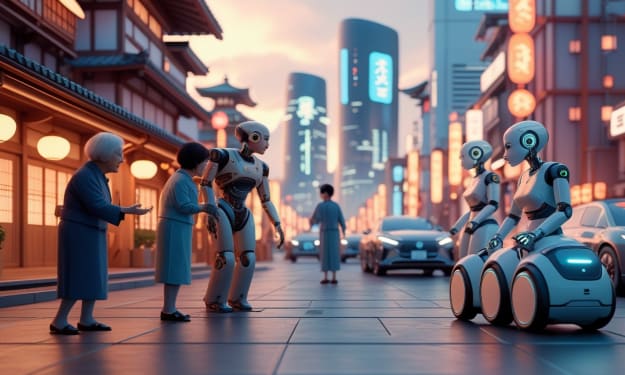
How Japan’s Aging Population is Driving Technological Advancement Discover how Japan’s aging crisis is fueling world-changing innovations in robotics, healthcare, and AI — transforming elderly care into a global model of technological progress.
By MystiTech Hubabout a year ago in History
The World’s Most Disliked Countries in 2024 – Understanding the Global Perception
Introduction In a time when the world is more interconnected than ever, global perception carries significant weight. Nations are judged not just by their policies or leaders but by their international behavior, media portrayal, and historical context. A recent global survey conducted by the International Statistics Organization in 2024 has revealed a list of the 15 most disliked countries in the world. While such lists spark heated debate, they also invite deeper reflection. Why are some countries so disliked? Is it due to politics, war, culture, or something more complex? Let’s explore the reasons behind this ranking and the broader implications of such global opinions. The 2024 List: Top 15 Most Disliked Countries 1. China 2. United States 3. Russia 4. North Korea 5. Israel 6. Pakistan 7. Iran 8. Iraq 9. Syria 10. India 11. United Kingdom 12. Japan 13. Saudi Arabia 14. Germany 15. Nigeria This list might raise eyebrows, but it reflects a global sentiment shaped by many interconnected factors. --- Geopolitical Power and Controversy The countries at the top—China, the United States, and Russia—are not just global superpowers but also frequent players in international conflict and political manipulation. Their foreign policies often create division. China's aggressive stance in the South China Sea, surveillance concerns, and treatment of minority populations (like the Uyghurs) has drawn global criticism. The U.S. is frequently disliked for its military interventions, perceived cultural dominance, and polarizing foreign policy. Meanwhile, Russia’s war in Ukraine and its authoritarian internal politics have severely damaged its global image. These countries’ roles in world affairs naturally place them in the spotlight—making their actions highly scrutinized and often controversial. --- Human Rights and Authoritarianism Many nations on this list have been repeatedly criticized for their human rights records. North Korea, known for its closed society, lack of freedoms, and dictatorship, faces near-universal condemnation. Iran and Saudi Arabia, despite their unique cultural and religious heritage, are often accused of oppressing women, silencing dissent, and restricting freedoms. Even democratic nations like India and Israel face accusations—India for increasing religious intolerance and suppression of minority voices, and Israel for its ongoing conflict with Palestinians. Global audiences tend to react strongly to perceived injustices, especially when these issues dominate international headlines. --- Wars, Terrorism, and Instability Countries like Iraq, Syria, and Pakistan have been at the center of regional and global conflicts for decades. Although many of their people are victims of violence and foreign intervention, these nations are often associated with terrorism, war, and instability. Western media, in particular, has played a significant role in reinforcing these perceptions. Nigeria, too, suffers from internal conflicts and extremist groups like Boko Haram, which adds to its unfavorable image internationally. It’s important to note that public opinion doesn’t always distinguish between governments, radical factions, and ordinary citizens—an unfortunate generalization that fuels misunderstanding. --- Colonial Legacy and Cultural Clashes The presence of the UK, Germany, and Japan on this list may seem surprising at first glance. However, the colonial history of the United Kingdom and Germany's 20th-century wars still cast a long shadow. Japan, while technologically advanced and peaceful today, faces criticism from its Asian neighbors for failing to fully reckon with its World War II past. In addition, cultural friction plays a role in how certain populations view others. When traditions, values, or ideologies clash, mutual respect often gives way to mistrust or even resentment. --- The Role of Global Media Perception is powerfully shaped by media narratives. News outlets, social media, and film industries play a massive role in influencing how one country sees another. For example, Hollywood often portrays certain regions (especially the Middle East or Asia) through a lens of conflict, extremism, or backwardness. Likewise, state-run media in various countries may intentionally paint other nations as enemies or threats, reinforcing public fear and animosity. This cycle of media-driven judgment has created deep stereotypes—some of which are far removed from the actual experiences of those living in these nations. --- Perception vs. Reality It’s crucial to understand that public perception doesn’t always reflect the truth. Most people in these countries live normal lives, seek peace, and want progress. The dislike toward a country often stems from the actions of a government, specific policies, or dominant media portrayals—not the culture or people as a whole. Such rankings, while useful for discussion, can also reinforce harmful stereotypes if not handled with care. They remind us how easy it is to judge from afar—and how important it is to approach international opinions with nuance. --- Conclusion The 2024 list of the most disliked countries is not just a popularity chart—it is a mirror reflecting how deeply intertwined our world has become. Political decisions, historical grievances, media influence, and cultural differences all contribute to global opinion. While some criticism is justified, other elements are rooted in misunderstanding or bias. To build a more compassionate and informed world, we must look beyond headlines and recognize the complexity within each country. After all, a nation is more than its politics—it’s its people, its history, and its hope for the future.
By Insect Legendsabout a year ago in History