Modern
The Clockmaker’s Promise -
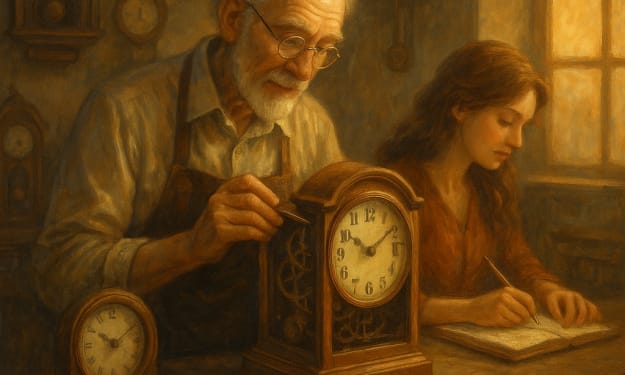
In a quiet village nestled between rolling hills, lived an old clockmaker named Eli. His shop was a magical place, filled with the rhythmic ticking of countless clocks, each one carefully crafted by his hands. Some were tall grandfather clocks with deep chimes, others were delicate pocket watches with golden gears. Yet, among all these, one silver clock stood out — not for its beauty, but because it had not ticked in years. This silver clock sat on a shelf behind Eli’s workbench, untouched and unmoving. Every morning, Eli would dust it gently, polish its face, and then leave it as it was — still, silent. Villagers often asked him why he never fixed it, but Eli would only smile and say, “That one’s waiting.” You see, the clock once belonged to Eli’s daughter, Anna. Years ago, when she was just sixteen, she had gone to the city for a job. She promised to return by the first snowfall, but she never did. Letters stopped coming, and after months of waiting, Eli was told she had vanished. Though grief-stricken, he never gave up hope. And in her memory, he made a promise: he would not restart her silver clock until the day she returned. Years passed. Eli grew older, his hair silver like the clock. The world changed around him, but his routine remained the same. Every tick in his shop reminded him of time moving forward — except for the silver one, which held time still, like a frozen hope. One rainy evening, just as Eli was about to close his shop, a small girl entered, no more than ten years old. She was soaked from head to toe and clutched a broken locket in her hand. “My locket... it's broken,” she said quietly, placing it on the counter. Eli took the locket gently, examining it under his lamp. Inside was a faded photo of a young woman — and Eli froze. It was Anna. “Where did you get this?” he asked, his voice shaking. “She was my mother,” the girl replied. “She passed away last year. She used to tell me stories about a clockmaker... a kind man who made time stand still for her.” Tears welled in Eli’s eyes. After all these years, he finally had a piece of his daughter back — his granddaughter. He poured her a cup of cocoa and sat with her by the fire. They spoke late into the night, sharing memories of Anna. As the fire crackled and the shop quieted, a sound echoed through the room — tick... tick... tick. Eli turned toward the shelf. The silver clock, untouched for years, had started ticking. Neither of them had wound it. The clock, it seemed, had been waiting too. Themes and Message Time and Memory: The silver clock represents Eli’s grief and his refusal to move on until his daughter returned. It's symbolic of how some memories are so precious that we try to freeze them in time. Promises: Eli’s promise to his daughter was not just about the clock — it was about holding on to hope, even when the world says to let go. Hope and Reunion: Though Anna never returned, her daughter did. Eli’s hope wasn’t in vain. The reunion with his granddaughter brought healing, closure, and a new beginning. Conclusion The Clockmaker’s Promise is a touching story about love, loss, and the enduring power of a promise. It reminds us that sometimes, even when all seems lost, time finds a way to bring things full circle. The ticking of the clock becomes not a reminder of what was lost — but of what was found again. Let me know if you'd like this turned into a PDF or need a Bengali translation of this version! ChatGPT can make mistakes. Check important i
By Ratan Kumar Royabout a year ago in History
Sunset in the mountains of Durmitor
Sunset in the mountains of Durmitor The afternoon was different. The sun was slowly setting on the mountainside, spreading golden colors in the sky. The sunset could be seen from the campus dormitory, like a perfectly arranged scene—as if painted by Allah with his own hands.
By Arshad Aliabout a year ago in History
Governing the Moon A History
This original historical study on the Moon Treaty's beginnings was funded by the Office of Technology, Policy, and Strategy in order to better investigate and comprehend a new space policy concern future lunar governance. Humanity's ability to plan our lunar journey could be just as crucial as
By MD NAFIUL ISLAMabout a year ago in History
Wink Martindale, Popular and Durable.
Wink Martindale passed away on Tuesday in Rancho Mirage, California. He was a radio personality who rose to fame on television as a stylish and friendly presenter of game shows such as "Gambit," "Tic-Tac-Dough," and "Debt" in the 1970s and 1980s. He was ninety-one.
By MD NAFIUL ISLAMabout a year ago in History
MAUMAU GENERAL'S GRAND RETURN?
47 years after his disappearance, the country rejoiced at the alleged return of the former Maumau General, Stanley Mathenge. He had been invited by the then President Mwai Kibaki who had been sworn into power a few months prior after a journalist had claimed to have found the former guerrilla still in exile in Ethiopia. The new Kibaki regime had signaled a new era of hope and although Mathenge’s return was perceived as yet another good omen, it deteriorated into an embarrassing scandal after the man claiming to be Mathenge turned out to be an Ethiopian farmer.
By HINGES OF TIMEabout a year ago in History
Trump sets sights on national African American history museum
In a significant shift from his earlier stance, President Donald Trump has recently targeted the Smithsonian Institution's National Museum of African American History and Culture (NMAAHC), accusing it of promoting "improper ideology" and "divisive narratives." This move has sparked widespread criticism from historians, artists, and civil rights advocates who view it as an attempt to sanitize American history.
By Md Soriful Islamabout a year ago in History
Why Are We Ignoring Easter?. Content Warning.
Why are we ignoring Easter in the UK? Easter is, besides Christmas, one of the most important events in Christendom. Never mind which denomination we belong to or what calendar we follow, Easter is celebrated by all churches. The story of Jesus and His last supper, where He proclaimed the breaking of bread and the drinking of red wine. This represented the breaking of His body on the cross and His blood, which He shed. It also represents the Third Day, upon which he arose, defeating death and ascending to His Father in Heaven. His followers are promised eternal life, salvation, and redemption.
By Nicholas Bishopabout a year ago in History
NASA Sets Coverage for Astronaut Don Pettit, Crewmates’ Return
NASA Sets Coverage for Astronaut Don Pettit, Crewmates’ Return to Earth After ISS Mission. NASA has announced detailed coverage plans for the upcoming return of NASA astronaut Don Pettit and his fellow crewmates aboard the Soyuz spacecraft. After completing a successful mission aboard the International Space Station (ISS), Pettit, alongside Russian cosmonaut Oleg Kononenko and European Space Agency (ESA) astronaut André Kuipers, will soon make their way back to Earth. This highly anticipated event marks the conclusion of an important chapter in human spaceflight and international collaboration. NASA has made arrangements to broadcast the entire process live, giving audiences around the world the rare opportunity to witness the careful and well-coordinated steps involved in bringing astronauts safely home from orbit. Comprehensive Live Coverage NASA’s coverage will include live video streaming of the Soyuz spacecraft’s undocking, deorbit burn, and final landing sequence. The entire event will be available to watch via NASA TV, the agency’s official website, and the NASA app. This ensures global accessibility for those eager to follow the journey of Pettit and his crewmates back to Earth. In addition to the technical coverage of spacecraft operations, post-landing interviews and health updates on the returning crew members will also be shared. These updates provide insight into how the human body adjusts after extended periods in microgravity and highlight the incredible resilience and adaptability of astronauts. Viewers can also expect mission highlights and recaps of the crew’s stay aboard the ISS. These summaries will showcase scientific experiments, technological demonstrations, and educational activities conducted during their mission, reflecting the ongoing importance of the ISS in supporting research that benefits life on Earth and future space exploration. Mission Designation and Return Details The return of Don Pettit and his colleagues is part of Expedition 71/72 (or the applicable mission designation, depending on the exact timeline). The crew is scheduled to leave the ISS aboard the Soyuz MS-XX spacecraft — the specific designation to be confirmed by NASA closer to the event. Key details of the return include: Return Vehicle: Soyuz MS-XX spacecraft Landing Location: Steppes of Kazakhstan Live Coverage Platforms: NASA TV, NASA’s official website, and the NASA app Undocking Date & Time: [To be announced] Landing Date & Time: [To be announced] The Soyuz descent module carrying the crew is expected to make a parachute-assisted landing in Kazakhstan, where recovery teams from NASA and Roscosmos will be standing by to assist the astronauts upon arrival. About Astronaut Don Pettit A seasoned NASA astronaut, Don Pettit is known not only for his scientific expertise but also for his unique ability to communicate the wonders of space to the public. Over the course of his career, Pettit has spent a cumulative [months/years] in space across several missions. His work aboard the ISS has included countless experiments in microgravity, exploring topics ranging from fluid physics to materials science and plant biology. Pettit is also widely recognized for his engaging educational outreach. His popular video series from space, where he demonstrated everyday phenomena in zero gravity, has inspired countless students and educators. These efforts highlight the importance of using spaceflight as a tool to excite and educate the next generation of scientists, engineers, and explorers. What Happens After Landing Once safely on the ground, Pettit, Kononenko, and Kuipers will undergo standard post-landing medical evaluations to monitor their readjustment to Earth’s gravity. These health checks are crucial for collecting data about the effects of long-duration spaceflight on the human body — information that is vital for planning future missions, including deep-space exploration to destinations like the Moon and Mars. Pettit’s return will mark the completion of yet another significant mission, contributing valuable scientific findings and operational experience to support humanity’s ongoing quest to explore beyond our home planet.
By Mahmudul Hasanabout a year ago in History