Medieval
How Sun Revolve around the Earth?
The Srimad Bhagvatam is one of the most practical and foremost texts of Vedic tradition. It offers multiple examples, stories of Lord Krishna offered to practitioners of Krishna consciousness to elevate a higher spiritual taste. The divine Srimad Bhagavatam gives a detailed and exact view of cosmic world which is far much different from modern science, and it's references directly questions modern scientists, which they often fails to answer too.
By Sahil Lathwal2 years ago in History
10 Scientific Facts Found in Ancient Indian Texts Centuries Before Modern Discovery
10 Scientific Facts Found in Ancient Indian Texts Centuries Before Modern Discovery Long before Newton dropped his apple and Einstein bent space-time, the ancient sages of India were penning down ideas that today’s scientists are only beginning to understand. Hidden in the verses of texts like the Rigveda, Sushruta Samhita, and Bhagavata Purana are shockingly accurate descriptions of scientific phenomena—ranging from gravity and atomic theory to surgical procedures and time dilation. While often dismissed as mythology or philosophy, these texts are treasure troves of forgotten knowledge. Here are 10 extraordinary scientific concepts that appear in ancient Indian scriptures long before they were "discovered" by modern science. You probably haven’t heard of half of them. --- 1. Speed of Light – Accurately Described in Rigveda Commentary. A 14th-century commentary by Sayana on the Rigveda states that light travels 2,202 yojanas in half a nimesha. Converted to modern units, this results in approximately 186,000 miles per second—the exact speed of light. This was centuries before science could even attempt to measure it. 2. Atomic Theory – Proposed by Sage Kanada. The Vaisheshika Sutras describe "anu" (atoms) as the smallest indivisible units that make up all matter. Sage Kanada even wrote about how these atoms combine and interact—long before Dalton’s atomic theory in the 19th century. 3. Water Cycle – Clearly Outlined in the Vedas. Texts like the Rigveda and Manusmriti mention the Sun evaporating water, which forms clouds and returns as rain—an accurate outline of the water cycle, described in spiritual texts long before science formalized the concept. 4. Gravity – Mentioned in Surya Siddhanta. The ancient astronomical text Surya Siddhanta, composed over 1,200 years before Newton, mentions that Earth has a gravitational force that pulls objects toward itself. It even attempts to explain planetary motion. 5. Time Dilation – Implied in Mahabharata. In a story from the Mahabharata, King Kakudmi and his daughter Revati visit Brahma’s realm for a few minutes. When they return, thousands of years have passed on Earth—a tale eerily similar to Einstein’s theory of time dilation. 6. Multiverse – Described in Bhagavata Purana. This text speaks of multiple universes, each governed by a different Brahma. The idea that many universes coexist independently aligns with the multiverse theory explored in quantum physics today. 7. Surgery and Anesthesia – Detailed in Sushruta Samhita. This ancient surgical manual from 600 BCE describes over 300 surgeries and 120 instruments. It also mentions the use of wine as an anesthetic—centuries before the invention of modern anesthesia. 8. Flying Machines – Outlined in Vaimanika Shastra. Describes “Vimanas” powered by mercury engines and anti-gravity technology. Though controversial, the level of detail (materials, aerodynamics) in these texts has intrigued even aerospace researchers. 9. Evolution – Reflected in Dashavatara (Ten Incarnations) The sequence of Vishnu’s avatars—fish, amphibian, boar, half-man, dwarf, and so on—uncannily matches the stages of Darwinian evolution, from aquatic life to complex human forms. 10. Cyclic Universe – Described in Vishnu Purana. The universe is said to undergo endless cycles of creation and destruction, mirroring current cosmological theories like the cyclic or oscillating universe model being explored in modern physics. Conclusion: While many of these ancient ideas were cloaked in metaphors or symbolic language, their core concepts align remarkably with modern scientific understanding. These aren’t just coincidental similarities—they challenge our assumptions about the origins of science itself. Maybe it’s time we stop calling these texts mere “mythology” and recognize them as early scientific thought wrapped in the poetic language of spirituality. Start writing...
By Riya mandal2 years ago in History
Houston Stuns Duke in Final Four Comeback to Reach NCAA Championship
SAN ANTONIO — In a thrilling Final Four showdown, Houston pulled off an incredible comeback to defeat Duke 70-67, overcoming a 14-point deficit in the final eight minutes. With this stunning victory, the Cougars are now set to face Florida in the NCAA Championship game on Monday night.
By Muhammad Hayat2 years ago in History
Harlow's End: Echoes of the Nameless Stranger
The Nameless Stranger The stranger came into town just after the rain. He didn't say a word as he passed the broken town sign that read "Welcome to Harlow's End." His boots were wet, his coat was covered in road dust, and there was silence. Population: crossed out in black spray paint. He came to a stop at the diner because the neon sign was flickering, as if it was trying to decide if it was still going to glow. Inside, the usual suspects—farmers, wanderers, and a disheveled waitress with too many secrets—shut down. Not because he looked dangerous, but because he looked like he didn’t belong anywhere. Tall. Pale. Eyes the color of river stone. No bags. No ID. No name. He sat at the counter and ordered coffee. Black. When the waitress asked his name for the tab, he just said, “No need.” And smiled like it was the saddest joke in the world. That night, strange things started happening. The dogs howled without a reason. Power flickered. The old church bell rang once—though the rope had snapped years ago. By morning, the mayor’s son was missing. They remembered the stranger, of course. How could they forget him? But when they checked the booth he’d sat in, the seat was bone-dry—untouched. The coffee cup was still full. Still warm.
By Al Amin Islam 2 years ago in History
Revolutionizing Healthcare: AI and mRNA Drive the Next Wave of Pharma Innovation . AI-Generated.
The pharmaceutical industry is experiencing a transformative shift with the integration of artificial intelligence (AI) and messenger RNA (mRNA) technology. These groundbreaking advancements are reshaping drug discovery, vaccine development, and personalized medicine, offering new possibilities for patient care and disease management. AI-driven algorithms have revolutionized the early stages of drug discovery by analyzing vast datasets to identify potential drug candidates more efficiently. Traditionally, the process of discovering new drugs could take several years and billions of dollars, but AI has dramatically reduced this timeline by using machine learning models to predict how molecules will interact with disease targets. By leveraging AI, researchers can filter through millions of compounds in a fraction of the time it would take using conventional methods, significantly accelerating the pipeline for drug development.
By Elevate Your Life Sciences CRM with Close-Up International2 years ago in History
A Stroll Through the Mist of Morning
Silently, the world was bathed in a gentle, golden tint as the first rays of dawn appeared over the horizon. With their silhouettes set against the pale sky, the tall, ancient trees stood like quiet protectors of the forest. The world was enveloped in a weird, almost unearthly silence as a silent mist clung to the ground, enveloping everything in its ethereal grip. It was so quiet in the morning that it seemed as though time had paused for a while. A air of expectancy and waiting permeated everything. As if the day had not yet begun, the land held its breath.
By MD SHAMIM RANA2 years ago in History
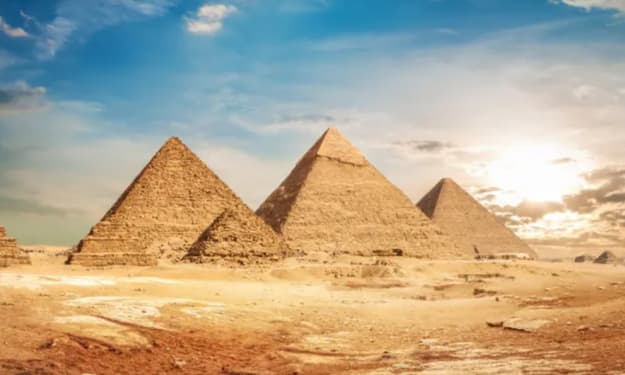
"Beneath the Sands of Time: The Controversial Discovery of a Subterranean Metropolis Under Egypt’s Pyramids"
The Eternal Allure of Egypt’s Mysteries The Great Pyramids of Giza, guardians of the desert for over 4,500 years, have long captivated humanity. These colossal structures, aligned with celestial precision, are testaments to the sophistication of ancient Egyptian civilization. Yet, as modern technology peels back layers of sand and stone, a provocative theory has emerged: beneath the pyramids and the Sphinx lies a sprawling subterranean network—a “hidden city” that could redefine Egyptology. This claim, however, has ignited fierce debate among experts, pitting traditional archaeologists against interdisciplinary researchers armed with radar scans and AI-driven simulations.
By Nada soliman2 years ago in History
A Promise in the Morning Rain
Everything seemed to be cleansed by the early rain, and the world outside shone in the resulting gentle light. I met him in the little village of Windmere, which was tucked away on the outskirts of a mile-long forest. Instead of being a torrential downpour, the rain was a light mist that left the ground smelling delicious and damp. The world seemed to be waiting for something to happen, as seen by the unusually calm streets.
By MD SHAMIM RANA2 years ago in History