Lessons
This Is How You Kill a Witness.
A Black woman, slight, deliberate, sharp-eyed. She is injured, holding crutches. She keeps her eyes low, but her spine is straight. She looks small against the backdrop of burnished wood. But today, she will not remain silent as so many other women had. Scared for their lives. Scared for their families. Scared of the consequences of telling the truth. Frances Thompson was terrified, but she knew that the only way to make them listen was to speak.
By River and Celia in Underlandabout a year ago in History
Alexander the Great: Hero or Tyrant?
Introduction Few historical figures are as polarizing as Alexander the Great. Born in 356 BCE in Macedonia, he created one of the largest empires in the ancient world before dying at just 32 years old. Lauded by some as a military genius and visionary leader who spread Hellenistic culture, and condemned by others as a ruthless conqueror who left chaos and death in his wake, Alexander’s legacy is a complex mosaic of heroism and tyranny. This article critically examines both aspects to determine whether Alexander deserves the title of “Great” — or something else entirely. --- The Heroic Narrative: Visionary Leader and Cultural Pioneer To his admirers, Alexander is the embodiment of a heroic ideal. Taught by Aristotle, he was not only a skilled warrior but also an intellectual. He led his troops from Greece through Asia Minor, Egypt, Persia, and into India, often participating directly in battles and inspiring fierce loyalty from his soldiers. One of Alexander’s most celebrated achievements was the spread of Hellenistic culture across three continents. By founding over 20 cities (most famously Alexandria in Egypt), he helped blend Greek, Persian, Egyptian, and Indian traditions. This cultural fusion led to advances in art, science, and philosophy, laying the groundwork for centuries of intellectual development. Additionally, Alexander often adopted elements of local customs and religions rather than imposing his own. In Persia, for instance, he began wearing Persian dress and married Roxana, a Bactrian princess, to legitimize his rule and unify different cultures under one empire. This behavior has been interpreted by some as visionary — an early attempt at global integration. --- The Tyrant’s Case: Conqueror, Not Liberator However, not everyone sees Alexander as a hero. Many historians argue that his conquests were driven less by idealism and more by personal ambition and thirst for glory. His military campaigns resulted in widespread death and destruction. The city of Tyre was besieged and destroyed after resisting his army; men were slaughtered, and women and children enslaved. Similarly, in India, his brutal campaign against the Mallians led to mass casualties and showed little regard for native populations. Alexander’s behavior also became increasingly erratic and tyrannical as his power grew. After the death of his close companion Hephaestion, he reportedly executed several people he blamed for the tragedy. He also murdered his friend and general, Cleitus the Black, in a drunken rage — an act that horrified even his most loyal followers. Moreover, Alexander’s policy of forcibly integrating peoples through military conquest and intermarriage has been criticized as a form of imperialistic domination. While he promoted cultural exchange, it was under the shadow of warfare and subjugation. --- Legacy: Greatness at What Cost? The question of whether Alexander was a hero or a tyrant is not easily answered. His military genius is undeniable; he never lost a battle and revolutionized warfare. The Battle of Gaugamela is still studied in military academies for its brilliant use of tactics and terrain. Yet, greatness in conquest does not necessarily equate to moral greatness. While he built an empire, it did not survive long after his death, fracturing into competing kingdoms ruled by his generals — the Diadochi. His sudden death in 323 BCE, possibly due to fever, poison, or overindulgence, left a power vacuum that plunged much of the known world into chaos. --- Conclusion Alexander the Great’s life and legacy defy easy categorization. He was a brilliant military leader and a unifier of cultures, yet also a ruthless conqueror whose ambition caused immense suffering. Whether one views him as a hero or a tyrant often depends on perspective: Was he a pioneer of globalization, or simply another imperial warlord? Perhaps the most honest answer is that Alexander was both — a visionary whose achievements shaped the world, and a despot whose methods came at a terrible cost. History remembers him as "Great," but with that greatness came complexity, contradiction, and consequence.
By Haris khanabout a year ago in History
Alexander the Great and the Indian Subcontinent
In 327 BCE, Alexander the Great, already a legend across the known world, gazed eastward toward a land few Greeks had ever seen—India. Having conquered Persia and stood victorious over mighty kings, Alexander sought new horizons. His ambition was as vast as his empire, and beyond the towering Hindu Kush mountains lay the fabled riches of the Indian subcontinent.
By Muhammad Saeedabout a year ago in History
What History Books Don’t Tell You About Colonialism
🩸 What History Books Don’t Tell You About Colonialism → A Raw Look at the Wounds That Never Healed We were told it was about “civilization.” About trains, law, and the English language. We were taught names like Vasco da Gama, Columbus, and Clive as pioneers. We memorized dates of conquests, not massacres. We celebrated “discoveries,” not theft. And somewhere between the footnotes and glorified timelines, the truth was buried.
By Md Ajmol Hossainabout a year ago in History
🏰Petra: The Lost Rose City of the Nabateans
🏰Petra: The Lost Rose City of the Nabateans 🌵The Ancient City Carved from Desert Stone If you ever find yourself in southern Jordan, standing at the mouth of a narrow canyon while the desert wind swirls red dust around your feet, you might have the sense that you’re on the edge of something extraordinary. And you’d be right. Just beyond that winding chasm lies Petra—a city carved straight into the rose-colored cliffs, a place that once bustled with life and now sits in silent, sun-baked grandeur. Petra isn’t just a monument to the past. It’s a labyrinth of stories, secrets, and stone, and its legacy is still unfolding.
By History Seekerabout a year ago in History
✈️The Top 5 Warplanes of World War II
✈️The Top 5 Warplanes of World War II: Masters of the Skies World War II was as much a war of machines as it was of men. Among those machines, warplanes soared to unprecedented importance. They reshaped battlefields, changed tactics, and became symbols of national pride and technical prowess. From the early days of dogfights to massive bombing raids, the aircraft that dominated the skies played crucial roles in determining the fate of nations. Many planes flew in these skies, but a handful stood out for their design, performance, versatility, and impact on the war effort.
By History Seekerabout a year ago in History
Remembering the Nigerian Civil War: How Colonialism Sparked Separatism in the East
The Nigerian Civil War, which took place from 1967 to 1970, emerged as one of the most brutal conflicts of the 20th century. The struggle of the Igbo people living in the eastern part of the country for the right to live in their own state of Biafra cost them enormous losses: according to various estimates, the death toll ranged from 1 to 3 million people. The colonial history of the nation was a primary factor contributing to the conflict.
By Uchenna Cosmas Nwokafor about a year ago in History
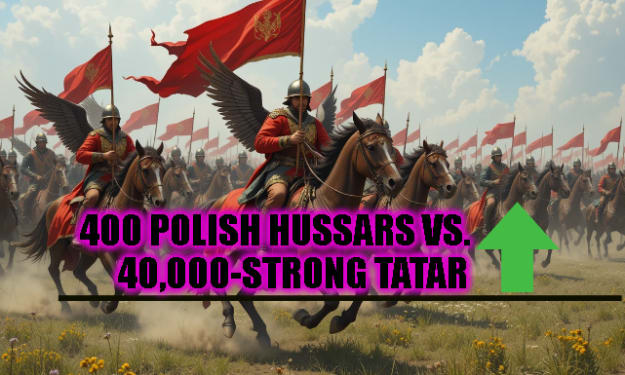
🛡️When 400 Polish hussars resisted a 40,000-strong Tatar force
The Battle of Hodów, fought in the summer of 1694, stands out as one of the most extraordinary confrontations in the history of the Polish-Lithuanian Commonwealth. This clash between a small detachment of approximately 400 Polish hussars and a massive Tatar raiding force, estimated at around 40,000 warriors, has become legendary as a symbol of valor, discipline, and tactical genius. Often called the “Polish Thermopylae,” the Battle of Hodów showcases how steadfast courage and military skill can defy overwhelming odds.
By History Seekerabout a year ago in History
6-0 DOGFIGHT ( Pakistan Air Force Vs Indian Air Force )
May 7, 2025 – Dawn of the Skies The sun had barely risen over the snow-capped peaks of the Himalayas when the first roars of jet engines pierced the morning calm. From the Indian Air Force’s forward bases, squadrons of Rafales and Su-30MKIs screamed into the sky, their mission clear: strike deep into Pakistani territory, avenge the deadly Kashmir attack of April 22, and reassert control over the restive region.
By Mehtab Ahmadabout a year ago in History
21 Sikh soldiers vs. 10,000 Afghan tribesmen, who won? - The Battle of Saragarhi (1897)
21 Sikh soldiers vs. 10,000 Afghan tribesmen, who won? - The Battle of Saragarhi (1897) The Ultimate Last Stand In the rugged mountains along the North-West Frontier of British India, a tiny outpost named Saragarhi became the stage for one of history’s most astonishing acts of military bravery. On September 12, 1897, 21 Sikh soldiers, part of the 36th Sikh Regiment of the British Indian Army, faced off against an estimated 10,000 Pashtun tribesmen. Outnumbered nearly 500 to 1, these men fought to the last breath, their sacrifice echoing through time as a symbol of courage, loyalty, and the unbreakable human spirit.
By History Seekerabout a year ago in History
🪖Top 5 Best Tanks of World War II
World War II was a watershed moment in the history of armored warfare, fundamentally changing how wars were fought and accelerating tank development at an unprecedented pace. Tanks became the spearhead of offensives, the backbone of mechanized infantry, and a symbol of industrial power and military innovation. Among the thousands of tanks produced by various nations during this global conflict, a handful emerged as icons of their era, epitomizing design excellence, battlefield effectiveness, and strategic impact. This article examines the five best tanks of World War II, weaving their stories continuously with in-depth analysis of their design philosophies, production challenges, battle performance, and lasting legacy.
By History Seekerabout a year ago in History