Lessons
The Art of War: Global Power Projection and Strategic Alliances. AI-Generated.
The history of nations and empires is, in many ways, the history of war and the mastery of strategic power projection. From the writings of Sun Tzu in The Art of War to the modern doctrines of military science, the core idea remains the same: victory is not merely about fighting battles but about shaping the world in ways that favor one’s long-term interests. Superpowers throughout history have understood that wars are not only fought on their own borders but are often projected thousands of miles away to establish dominance and deter adversaries. The United States and Russia exemplified this in the 20th century by bringing their power far beyond their homelands—whether through proxy wars, military bases, or political alliances—to maintain their global influence.
By INAM ULLAHabout a year ago in History
The Saudi–Pakistan Defense Deal: Strategic Implications and Its Impact on Global and Regional Politics. AI-Generated.
Defense cooperation between Pakistan and Saudi Arabia has long been a cornerstone of their bilateral relationship. The recent developments in their defense partnership—ranging from joint military exercises to strategic agreements on arms production, intelligence sharing, and security cooperation—have reignited global debates about its impact on regional politics. This evolving alliance carries deep implications for countries like Israel and India, both of which see Pakistan as a security concern and view Saudi Arabia as a potential player in shaping Middle Eastern geopolitics. At the same time, this defense deal holds promising opportunities for strengthening Muslim unity, advancing Pakistan’s defense industry, and revitalizing its struggling economy.
By INAM ULLAHabout a year ago in History
Tithing is not required for New Testament believers. Content Warning.
Please click on the accompanying links so you can see the progression of tithing for yourself. Is tithing a hoax? Is tithing required for modern-day churchgoers, or has a hoax been perpetuated on the people? The question of how tithes went from produce to monetary giving was a hot topic when Pastor Creflo Dollar changed his views.
By Cheryl E Prestonabout a year ago in History
UN Report Accuses Israel of Genocide in Gaza: Evidence, Allegations, and Global Reactions
The allegations of genocide against Israel in Gaza by the United Nations Commission of Inquiry are based on a report which states that since the beginning of the war with Hamas in 2023, Israel has committed four out of the five acts required under international law to classify a situation as genocide. This detailed report presents evidence and concludes that Israel has violated the Genocide Convention, which was adopted in 1948 by the newly established United Nations. The word genocide, and the convention that defined it as a crime, was directly influenced by Nazi Germany’s extermination of six million Jews. The definition of genocide in the 1948 Convention is the intent to destroy, in whole or in part, a national, ethnic, racial, or religious group—in this case, the Palestinians of Gaza. Israel denies all such allegations that its conduct in Gaza has violated the conventions and treaties that form the basis of the laws of war and international humanitarian law. It presents its actions as measures of defense aimed at protecting civilians and pressuring for the release of Israeli hostages. The Israeli military launched its assault on Gaza after Hamas attacks killed 1,200 people and kidnapped 251 Israelis. According to the Palestinian Ministry of Health, nearly 65,000 Palestinians have been killed so far by Israeli strikes and operations. Ninety percent of homes are either destroyed or damaged. Gaza’s public health, water, and sanitation systems have also collapsed. Israel has dismissed the report as Hamas-influenced, anti-Semitic lies. The report was prepared by the UN Human Rights Council’s Commission of Inquiry. Both Israel and the United States have boycotted this council. The findings of the report are expected to add to the growing international condemnation of Israel’s conduct—not only from its traditional Western allies but also from Gulf Arab monarchies that normalized relations with Israel under the Abraham Accords. Next week, at the United Nations General Assembly in New York, the UK, France, Australia, Canada, and other countries are expected to formally recognize an independent Palestinian state. This step will be far more than symbolic. It is likely to change the debate about the future of the conflict, which began more than a century ago when Zionist Jews from Europe settled in Palestine. Israeli Prime Minister Benjamin Netanyahu has denounced the move as anti-Semitic. He has declared that Palestinians will never gain independence on any part of the land between the Jordan River and the Mediterranean Sea, claiming that a Palestinian state would endanger Israelis. Religious nationalist extremists in Israel believe that this land was granted by God solely to the Jewish people. The investigative report also details Israel’s actions against Palestinians both inside Gaza and in Israeli prisons. The long list of allegations includes Israel’s targeting of civilians, whom it is legally obligated to protect, as well as the imposition of “inhuman conditions” that cause Palestinian deaths—such as deprivation of food, water, and medicine. According to the international body IPC, which monitors food emergencies, this refers to the blockade that has led to famine and widespread starvation in Gaza. The UN’s new report also documents forced displacement inside Gaza, including the order by the Israeli military for all residents of Gaza City to move south. This reportedly affected around one million people. Israel’s aggression in Gaza has intensified, with airstrikes destroying many buildings, including iconic high-rises that once defined Gaza City’s skyline. The report further states that Israel has taken “measures intended to prevent births.” This refers to the attack on Gaza’s largest fertility clinic, in which nearly 4,000 embryos and around 1,000 sperm and egg samples were reportedly destroyed. Along with the consequences of military action, the UN report also criticizes three Israeli officials. One of them is then-Defense Minister Yoav Gallant, who declared on October 9, 2023, that Israel was “fighting human animals.” Like Prime Minister Netanyahu, Gallant already faces an International Criminal Court arrest warrant for war crimes. Netanyahu himself is accused of incitement for comparing the war in Gaza to the biblical story of the Jewish fight against the Amalekites, in which God commanded the Jews to destroy all Amalekite men, women, children, and even their livestock. The third official is President Isaac Herzog, who in the first week of the war condemned Gaza’s Palestinians for not rising against Hamas. On October 13, 2023, he stated: “This is an entire nation that is responsible.” Those who drafted the Genocide Convention, and the International Court of Justice in its recent rulings, have set a high legal threshold for determining genocide. As the war in Gaza continues—and perhaps escalates with Israel’s ongoing aggression—the UN report is expected to further divide global opinion on the conflict. On one side are countries demanding an immediate end to the bloodshed and destruction in Gaza, and condemning the famine caused by Israel’s blockade. These include the UK and France. On the other side are Israel and the United States. The Trump administration continues to provide Israel with significant military aid and diplomatic protection—without which it would struggle to sustain its war in Gaza and its bombing campaigns elsewhere in the Middle East.
By Real contentabout a year ago in History
The Mysteries of Faith: Unraveling Belief in an Age of Skepticism
I, Stefano D'Angelo, found myself absorbed by a Netflix documentary series, a compelling exploration that boldly challenged conventional narratives, presenting what some might label as heresy, while others might see as profound truth. It delved into the very fabric of belief, juxtaposing the raw power of faith – often said to move mountains – against archaeological findings and scientific scrutiny. The series, much like our modern world, asked: what truly is real, and what is merely perceived?
By Stefano D'angelloabout a year ago in History
The Coffee That Changed My Morning
It was raining the morning I decided to leave ten minutes earlier than usual. That might not sound like much, but for me, those ten minutes were a miracle. Normally, I am the person darting out the door with my shoelaces half-tied, hoping the bus hasn’t already passed, mentally rehearsing everything I’m late for before the day has even begun. Mornings are rarely kind to me. But that day, for reasons I still can’t fully explain, I left early. Maybe it was the steady patter of rain against the window, reminding me that life doesn’t always have to move in a straight line. Maybe it was the heaviness I had been carrying lately—the sense that every day was blending into the next without pause. Or maybe, it was nothing more than chance. Whatever the reason, I found myself stepping outside into the drizzle, umbrella in hand, with time to spare. As I walked toward the bus stop, I noticed the little café on the corner glowing like a lantern through the gray morning. I had passed it countless times. In fact, I could picture the layout from memory: the chalkboard menu leaning slightly to one side, the potted plant always on the verge of dying, the same man who seemed permanently stationed at the corner table with his laptop. And yet, I had never gone in. It wasn’t that I didn’t like cafés. I loved the smell of coffee, the sound of milk being frothed, the gentle hum of strangers’ conversations. But in my mind, cafés were for people with more time, more money, more room in their day to pause. For me, it felt like indulgence, a luxury I hadn’t earned. I always hurried past, clutching my to-do list like armor. But that morning, with ten extra minutes in my pocket, I pushed the door open. The warmth hit me immediately, a soft contrast to the damp chill outside. The windows fogged slightly from the heat inside, making the world beyond look dreamlike. The smell of fresh coffee beans and pastries was almost overwhelming after the rain-soaked streets. For a second, I just stood there, dripping umbrella in hand, feeling oddly out of place, like I’d stepped into someone else’s life. The barista caught my hesitation. She smiled—one of those genuine smiles that reaches the eyes—and said, “Morning! What can I get you?” Her tone was so bright, it felt as though she’d been waiting for me specifically. I ordered the simplest thing I could think of: just a black coffee. Nothing fancy, no syrups or foamed art. I handed over my card, but she shook her head. “First one’s on the house,” she said. “Looks like you needed it.” I blinked. For a moment, I wasn’t sure I’d heard her correctly. In a world where every penny seemed to come with strings attached, her words felt unreal. But before I could protest, she slid the cup toward me, steam curling into the air like something alive. It wasn’t just coffee. It was kindness, unexpected and unearned. And it landed at the exact moment I didn’t know I needed it. I carried the cup onto the bus, and instead of burying my face in my phone as usual, I watched the raindrops stream down the window. They raced each other, sliding into little rivers that caught the glow of streetlights. I noticed the quiet rhythm of the city waking up: the woman clutching her grocery bags, the man in a suit who kept checking his watch, the teenager nodding off against the window. For once, I wasn’t impatient for the bus to move faster. I wasn’t calculating my day down to the minute. I was simply there, present, coffee warming my hands, rain painting the glass. That morning taught me something I still carry tucked away: sometimes the tiniest shifts—leaving a little earlier, stepping into a place you usually avoid, accepting a stranger’s kindness—can flip your entire day. Sometimes even your whole perspective. Since then, I’ve gone back to that café a few times. The barista never remembered me, and that’s fine. The coffee wasn’t free after that, and that’s fine too. The magic was never in the price or even in the drink itself. The magic was in the reminder that slowing down opens space for life to surprise you. It made me realize how many mornings I’d rushed through without noticing the details: the way the rain made the streets smell like earth, the way strangers sometimes hum little songs under their breath, the way the first sip of coffee can feel like a promise. I had been sprinting through life, head down, waiting for some grand, life-altering moment to show up. But instead, it came quietly, in a black coffee offered by a stranger on a rainy morning. And isn’t that how most lessons arrive? Not with fireworks or fanfare, but in the smallest of gestures—an extra ten minutes, a smile, a cup placed gently in your hand. Now, on mornings when I feel the old rush creeping in, I remind myself of that day. I try to tie my shoes without hurry. I pause long enough to notice the steam rising from my mug at home. Sometimes I even leave the house ten minutes early, just to see what waits for me when I’m not rushing past. Because life doesn’t always hand us grand opportunities to reset. More often, it hands us small, ordinary ones. And if we’re lucky, we learn to recognize them—not as distractions from the “real” work of living, but as the very heart of it. That morning’s lesson was simple, but it has stayed with me: the world is softer than we think, and kindness is closer than it seems. All it takes is slowing down long enough to notice.
By Johar Rahmanabout a year ago in History
Reichstag to MAGA: Unveiling the Alarming Parallels Between Nazi Germany and Trump's America
Introduction History serves as both a mirror and a warning. The rise of Nazi Germany in the early 20th century and the political landscape of Donald Trump's America in the 21st century offer strikingly similar narratives. While the contexts differ, the methods employed to consolidate power, manipulate public perception, and suppress dissent exhibit disturbing parallels. This article delves into a comparative analysis of key events and strategies from Nazi Germany and Trump's America, highlighting the unsettling similarities in their approaches to governance, propaganda, and societal control.
By No One’s Daughterabout a year ago in History
Beyond the Basics: Discover the Hidden Meanings of Angel Numbers 1212 and 1234
You’ve likely heard about the famous angel numbers like 111 or 444, but what about the sequences that seem to follow a specific pattern, like 1212 or 1234? These ascending and repeating numbers carry a deeper, more structured message from the universe. They are not just random signs; they are a clear indication of a step-by-step process unfolding in your life. This article will explore the unique and powerful messages behind these two sequences, showing you how they are a roadmap for your spiritual and personal growth.
By Sthephanieabout a year ago in History
California Wildfires: Flames, Smoke, and Resilience
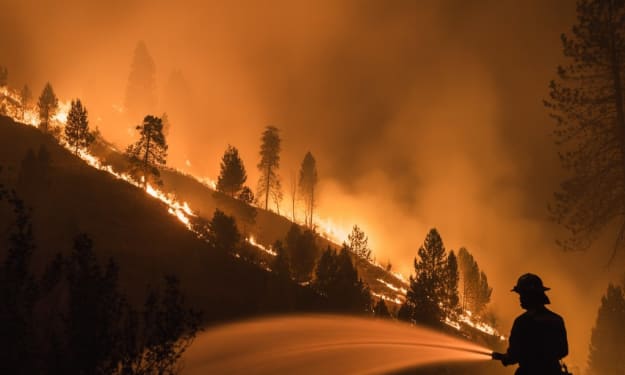
Every summer and fall, California braces for a familiar and terrifying enemy: wildfires. Fueled by dry heat, strong winds, and drought-stricken landscapes, these blazes sweep across the state, consuming forests, towns, and sometimes entire communities.
By Echoes of Lifeabout a year ago in History