Lessons
The War That Erased a Nation—And Why We Still Need to Remember
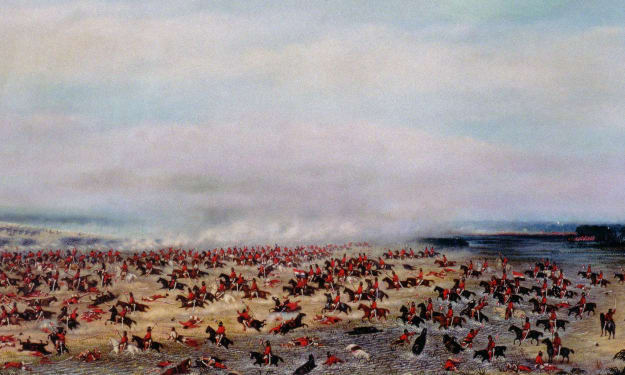
Have you ever stumbled on a story so wild you can’t believe it’s not a movie? Let me tell you about a war that killed over 60% of a nation’s population —more devastating than the Black Death—and yet, outside a handful of history nerds, nobody talks about it. What the hell happened in Paraguay between 1864 and 1870? And why does it feel like the world hit “delete” on this chapter of history?
By ChronoCurator2 years ago in History
Prayer and Love
Prayer and Love Love is not just a feeling, surrendering that feeling through prayer is a kind of worship. In the course of life, we experience many loves—friends, relatives, and special people. However, there is one thing that can increase the emotional and powerful nature of that deep love: prayer. The desire for him transforms into "He is good in my heart" when we love. And there is nothing greater than the well-being of a believer—if someone can pray for him.
By Arshad Ali2 years ago in History
"In Search of Digital Gold"
3 a.m. Adil's eyes are lit up by the screen of a mobile phone in a quiet Dhaka alley. He is deeply absorbed in coding lines while seated in a corner of his room. He is surrounded by silence, broken only by the keyboard clicking and the soft hum of his laptop fan. Adil was a self-proclaimed hacker and tech enthusiast. During his final year at university, he stumbled upon a YouTube video titled: "Bitcoin: The Currency of the Future." Back then, hardly anyone in Bangladesh had even heard of the term. In the video, it was explained how Satoshi Nakamoto created Bitcoin, a digital currency, in 2009. It operated without banks, governments, or any central authority. It was "decentralized" and operated by thousands of computers that checked the transactions. Adil thought to himself—this is like finding gold! A kind of digital mine where “mining” meant solving algorithms to earn Bitcoin.
By MD RASEDUL ISLAM 2 years ago in History
A Morning at the Train Station
Like breath on a windowpane, the early morning coolness hovered in the air, delicate and persistent. Above the tranquil town of Elmridge, which is more famous for its antique stores and apple orchards than for any sort of excitement, gray clouds swirled. However, there was a subdued urgency to the old rail station on the outskirts of town on this specific day, like to a secret whispered between two friends.
By MD SHAMIM RANA2 years ago in History
The Mystery Behind France's Forgotten Medieval Villages
The Mystery Behind France's Forgotten Medieval Villages Introduction In the heart of France, beyond the buzzing cities and glossy tourist brochures, lies a world almost completely untouched by modern hands. Scattered across quiet countryside and hidden behind thick forests or rolling hills are villages that time simply forgot. These aren’t just small towns with low populations—these are places that hold echoes of ancient conversations, where walls still bear the scars of forgotten wars and pathways are etched with the footprints of long-gone peasants, knights, and merchants. But how did these villages vanish from modern memory, and why do they stir something so deep in the soul of anyone who visits? The answers lie buried in history, myth, and silence.
By Vera Marçoli2 years ago in History
The Ongoing Palestine Conflict: A Deep-Rooted Struggle. Content Warning.
The ongoing conflict in Palestine: A struggle with deep roots One of the most complicated and long-lasting conflicts in modern history is the Palestinian conflict, also known as the Israeli-Palestinian conflict. It is centered on a place that has a significant historical, religious, and cultural significance for Christians, Muslims, and Jews alike. The conflict between the Palestinian people and the State of Israel centers on competing national aspirations and territorial claims. Background in History The roots of the conflict date back to the early 20th century, during the decline of the Ottoman Empire and the rise of nationalist movements. Under a mandate from the League of Nations, Britain took control of the Palestine region after World War I. Jewish immigration to the region as a result of persecution in Europe and the rise of Zionism, a movement advocating for a Jewish homeland, exacerbated tensions between Arab and Jewish populations. In 1947, the United Nations proposed a partition plan to divide Palestine into separate Jewish and Arab states, with Jerusalem as an international city. The plan was accepted by Jewish leaders, but it was rejected by Arab leaders. When Israel declared independence in 1948, neighboring Arab states launched a war, leading to Israel’s victory and the displacement of over 700,000 Palestinians—a tragedy Palestinians refer to as the Nakba, or “catastrophe.”
By Md Omit Hasan2 years ago in History
Argentina seals $20 billion IMF deal, tears down currency controls
BUENOS AIRES, April 11 (Reuters) - Argentina sealed a $20 billion, 48-month Extended Fund Facility deal with the International Monetary Fund on Friday and, in a major policy move ahead of the deal, dismantled key parts of its years-long currency controls and loosened its grip on the peso.
By rifat_hakson2 years ago in History
Nawab Siraj ud-Daulah
Nawab Siraj ud-Daulah was the last independent Nawab of Bengal, and his life story is one of valor, youthful ambition, political betrayal, and the beginning of British domination in India. Born in 1733, Siraj ud-Daulah was the grandson of Alivardi Khan, the then Nawab of Bengal. From a young age, he was trained in the art of warfare and governance, as his grandfather saw him as the future ruler of Bengal. He was energetic, intelligent, and bold—but also impulsive and often harsh in his decisions.
By Azmi Sarkar2 years ago in History
The Assassin
Footsteps in the tiny alleys below were muffled by the rain that dropped like whispers on the old city's rooftops. He walked like a ghost somewhere in the tangle of shadows, with no identity, no history, only a mission. He was referred to as the Assassin. It was already too late when the city's elite realized he was on his way.
By Ariyan Islam Masud2 years ago in History