General
Where to Find Free Samples of ED Medications
Good nutrition is more than just eating fruits and vegetables—it’s about fueling your body with the right mix of vitamins, minerals, antioxidants, fiber, and other essential nutrients. Whether you're looking to improve your energy levels, support a healthy immune system, manage weight, or feel your best every day, the food you eat plays a central role.
By Khadim Hussainabout a year ago in History
Where to Find Free Samples of ED Medications Online
Good nutrition is more than just eating fruits and vegetables—it’s about fueling your body with the right mix of vitamins, minerals, antioxidants, fiber, and other essential nutrients. Whether you're looking to improve your energy levels, support a healthy immune system, manage weight, or feel your best every day, the food you eat plays a central role.
By Khadim Hussainabout a year ago in History
The Clockmaker’s Secret
In the heart of the old town of Eldenwick, tucked between a forgotten bakery and a shuttered bookstore, stood a tiny clock shop. Its windows were clouded with age, and the sign above the door, “H. Thorne, Horologist,” had faded into near invisibility. Yet, inside, time thrummed like a living thing. Harold Thorne, a quiet man in his late sixties, was known only to a few. He had no family, few friends, and kept odd hours. But the clocks—oh, the clocks. They lined the walls, sat on shelves, and hung from rafters, ticking in perfect, mesmerizing harmony. But Harold’s true masterpiece sat behind a velvet curtain in the back of the shop. It was a tall, intricate grandfather clock with golden gears and a celestial dial at its center. He called it “The Heartbeat.” No one else had ever seen it. One rainy evening, a girl named Lila stumbled into the shop. Soaked and shivering, she looked barely sixteen. Harold rarely accepted visitors, but something in her eyes—bright, curious, and ancient—made him pause. “I need a place to wait out the storm,” she said softly. Without a word, Harold handed her a woolen blanket and motioned to a stool. The clocks ticked around them, a symphony of seconds. Lila gazed at them in awe. “They all tick together,” she whispered. “Like they’re… talking.” Harold gave a thin smile. “Time has a language of its own.” That night, Lila returned again. And again the next. Over the weeks, she became a quiet fixture in the shop. She asked questions about the clocks, their history, their mechanisms. And eventually, she asked about the velvet curtain. Harold’s expression turned guarded. “That one… isn’t for sale.” “Is it broken?” “No. It works too well.” He tried to avoid her after that. But curiosity is a force no storm can hold back. One afternoon, while Harold was restocking parts in the cellar, Lila pulled back the curtain. “The Heartbeat” stood gleaming in the dust-dappled sunlight. Its hands didn’t point to any numbers—just a swirling map of stars and planets. As she leaned closer, the air shimmered. The tick-tick slowed… and then reversed. Suddenly, she was no longer in the clock shop. She stood on a cobbled street, younger, wearing a blue dress. Her mother called from the doorstep of a sunlit house. It was a memory—hers—but she was living it again. Lila gasped, the moment dissolving like fog as Harold’s hand pulled her back. “What did you do?” he asked, shaking. “That clock isn’t a machine—it’s a door.” “To where?” “To when.” He sat her down and told her the truth: he had built The Heartbeat not to tell time, but to travel it. Years ago, he had tried to go back and fix a mistake—one that cost him his wife. But time is not a path; it’s a web. Change one thread, and others unravel. “I swore I’d never use it again.” But Lila looked at him with a resolve he recognized all too well. “I lost someone too,” she whispered. “I just want to say goodbye.” Harold closed his eyes. He had spent decades guarding that clock, warning himself that no moment—no matter how painful—should be rewritten. And yet, hadn’t he always hoped someone else might be strong enough to use it? That night, Harold adjusted the gears, mapped her coordinates, and opened the pendulum gate. “You have ten minutes. Not a second more.” Lila stepped through. The moment wrapped around her like a warm blanket. Her brother, Jamie, stood by the lake, skipping stones just as he had a week before the accident. She didn’t try to change fate. She only hugged him, whispered how much she loved him, and left him smiling. Ten minutes later, she returned, tears streaming down her cheeks—not of sorrow, but peace. Harold dismantled The Heartbeat that very night, piece by careful piece. The past had been honored. The present reclaimed. Years later, the clock shop became a quiet little café run by Lila, its walls still lined with clocks. None ticked in unison anymore—but one small golden gear sat beneath the glass counter, marked with a tiny star. A reminder that time’s greatest gift is not changing the past… …but cherishing the moments we’re given. ent
By DigitalAddiabout a year ago in History
Who Were the Nephilim? The Forbidden Giants of the Bible That Mainstream History Can’t Explain
👣 Giants in the Bible? It’s Right There in Genesis “There were giants in the earth in those days…” So begins Genesis 6:4, one of the most mysterious — and controversial — verses in the entire Bible.
By Rukka Novaabout a year ago in History
Álvares de Azevedo
In the history of Brazilian literature, few individuals shine as brightly—and as briefly—as Manuel Antônio Álvares de Azevedo (1831–1852). A prodigy of the Ultra-Romantic movement, Azevedo’s existence was a fleeting comet of poetic brilliance, characterized by melancholy, morbidity, and a fixation on love and death. His works, released posthumously, became cult classics, shaping the influence of generations of Gothic and Romantic authors. This article delves into his tumultuous life, his literary impact, and the tragic fate that secured his status as Brazil’s equivalent to Lord Byron.
By A Históriaabout a year ago in History
Barton Haunted Air Field Uk
Barton Haunted Air Field Uk We stood with the camera in hand at Barton Airbase. I imagined the deaths—the aircraft that went down during the war. The watchtower stood dark and empty. An eerie feeling pinched at my skin like a swarm of insects biting in rhythm.
By ♿ V+ Marie381Uk about a year ago in History
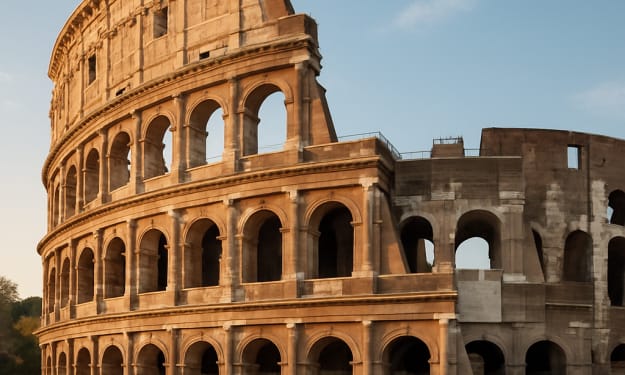
Timeless Glory: Colosseum’s Enduring Legacy
Rising majestically in the heart of Rome, the Colosseum stands as one of the most iconic and enduring symbols of the Roman Empire. Known in ancient times as the Flavian Amphitheatre, this monumental structure was commissioned around 70–72 AD by Emperor Vespasian of the Flavian dynasty and completed by his son Titus in 80 AD. Built to demonstrate the might of the new regime, the Colosseum served not just as a center for entertainment but also as a powerful tool for political propaganda, showcasing the glory, wealth, and engineering genius of the empire.
By Mukhtiar Ahmadabout a year ago in History
Timeless Majesty of Giza Pyramids
Rising from the golden sands of the Giza Plateau, just outside modern-day Cairo, the Pyramids of Giza are among the most iconic and enduring symbols of ancient Egypt. These colossal monuments—the Great Pyramid of Khufu, the Pyramid of Khafre, and the Pyramid of Menkaure—were constructed during Egypt’s Fourth Dynasty, over 4,500 years ago. They are not only architectural marvels but also bear powerful testimony to the grandeur, innovation, and spiritual depth of ancient Egyptian civilization.
By Mukhtiar Ahmadabout a year ago in History
"I Spent a Week Living Like a 19th Century Aristocrat — Here’s What Modern Life Has Completely Forgotten"
My best friend, a history nerd with a flair for dramatics, challenged me to live an entire week like a 19th-century aristocrat. No electricity. No phones. No Uber Eats. Just corsets, candlelight, and carriages—or at least, their closest modern-day equivalents. I laughed. How hard could it be? A week of tea, long baths, and lounging around in lace sounded like a luxury spa retreat. Right? Wrong. Day One: The Corset Conundrum Before I even opened my eyes on Monday morning, I was already breaking modern rules. No alarm clock. Instead, I’d instructed a friend to knock on my door at 7 a.m. sharp, like a loyal footman. He was less loyal, more amused. I woke up to the sound of him snickering outside my apartment door. Getting dressed was the first hurdle. The corset I ordered online looked beautiful in the photo. In reality, it felt like a boa constrictor with anger issues. After 30 minutes of struggling and googling “how to breathe in a corset” (oops—cheated there), I was finally laced in and barely mobile. My gown, an explosion of ruffles and petticoats, turned a simple walk to the kitchen into a small-scale military operation. Day Two: Tea Time and Typing Trouble I swapped my usual iced coffee for a strong cup of Earl Grey, steeped using a stovetop kettle, naturally. Breakfast was toast and jam, made with ingredients I picked up from a local farmer’s market. So far, so good. Then came the letter writing. Since aristocrats didn’t text, I decided to write a handwritten note to my landlord about a leaky tap. My cursive was atrocious, my ink pen kept blotting, and by the end, my hand ached like I’d just transcribed a Shakespearean play. Still, there was something oddly satisfying about sealing a letter with red wax, like I was sending battle plans. Day Three: Candlelit Chaos That evening, I banned all artificial light. Out came the candles—dozens of them—giving my apartment a warm, flickering glow. It was romantic in theory. In practice, it was a fire hazard. I nearly set my curtain ablaze trying to light the chandelier knockoff I’d found at a thrift store. Bath time was another ordeal. I heated water on the stove and filled the tub, bucket by bucket. By the time it was ready, the water was lukewarm and I was exhausted. Aristocrats had staff. I had sore arms and a newfound appreciation for water heaters. Day Four: Dining with Decorum I hosted a dinner party, 19th-century style. No pizza. No takeout. Just roast chicken, potatoes, and an attempt at a pudding that resembled a Victorian jellyfish. My friends showed up in thrifted vintage outfits and were oddly excited to follow strict etiquette rules. No elbows on the table, napkins in laps, speak only when spoken to. Conversation, though, was the highlight. Without phones, we actually talked. For three full hours. About books, relationships, ambitions. It was intimate in a way I hadn’t experienced in years. Nobody checked their notifications. Nobody posted their plate on Instagram. We were fully present. And it felt… revolutionary. Day Five: The Great Outdoors (and Inconveniences) I decided to “take the air,” as 19th-century folks called it. I strolled through the park with a lace parasol and drew a few confused glances and more than one compliment. Without earbuds, I noticed birdsong, wind in the trees, and even a child giggling on a swing set. Nature felt louder. But so did the blisters from my leather boots. Fashion was pain back then—and let me tell you, they weren’t exaggerating. Day Six: Letters and Loneliness By now, the novelty was wearing off. My back ached from corsets, and I missed the convenience of streaming Netflix in my pajamas. The silence became louder too. Without constant digital distractions, I was left with my own thoughts. It was both peaceful and jarring. I wrote long letters to family members, which felt more vulnerable than a quick text or meme. Somehow, putting feelings on paper made them more real. I began to see why people once treasured love letters and journals. They were physical proof of connection. Day Seven: Reflection and Reality On the final day, I lay in bed—corset-free—watching the morning light pour in through the window. I hadn’t touched my phone in a week. I missed it, but not the way I expected. What I craved wasn’t the screen itself, but the illusion of productivity it gave me. The truth was, I’d gotten more done this week than in a month of multitasking. I’d read an entire book. Cooked actual meals. Slept like a log. I’d also learned what modern life has forgotten. We’ve forgotten how to be still. To truly connect. To let one task, one conversation, or one moment hold our full attention. We’ve traded presence for productivity, speed for depth. Living like a 19th-century aristocrat was inconvenient, exhausting—and profoundly enlightening. Final Thoughts No, I won’t be giving up my phone permanently or writing every message with a quill. But I’ll be lighting more candles, writing more letters, and treating dinner like a sacred pause rather than a pitstop. The past isn’t a place I want to live in forever—but it’s a place worth visiting. Because sometimes, the slowest way is the richest way.
By Nizam khanabout a year ago in History