General
Presidents' Day replaced separate celebrations in February
Presidents' Day replaced two February observances When I was a schoolgirl in the early 1960s, we observed the birthdays of Abraham Lincoln on February 12 and George Washington on the 22nd. Lincoln's birth date was never a holiday, but teachers had us draw pictures of both US leaders, and we learned about their contributions.
By Cheryl E Preston11 months ago in History
The Day the Sky Burned
On the evening of May 6, 1937, the sky over Lakehurst, New Jersey, was calm and expectant. A gentle rain had fallen earlier, and a crowd of reporters, photographers, and spectators stood watching as a giant silver shape slowly descended from the clouds. It was the LZ-129 Hindenburg, the pride of Germany and the largest airship ever built. To many, it was not just a mode of transport—it was a symbol of human ambition, luxury, and technological triumph. No one knew that within minutes, this floating marvel would become a burning nightmare.
By moeez yousafzai11 months ago in History
Who is John Snow? What is John snow real name?
Early Life and Birth Kit Harington, best known for portraying Jon Snow in the globally acclaimed television series Game of Thrones, was born on December 26, 1986, in Acton, London, England. His full name is Christopher Catesby Harington. He comes from a historically notable family; his ancestry can be traced back to English nobility, including ties to King Charles II. However, despite this lineage, Kit was raised in a relatively modest and grounded environment.
By Daily Motivation11 months ago in History
The Legacy of Genocidal Maniacs and the Father of It All.
I posted a piece earlier today on Meta, and the engagement lent to the discussion of what Trump will be remembered for. I believe that the end will be less than what he conceived, but he will absolutely be remembered for something.
By Sai Marie Johnson11 months ago in History
John Cena: The Rise of a WWE Icon, Hollywood Star, and Global Phenomenon. John Cena life story
Early Life and Background: John Cena was born on April 23, 1977, in West Newbury, Massachusetts, to John Cena Sr. and Carol Cena. Growing up in a tight-knit family of five boys, Cena’s life was marked by competition and a drive to excel. His father was a WWE Hall of Famer, and Cena’s early exposure to athletics created a deep love for fitness, strength training, and sports. Cena's family was not famous, but they instilled in him the values of hard work, perseverance, and pushing through adversity.
By Daily Motivation11 months ago in History
The World’s Safest (and Least Safe) Countries 🤝 . AI-Generated.
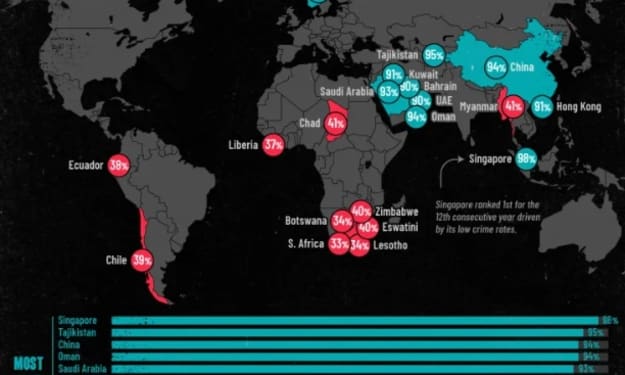
When people talk about the “safest” or “least safe” countries in the world, the conversation often sounds simple—almost like a list you can glance at and move on from. But safety is far more complex than a ranking. It’s shaped by politics, culture, economics, geography, and even perception. A country can feel incredibly safe to one person and deeply unsafe to another. Understanding global safety means looking beyond headlines and statistics and into the everyday realities people live with. So what actually makes a country safe—or unsafe? at Does ‘Safety’ Really Mean? Safety isn’t just about crime rates. It includes: Political stability Access to healthcare Trust in law enforcement Freedom from conflict Economic security Social cohesion Natural disaster preparedness Some countries excel in almost all of these areas. Others struggle in multiple ways at once. untries Often Seen as the Safest Many nations consistently earn reputations for safety because of strong institutions and social trust. Countries like Iceland, Switzerland, New Zealand, Japan, and Norway are often described as safe—not because nothing ever goes wrong, but because systems work when something does. In these places: Crime rates are generally low Emergency services respond quickly Governments are relatively transparent Citizens trust public institutions Japan, for example, combines dense cities with remarkably low violent crime. Iceland has no standing army and a deeply rooted culture of social responsibility. Switzerland balances security with neutrality and economic stability. Safety here feels predictable. Life functions. Rules are followed. Disputes are resolved without violence. y These Countries Feel Secure One shared trait among safer countries is strong social contracts—an unspoken agreement between citizens and the state. People pay taxes, follow laws, and trust that institutions will protect them. Corruption exists everywhere, but in safer countries, it’s limited and punishable. Education, healthcare, and economic opportunity also reduce desperation—one of the biggest drivers of crime. untries Often Labeled ‘Least Safe’ On the other end of the spectrum are countries facing conflict, political instability, or economic collapse. Nations affected by prolonged war, civil unrest, or failed governance—such as parts of Afghanistan, Yemen, South Sudan, Syria, and Haiti—are often considered among the least safe. In these places: Law enforcement may be weak or absent Armed groups compete for control Infrastructure is damaged or destroyed Daily survival takes priority over long-term safety However, it’s important to say this clearly: people still live, love, and survive in these countries. Danger does not erase humanity. y ‘Unsafe’ Is Often Oversimplified Labeling a country as unsafe ignores regional and personal realities. A capital city may be dangerous while rural areas remain calm—or vice versa. Tourists may face risks locals know how to avoid. Media coverage also plays a major role. Some countries are portrayed as dangerous because conflict is visible. Others hide deep problems behind polished images. Safety is not evenly distributed, even within borders. e Role of Perception Fear travels faster than facts. A single violent event can define a country’s reputation for years, while long-term instability in “safe” nations often goes unnoticed. Gun violence, inequality, and systemic injustice exist even in wealthy countries—but are normalized. Perception shapes policy, tourism, migration, and even empathy. en Safe Countries Don’t Feel Safe Some nations rank high in safety metrics yet still leave people feeling anxious. High surveillance, social pressure, or lack of personal freedom can create emotional insecurity. Safety isn’t just about avoiding harm—it’s also about feeling free and protected at the same time. at We Can Learn From Both Extremes The world’s safest countries teach us the power of: Trust Education Fair governance Long-term planning The least safe countries remind us what happens when: Institutions collapse Inequality grows unchecked Violence replaces dialogue Neither condition appears overnight—and neither is permanent. Shared Responsibility Global safety isn’t only a national issue. Wars, climate change, pandemics, and economic shocks ignore borders. Stability in one region often depends on justice and peace in another. Understanding safety means moving beyond judgment and toward awareness. nal Thoughts The world is not divided cleanly into safe and unsafe places. It is a spectrum shaped by history, choices, and chance. Instead of asking which country is safest, maybe the better question is: What makes people feel protected, valued, and hopeful? Because that’s where real safety begins.
By Zahid Hussain11 months ago in History
The Real Santa Claus Explained by Michael Savage, New Canaan
Every December, the image of Santa Claus appears everywhere, from store windows to holiday movies and children’s letters. He is cheerful, generous, and always ready to bring joy. However, behind the red suit and flying reindeer is a true story rooted in history and kindness. Understanding where Santa Claus really came from adds deeper meaning to Christmas. New Canaan’s blogger Michael Savage often says that knowing the origin of holiday traditions helps people appreciate the values behind them, not just the symbols.
By Mike Savage New Canaan11 months ago in History
The Letters That Survived a War
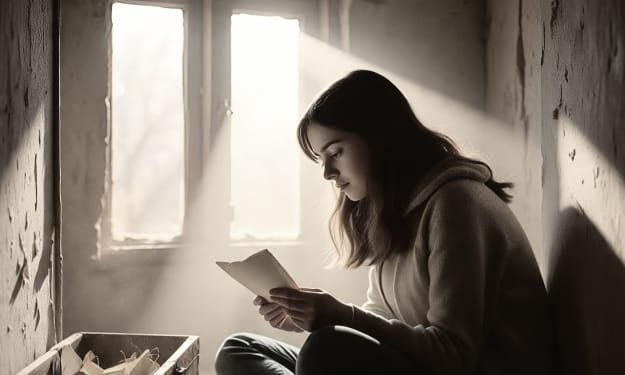
In 1942, in a small town in northern France, life felt impossibly fragile. The war had already changed everything. Streets that once carried children laughing were now filled with silence or the distant thrum of military vehicles. The air carried a tension that had no scent, a weight you could feel pressing on your chest whenever you stepped outside. Marie, a young schoolteacher, had grown up surrounded by books. History fascinated her even then, though she never imagined she would live through an era that would one day be studied as history itself. Her days were consumed with teaching, with rationing, and with the quiet fear of what tomorrow might bring. Every morning, she would walk past the same corner where the local market used to be, imagining the bustling life that had vanished almost overnight. One day, while clearing out her small attic, Marie discovered a box of letters. They were brittle, the ink faded with age, but each one bore the signature of her father, who had disappeared years earlier at the onset of the war. Reading them felt like touching history itself. These letters told stories of a man who loved deeply, who worried endlessly about his family, and who clung to the small moments of humanity that war could not take away. The letters became her secret refuge. At night, she would sit by the window, candlelight flickering across the paper, reading her father’s words over and over. He wrote about the changing seasons, about neighbors who had fled, and about the quiet hope that he would one day return home. Though he never did, his words taught Marie something profound: history is not just dates and battles; it is the human experience that survives between them. As the war progressed, the town experienced more upheaval. Soldiers came and went. Families were torn apart. But Marie held onto the letters, treating them like a lifeline. She shared some of their stories with her students, teaching them not only language and arithmetic but also the power of memory and the importance of recording life as it happens. The children listened in silence, absorbing the weight of history through her voice. Years later, long after the war ended, Marie moved to Paris. The city was rebuilding, but the scars of the past were visible in every street, every building, every story whispered among strangers. She carried the box of letters with her, a reminder that ordinary people live through extraordinary times and that their experiences form the threads of history that textbooks cannot capture. One afternoon, she donated the letters to a small museum dedicated to documenting the lives affected by the war. The curator looked at the fragile papers and said, “These are not just letters. They are a testimony to resilience.” For Marie, it was the first time she realized that the story of her father, and of her town, could teach others lessons about courage, hope, and the endurance of the human spirit. Visitors to the museum would often pause in front of the letters, tracing the faded ink with their eyes, imagining the life behind each word. They could almost hear the father’s voice, whispering across time, carrying love, fear, and hope. History, Marie realized, is not only about kings and generals, treaties and battles. It is about the people who lived, who wrote, who remembered, and who survived despite everything. The letters had survived decades of neglect, decay, and silence. They survived because someone cared enough to keep them safe. In doing so, they became a bridge between the past and the present, a reminder that history is alive in the smallest details of everyday life. Marie’s story, though small in the vast timeline of the war, reflected a universal truth: history is not only found in monuments or textbooks. It lives in letters, photographs, memories, and the ordinary moments of people who endure extraordinary circumstances. Every word on those pages was a pulse, a heartbeat echoing across time, teaching future generations what it meant to live, to love, and to hope in the midst of uncertainty. In the end, history is not simply a record of what happened. It is a story waiting to be discovered, understood, and remembered. And sometimes, it survives in a box of letters in an attic, waiting for someone to open it and let the past speak.
By Jhon smith11 months ago in History