General
What is a Virtual or Metaverse city?
A Virtual or Metaverse City is a concept that extends the idea of a virtual world or metaverse into a city-like environment within digital spaces. It's a virtual space where users can interact, socialize, work, play, and create using avatars or digital representations of themselves. Similar to real-world cities, virtual metaverse cities can have various zones for entertainment, commerce, education, events, and more.
By Donna Lenk3 years ago in History
One lady remained on the edge of a disintegrating precipice
In the midst of the twirling bedlam of a world in the pains of environment commotion, one lady remained on the edge of a disintegrating precipice, her look fixed on the rough ocean beneath. Emma's heart resounded with the crashing waves, reflecting the strife inside her spirit. She had consistently tracked down comfort by the water's edge, however today, the sea appeared to repeat her own blustery feelings.
By Kamrul Hasan Rubel3 years ago in History
Baba Vanga predictions for 2023
Baba Vanga was a blind Bulgarian mystic who is said to have predicted many world events, such as the 9/11 attacks, the Brexit, the Chernobyl disaster, and more. She died in 1996, but left behind a list of prophecies for the future until the year 5079. Some of her predictions for 2023 are:
By Robinson Victorraj3 years ago in History
Secrets of the Deep
tlecretsfheeep In the heart of a small coastal village named Havenbrook, nestled between rugged cliffs and golden sands, lived a young woman named Elara. She was known by the villagers as someone who was always drawn to the sea. Since childhood, Elara's eyes sparkled with curiosity whenever the waves kissed the shore, and her heart pounded in rhythm with the tides. While the village fishermen brought tales of their catches and the distant horizon, Elara yearned for something more—a glimpse into the mysteries that lay beneath the ocean's surface.
By Gyimah Michael3 years ago in History
The First Educated Nigerian
Olaudah Equiano was born in 1745 to the Igbo people in the region now known as Nigeria. The youngest son, he had five brothers and a younger sister. When he was eleven, he and his sister were kidnapped and sold to native slaveholders. After changing hands several times, Equiano was taken to the coast where he was held by European slave traders. He was transported with 244 other enslaved Africans across the Atlantic Ocean to Barbados in the West Indies, from where he and a few others were soon transferred to the British colony of Virginia. He was bought by Michael Pascal, a lieutenant in the Royal Navy. Pascal renamed the boy as Gustavus Vassa, after the Swedish noble who had become Gustav I of Sweden, king in the 16th century. Equiano had already been renamed twice: he was called Michael while on the slave ship that brought him to the Americas; and Jacob, by his first owner. This time Equiano refused and told his new owner that he would prefer to be called Jacob. His refusal, he says, “gained me many a cuff” – and eventually he submitted to the new name. Equiano wrote in his narrative that domestic slaves in Virginia were treated cruelly, suffering punishments such as an “iron muzzle” (scold’s bridle), used around the mouth to keep house slaves quiet, leaving them unable to speak or eat. He thought that the eyes of portraits followed him wherever he went, and that a clock could tell his master about anything Equiano did wrong. Shocked by this culture, Equiano tried washing his face in an attempt to change its colour. As the slave of a naval captain, Equiano was trained in seamanship and traveled extensively with his master. This was during the Seven Years War with France. Although Pascal’s personal slave, Equiano was expected to assist the crew in times of battle; his duty was to haul gunpowder to the gun decks. Pascal favoured Equiano and sent him to his sister-in-law in Great Britain, to attend school and learn to read. At this time, Equiano converted to Christianity. His master allowed Equiano to be baptized in St Margaret’s, Westminster, on February 1759. Despite the special treatment, after the British won the war, Equiano did not receive a share of the prize money, as was awarded to the other sailors. Pascal had promised his freedom, but did not release him. Pascal sold Equiano to Captain James Doran of the Charming Sally at Gravesend, from where he was transported to Montserrat, in the Caribbean Leeward Islands. He was sold to Robert King, a Quaker merchant from Philadelphia who traded in the Caribbean. Pascal had instructed Doran to ensure that he sold Equiano “to the best master he could, as he told him I was a very deserving boy, which Captain Doran said he found to be true Equiano travelled to London and became involved in the abolitionist movement, which had been particularly strong amongst Quakers, but was by 1787 non-denominational. As early as 1783 he had been passing information about the slave trade to abolitionists such as Granville Sharp, and the publicisation of the Zong massacre (a cause célèbre for the abolitionist movement) can ultimately be attributed to Equiano. Equiano was a Methodist, having been influenced by George Whitefield’s evangelism in the New World. Front page of Equiano’s autobiography. Equiano was befriended and supported by abolitionists, many of whom encouraged him to write and publish his life story. Equiano was supported financially by philanthropic abolitionists and religious benefactors; his lectures and preparation for the book were promoted by, among others, Selina Hastings, Countess of Huntingdon. His account surprised many with the quality of its imagery, description, and literary style. Some who had not yet joined the abolitionist cause felt shame at learning of his suffering. Entitled The Interesting Narrative of the Life of Olaudah Equiano, or Gustavus Vassa, the African, it was first published in 1789 and rapidly went through several editions. It is one of the earliest known examples of published writing by an African writer to be widely read in England. It was the first influential slave autobiography. Equiano’s personal account of slavery and of his experiences as a black immigrant caused a sensation on publication. The book fueled a growing anti-slavery movement in Great Britain. The autobiography goes on to describe how Equiano’s adventures brought him to London, where he married into English society and became a leading abolitionist. Equiano’s book became his most lasting contribution to the abolitionist movement, as it vividly demonstrated the humanity of Africans as much as the inhumanity of slavery. Equiano records his and Granville Sharp’s central roles in the movement. As a major voice in this movement, Equiano petitioned the King in 1788. He was appointed to an expedition to resettle London’s poor Blacks in Sierra Leone, a British colony on the west coast of Africa. He was dismissed after protesting against financial mismanagement. The book not only was an exemplary work of English literature by a new, African author, but it also increased Equiano’s personal revenue. He traveled extensively throughout England, Scotland, and Ireland promoting the book. The returns gave him independence from benefactors and enabled him to fully chart his own purpose. He worked to improve economic, social and educational conditions in Africa, particularly in Sierra Leone. Related to the abolitionist cause, Equiano was also a leader of the Poor Black community in London. Because of his connections, he was a prominent figure in the political realm, and he often served as a voice for his people. Equiano’s reactions and remarks were frequently published in newspapers like the Public Advertiser and the Morning Chronicle. He had more of a voice than most Africans, and he seized various opportunities to utilize it. According to Wealth Result, Olaudah Equiano is not only the first Nigerian to be educated but is also the first African author.
By Emma D'Teller3 years ago in History
A Journey of Discovery: Unraveling the Past and Embracing the Future in Kumasi
In the heart of Ghana, beneath the warm African sun, a woman embarked on a journey that would forever change her life. Sarah had always felt a void, a missing piece of her identity. She knew her father's name, but nothing more. It was time to fill in the gaps, to connect the threads of her story that had been left hanging for far too long.
By NII LANTEY PARKER3 years ago in History
Nigeria's Economic Crisis Solutions
"Unlocking Economic Potential: Combating Corruption's Grip on Nigeria's Development" Corruption, a pervasive challenge deeply ingrained in Nigeria's socio-economic fabric, has posed a significant hurdle to the nation's journey toward sustainable economic development. As a formidable obstacle, corruption has not only eroded public trust in government institutions but has also deterred domestic and foreign investment, hindering Nigeria's potential for growth and prosperity. Nigeria's rich resources and diverse economic sectors hold immense promise. Yet, the shadow of corruption has cast doubt on the realization of this promise. Rampant bribery, embezzlement, and undue influence have siphoned public funds away from essential services, such as education, healthcare, and infrastructure, impeding the very foundations of economic progress. This misallocation of resources has perpetuated inequality and stifled the growth of a vibrant middle class – a cornerstone of any thriving economy.
By Mejabi Elisha Oluwasegun3 years ago in History
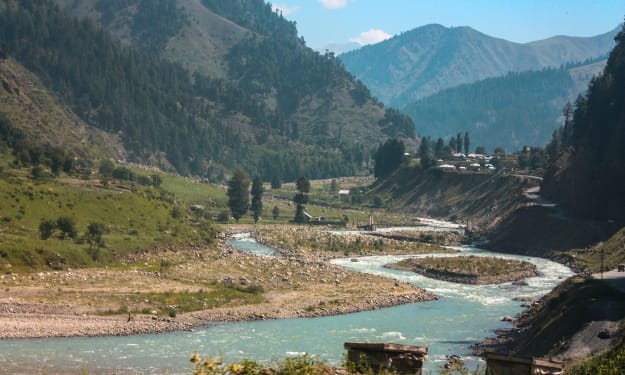
Beauty of pakistan
**The Enchanting Tapestry of Beauty: Exploring the Splendors of Pakistan** Nestled at the crossroads of South Asia, Pakistan is a land that effortlessly marries history, culture, and nature to create a breathtaking tapestry of beauty. From its majestic landscapes to its rich cultural heritage, Pakistan offers a journey of discovery that captivates the senses and leaves a lasting impression on all who are fortunate enough to explore its treasures. In this exploration, we unveil the allure of Pakistan, a country whose beauty goes beyond the physical to touch the soul.
By Abdul Rehman Raza3 years ago in History